Georgia
Top Sights & Landmarks
The Spiritual Heart of Georgia
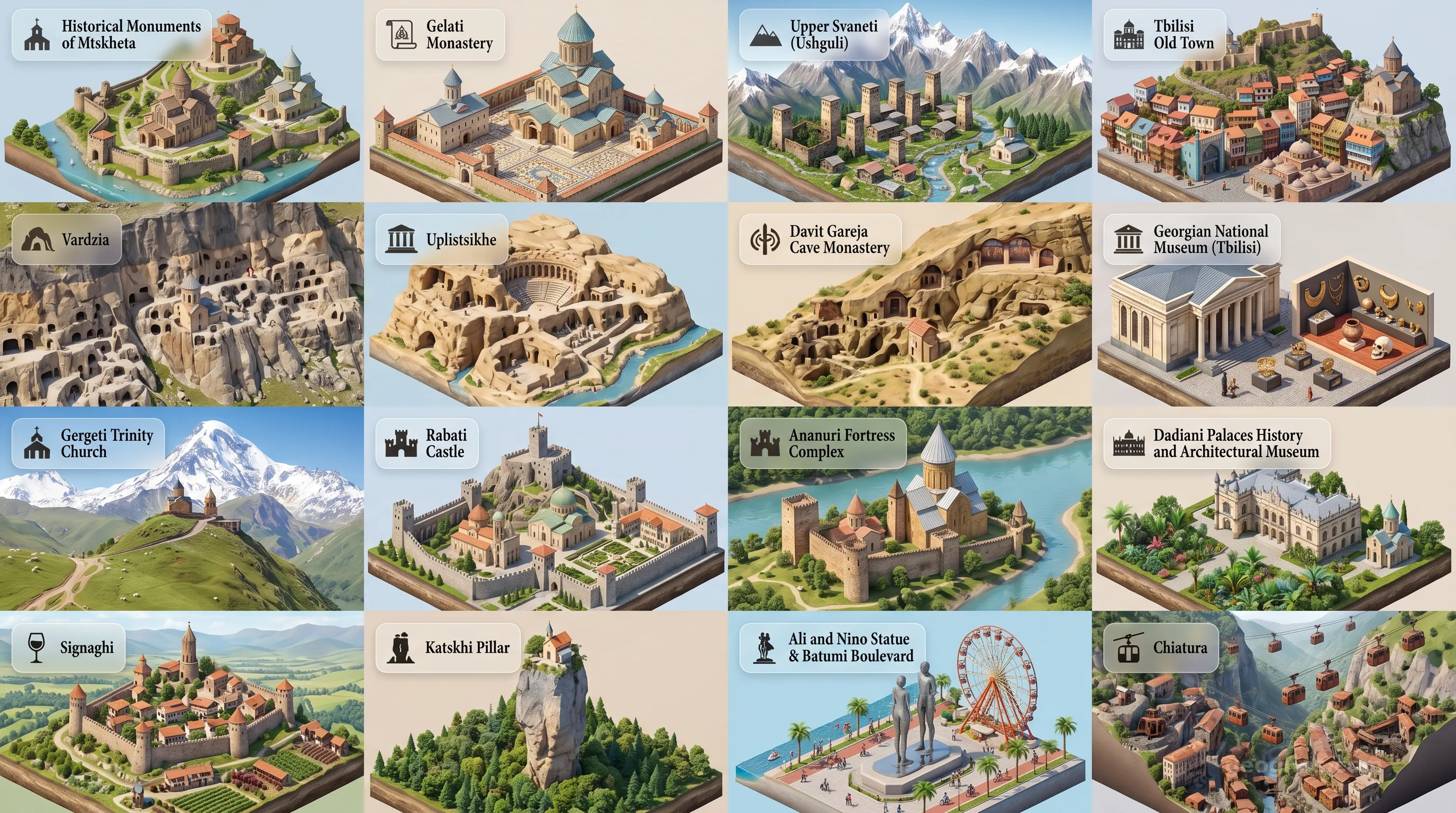
Mtskheta, the ancient capital of the early Georgian Kingdom of Iberia, remains the spiritual heart of the nation. It is home to the magnificent 11th-century Svetitskhoveli Cathedral—believed to house Christ's mantle—and the 6th-century Jvari Monastery, which perches dramatically on a cliff overlooking the confluence of the Aragvi and Mtkvari rivers. Studying Mtskheta provides unparalleled insights into the dawn of Christianity in the Caucasus (adopted here in 337 AD). The best seasons to visit are Spring (May) and Autumn (September to October). Tourist Tip: Strict dress codes apply; women must wear skirts and cover their heads, while men must wear long trousers.
The Masterpiece of the Georgian Golden Age
Founded in 1106 by King David the Builder, Gelati Monastery was one of the most prominent cultural and intellectual centers in medieval Georgia, often referred to as 'a new Hellas' and 'a second Athos'. The complex housed an academy that employed some of the most celebrated Georgian scientists, theologians, and philosophers. Its interiors are globally renowned for their vibrant, well-preserved mosaics and frescoes. Summer and early Autumn are ideal for visiting. Tourist Tip: Spend time examining the breathtaking 12th-century mosaic of the Virgin Mary in the main apse, and look for the grave of King David the Builder at the complex's original south gate.
Europe's Highest Inhabited Village
Nestled deep in the Caucasus Mountains, the historical region of Upper Svaneti is famous for its exceptional alpine landscapes and incredibly preserved medieval defensive towers (Svan towers). Ushguli, a community of four villages, is often cited as the highest continuously inhabited settlement in Europe (2,100 meters). Its extreme isolation protected Georgian cultural artifacts during times of invasion. It is highly recommended for anthropology and history students. The only reliable time to visit is Summer (July-August) due to heavy snowfall the rest of the year. Tourist Tip: Hire a local 4x4 from Mestia for the rugged terrain, and try the local Kubdari (meat-filled pastry).
A Cultural Melting Pot on the Silk Road
Tbilisi's Old Town is a remarkable testament to its history at the crossroads of Europe and Asia. Characterized by its winding alleyways, colorful carved wooden balconies, and the historic Abanotubani district (famed for its domed, sulfur hot spring baths), the area is overshadowed by the ancient Narikala Fortress. Students of architecture and urbanism will marvel at the blend of Georgian, Byzantine, Middle Eastern, and Neoclassical European influences. Spring and Autumn offer the most pleasant weather for exploring. Tourist Tip: Book a private room in the sulfur baths in advance, and ride the aerial tramway at sunset for unforgettable panoramic city views.
The Cave City of Queen Tamar
Vardzia is a spectacular 12th-century cave monastery excavated from the slopes of the Erusheti Mountain. Originally built as a fortress to protect against Mongol invasions, it was transformed into a complex urban and religious center by Queen Tamar. At its peak, it housed over 6,000 monks in 13 levels, complete with a throne room, bakeries, and an irrigation system. It is vital for understanding Georgia's medieval engineering and monastic life. Late Spring and early Autumn are the best times to visit. Tourist Tip: Wear sturdy shoes, as you will be navigating hundreds of steep, uneven rock stairs and dark, narrow tunnels.
The Ancient Rock-Hewn Silk Road Town
One of the oldest urban settlements in Georgia, Uplistsikhe dates back to the Early Iron Age. The town is notable for the unique combination of various styles of rock-cut cultures from Anatolia and Iran, alongside the coexistence of pagan and Christian architecture. It played a major role in regional politics and trade along the Silk Road before the introduction of Christianity. Spring and Autumn are best, as the exposed rock makes the area incredibly hot in mid-summer. Tourist Tip: Hire an official guide at the entrance to fully grasp the significance of the sacrificial pits and ancient apothecaries.
Desert Monasticism and Ancient Frescoes
Founded in the 6th century by St. David Garejeli, one of the thirteen Assyrian monks who spread Christianity in Georgia, this rock-hewn Orthodox monastery complex is situated in the semi-desert region bordering Azerbaijan. The site is immensely valuable for art historians due to its unique, highly expressive medieval frescoes that depict the lives of saints and Georgian royalty. April, May, September, and October are ideal, avoiding the blistering summer heat. Tourist Tip: Check current border relations before visiting, as some parts of the complex are subject to a border dispute with Azerbaijan.
The Treasury of the Caucasus
The Simon Janashia Museum of Georgia is an essential educational stop for anyone wanting to understand the deep chronology of the Caucasus. It houses the Archaeological Treasury—displaying exquisite pre-Christian Colchian gold artifacts that gave rise to the myth of Jason and the Argonauts—as well as the sobering Museum of the Soviet Occupation. The 1.8-million-year-old hominid skulls from Dmanisi are highly significant for evolutionary studies. It is a year-round destination. Tourist Tip: Dedicate at least 3 hours here, and start in the basement treasury to see the most impressive golden artifacts first.
The Iconic Silhouette of the Caucasus
Situated at an elevation of 2,170 meters right under the glacier of Mount Kazbek, the 14th-century Gergeti Trinity Church is the most iconic symbol of Georgia. Historically, during times of danger, precious relics from Mtskheta were brought here for safekeeping. Its remote, breathtaking setting is a marvel of medieval religious placement, symbolizing the Georgian soul—isolated, resilient, and deeply tied to nature. Summer and early Autumn provide the safest weather conditions. Tourist Tip: You can take a 2-hour scenic hike up from Stepantsminda or hire a local driver to navigate the steep mountain road.
A Monument to Multiculturalism
Located in Akhaltsikhe, Rabati is a massive medieval castle complex with a complex history that reflects the diverse cultural influences of the region. Initially established in the 9th century, it was later transformed by the Ottomans into an Islamic hub. Following a massive restoration in 2012, the complex now beautifully juxtaposes a mosque, a synagogue, a Christian church, and an extensive museum, serving as an outstanding case study in regional architectural synthesis. Best visited from Spring to Autumn. Tourist Tip: Stay until late afternoon; the golden hour light makes the golden domes and restored courtyards spectacular for photography.
The Seat of the Dukes of Aragvi
Perched on the edge of the turquoise Jinvali Reservoir, Ananuri was the formidable castle and seat of the Eristavis (Dukes) of Aragvi, a feudal dynasty that ruled the area from the 13th century. The complex witnessed numerous brutal battles, peasant uprisings, and massacres. Architecturally, it features exceptionally well-preserved stone carvings, including intricate grapevine cross motifs that are vital to studying late-feudal Georgian masonry. Best visited in Summer for the vivid water colors. Tourist Tip: It's an ideal stopover on the Georgian Military Highway route heading toward Mount Kazbek.
The Legacy of the Megrelian Nobility
Located in Zugdidi, this elegant 19th-century palace was the residence of the Dadiani dynasty, who ruled the Samegrelo region. The palace bridges Georgian aristocratic life with European influences. Amazingly, the museum houses a death mask of Napoleon Bonaparte, brought by a descendant of his marshal who married into the Dadiani family, alongside an immense collection of Georgian cultural heritage, including the Holy Robe of Mary. The palace and its botanical garden are excellent to visit year-round. Tourist Tip: Take a stroll through the adjacent Zugdidi Botanical Garden, originally designed by Queen Ekaterine Dadiani using imported European plants.
The City of Love and Wine
Overlooking the vast Alazani Valley with the Caucasus Mountains in the distance, Signaghi is famed as a royal town established by King Erekle II in the 18th century. Surrounded by a 4.5-kilometer defensive wall with 23 towers, the town features impeccably preserved pastel houses and cobbled streets. It sits at the heart of Kakheti, the premier wine-making region, making it an excellent base for studying Georgia's 8,000-year-old qvevri wine-making tradition. Autumn (September-October) is the best time, coinciding with the 'Rtveli' grape harvest festival. Tourist Tip: Walk along the restored sections of the town wall for the best valley views.
The Ascetic's Monolith
The Katskhi Pillar is a striking, 40-meter high natural limestone monolith in western Georgia. Atop this dizzying pillar sits a tiny, restored 9th-century church, famously inhabited for two decades by a modern-day stylite monk seeking extreme spiritual isolation. Historically, it was used by hermits who believed that praying up high would bring them closer to God. This fascinating intersection of natural geology and extreme ascetic religion is best viewed in Spring or Summer. Tourist Tip: Visitors are strictly forbidden from climbing the pillar; you can only view it from the complex at the base, so bring a camera with a good zoom.
A Moving Monument to Tragic Romance
Located in the vibrant Black Sea coastal city of Batumi, the 8-meter tall kinetic sculpture of 'Ali and Nino' symbolizes the tragic love story of a Muslim Azerbaijani boy and a Christian Georgian girl, based on the famous 1937 novel. Designed by Tamara Kvesitadze, the massive steel figures slide toward each other, merge, and pass through one another every 10 minutes. It represents the cultural intersection and turbulent history of the Caucasus. Summer is the best season to enjoy Batumi's coastal culture. Tourist Tip: Visit the statue in the late evening when it is beautifully illuminated and the mechanical movement is most mesmerizing.
The Vertical Soviet Mining Town
Nestled in a deep gorge, Chiatura is a striking remnant of Soviet industrial ambition. Discovered to possess rich manganese deposits in the 19th century, the town was outfitted in the 1950s with a vast network of 'rope roads' (cable cars) to transport miners up the sheer cliffs. Studying Chiatura offers an unfiltered look into Soviet urban planning and industrial history. Many of the original 'flying coffins' have recently been replaced, making the town a surreal blend of rusting history and modern transit. Spring and Autumn provide optimal weather for urban exploration. Tourist Tip: Ride the newly renovated, safe cable cars to the upper mining districts for panoramic views of brutalist architecture.