Nauru
Top Sights & Landmarks
Nauru's Highest Peak and WWII Fortress
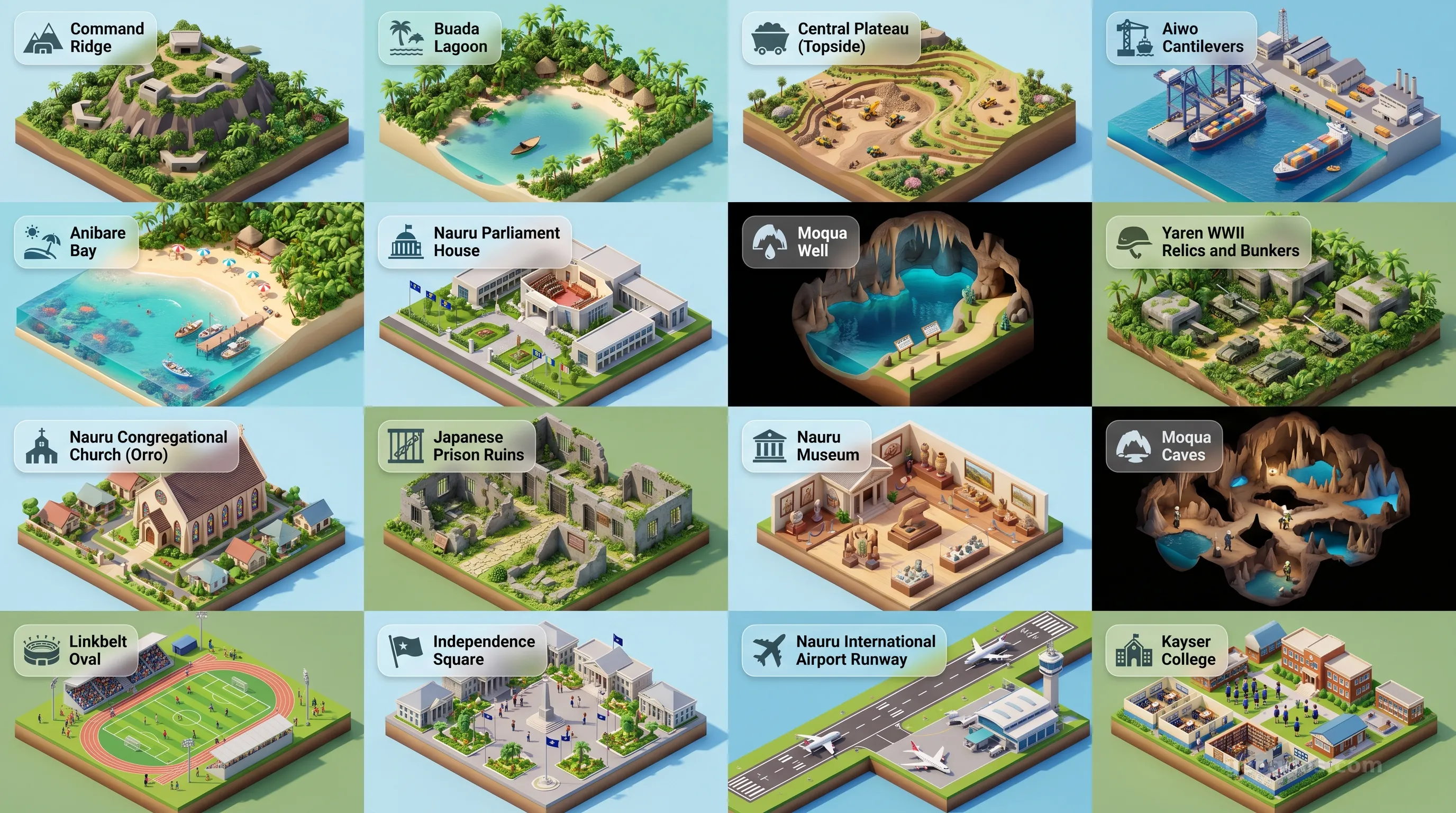
Command Ridge is the highest elevation point in Nauru and an essential site for historians and WWII enthusiasts. During the Japanese occupation in the 1940s, this ridge was heavily fortified. Today, it remains an open-air museum featuring rusted anti-aircraft guns, artillery remnants, and a largely intact communications bunker. It offers a sobering study into the Pacific theater of WWII and the strategic exploitation of micro-states. The best season to visit is during the dry months from May to November, ensuring the trails are accessible and less humid. Tourist tip: Hire a local guide; the trails are unpaved and unmarked, and a guide will provide invaluable context regarding the local Nauruan experience during the occupation.
Lush Landlocked Freshwater Lake
Offering a striking contrast to Nauru's heavily mined central plateau, Buada Lagoon is a serene, landlocked, slightly brackish lake surrounded by dense tropical vegetation. Historically and culturally, it is immensely significant as the traditional site where indigenous Nauruans practiced the aquaculture of ibija (milkfish) for centuries before colonial contact. It provides an exceptional case study in indigenous resource management and ecological adaptation. Visit between May and October for the most pleasant weather and lower humidity. Tourist tip: The lagoon is located in a quiet residential area; respect local privacy, do not swim in the water, and bring a camera to capture the beautiful palm-fringed reflections.
The Lunar Landscape of Phosphate Mining
Affectionately known as 'Topside' by locals, the Central Plateau is a stark, fascinating geological marvel created by a century of relentless phosphate strip-mining. The removal of the topsoil has left behind a jagged, fossilized limestone coral landscape that resembles the surface of the moon. This area is crucial for environmental science and economics students studying the 'resource curse' and the ecological aftermath of extractive industries. The dry season (May-October) is highly recommended for a visit, as rain makes the limestone incredibly slippery. Tourist tip: Never attempt to hike Topside without closed, sturdy footwear, as the coral pinnacles are razor-sharp.
Monuments of an Economic Boom
Dominating the western coastline of Nauru, the giant Aiwo Cantilevers are towering, rust-covered industrial structures that were historically used to load highly prized phosphate onto cargo ships. They are the ultimate physical representation of Nauru's mid-20th-century boom, during which it had one of the highest per-capita incomes in the world. Architectural and history students will find these decaying behemoths a powerful testament to industrial engineering in extreme environments. They can be viewed year-round, though the golden hour (sunset) provides the most dramatic lighting for photography. Tourist tip: While you cannot climb the structures due to safety reasons, viewing them from the nearby coastal road or Aiwo boat harbor offers the best perspective.
Nauru's Premier White Coral Beach
Anibare Bay is Nauru's most beautiful natural coastline, featuring a breathtaking crescent of white coral sand backed by lush tropical flora and towering limestone pinnacles. It is an excellent site for environmental studies concerning coral reef ecosystems and Pacific coastal erosion. While the undertow can be strong, the spectacular views make it the most popular spot on the island for relaxation and photography. The bay is best enjoyed during the dry season when the trade winds provide a refreshing breeze. Tourist tip: Swimming is best done at the government-constructed Anibare Harbor at the southern end of the bay, where the waters are calmer and safer from strong ocean currents.
The Political Heart of the Republic
Located in the Yaren District, the Nauru Parliament House is the epicenter of the nation's governance. As the political hub of one of the world's smallest independent republics, it holds immense value for students of political science, international relations, and Pacific studies. The building itself is a modest yet vibrant representation of post-colonial micro-state architecture. The area is accessible year-round, but visiting on weekdays provides a glimpse into the daily bureaucratic life of the island. Tourist tip: While formal tours aren't regularly scheduled, visitors who politely inquire at the administration offices are sometimes allowed a peek inside the legislative chamber.
Historic Underground Freshwater Lake
Moqua Well is not a traditional well, but rather a small, naturally occurring underground freshwater lake situated beneath the Yaren district. Historically, it was a critical survival resource, providing essential drinking water to the indigenous population and later to hiding locals and Japanese forces during WWII. Geologically, it offers insight into the hydrology of raised coral atolls. The site can be visited any time of the year. Tourist tip: The descent into the well area can be steep, dark, and slippery; bring a good flashlight and ensure you are wearing high-grip shoes.
Coastal Defenses of the Pacific War
Scattered throughout the Yaren district and near the airport are numerous remnants of the Japanese military occupation, including concrete pillboxes, fortified bunkers, and decaying artillery. These ruins are invaluable for military history students studying the widespread, aggressive fortification tactics used by Japan to defend the Pacific peripheries. They are highly accessible year-round. Tourist tip: Many of these relics are located right next to the main ring road or behind local buildings. Always ask permission if a bunker appears to be on or near someone's private property.
Center of the Island's Protestant History
The Nauru Congregational Church is the spiritual center for the majority of Nauruans and stands as a significant marker of the island's colonial and missionary history. Originally established in the early 20th century by Reverend Alois Kayser and Protestant missionaries, the building represents the sweeping cultural transformation of Nauruan society. It is an important site for cultural and sociological studies regarding the influence of Western religion on Pacific Island cultures. Sundays are the best time to visit to hear the incredible a cappella harmonies of the congregation. Tourist tip: Visitors are welcome to attend Sunday services, but be sure to dress modestly (shoulders and knees covered).
Somber Remnants of Wartime Incarceration
Hidden within the island's jungle foliage are the concrete ruins of a prison built by the Japanese military during WWII. The prison was used to incarcerate allied prisoners, local resisters, and forced laborers. For historians and human rights scholars, the ruins are a poignant reminder of the island's dark wartime history, which culminated in the mass deportation of most Nauruans to Chuuk Lagoon. The dry season is the best time to trek here. Tourist tip: The ruins are largely unmaintained and overtaken by nature, so wearing long pants and insect repellent is highly recommended to protect against mosquitoes and underbrush.
Preserver of Nauruan Heritage
Though small and occasionally relocated depending on government funding, the Nauru Museum (or Nauru Heritage Center) holds a vital collection of pre-mining Nauruan artifacts, historic photographs, traditional crafts, and WWII memorabilia. It is the premier site for students of anthropology and history to understand the traditional Nauruan way of life, including their ancient 12-tribe matrilineal society, before phosphate wealth permanently altered it. It is an excellent indoor activity during the rainy season (November to February). Tourist tip: Operating hours can be highly irregular; it is best to check with the local government office in Yaren or your hotel reception to confirm when the curator is present.
Limestone Labyrinth Beneath Yaren
Connected to the Moqua Well, the Moqua Caves constitute a series of subterranean limestone caverns carved by geological processes over millennia. They offer geology and speleology students a first-hand look at the internal karstic structures of raised coral atolls. Historically, the caves provided shelter for locals during Allied bombing raids in WWII. Visit during the dry season, as heavy rains can cause water levels in the lower caverns to rise unpredictably. Tourist tip: Do not attempt to explore deep into the cave system without a knowledgeable local guide, as the network is complex and unlit.
The Home of Nauruan Australian Rules Football
Linkbelt Oval is the primary sports stadium in Nauru and the cultural epicenter for the nation's absolute sporting obsession: Australian Rules Football (AFL). The oval, built on land formerly belonging to the local phosphate company, is vital for sociology and sports studies, illustrating the deep cultural ties and soft-power influence between Australia and Nauru. The best time to visit is during the local football season (generally March to November) to catch a weekend match. Tourist tip: Attend a local game to experience the most vibrant, passionate, and authentic slice of modern Nauruan community life; entry is usually free or very cheap.
Commemoration of Sovereign Autonomy
Situated in Yaren, Independence Square is the ceremonial heart of Nauru. It features monuments and open spaces dedicated to Nauru's independence from the joint trust administration of Australia, New Zealand, and the UK on January 31, 1968. For political science and history students, it is a focal point of post-colonial Pacific autonomy. The square is well-kept and accessible year-round. Tourist tip: If you plan your visit around January 31st, you will be treated to lively national Independence Day celebrations, featuring traditional dances, music, and local food stalls.
An Airstrip Dictating Island Life
Because of Nauru's tiny size, the Nauru International Airport runway takes up a significant portion of the island's southern coast, literally bisecting the main ring road. Traffic lights are used to stop vehicles and pedestrians from crossing the road whenever an aircraft lands or takes off. This provides a fascinating study in micro-state urban planning and infrastructure adaptation. It is a daily marvel accessible year-round. Tourist tip: Check the flight schedule (flights are infrequent) and wait near the perimeter fence for an unforgettable, up-close experience of a Boeing 737 landing just meters above the coastal highway.
Historic Educational Institution
Located in the northern district of Ewa, Kayser College is an important historical landmark representing the dawn of formalized Western education in Nauru. Named after the German Catholic missionary Father Alois Kayser—who lived in Nauru in the early 20th century and wrote the first comprehensive Nauruan grammar book—the site is key for linguistic and historical studies regarding the preservation and documentation of the Nauruan language. The school is active, so visiting during the dry season's academic term offers a look at modern Nauruan education. Tourist tip: Since it is an active school, visitors should request permission at the administration office before wandering the grounds.