Fiji
Top Sights & Landmarks
Fiji's First Colonial Capital
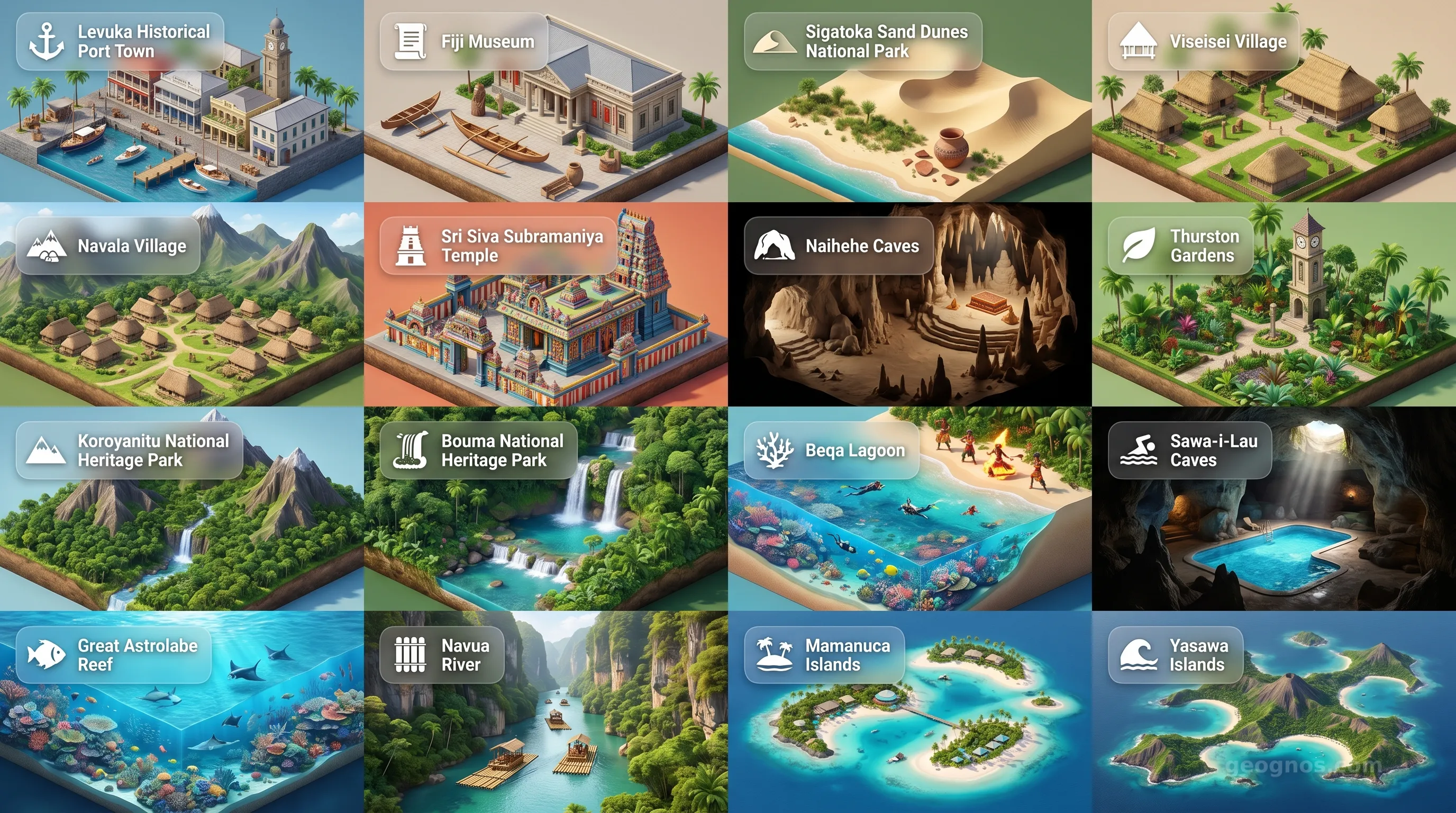
Levuka is a rare, perfectly preserved example of a 19th-century Pacific port settlement and Fiji's only UNESCO World Heritage site. It holds immense historical significance as the site where the 1874 Deed of Cession was signed, handing control of Fiji to Great Britain. For students of Pacific history and colonial architecture, it offers an unmatched real-world classroom. The best season to visit is the dry season from May to October. Tourist tip: Take a guided walking tour along Beach Street to fully appreciate the authentic wooden storefronts and the historical Royal Hotel.
Keeper of Fijian History
Located within Suva's Thurston Gardens, the Fiji Museum is the premier institution for studying the archipelago's rich heritage. It houses an exceptional collection of archaeological artifacts dating back 3,700 years, alongside deep dives into traditional Fijian culture, cannibalism eras, and the arrival of Indo-Fijians. It is a must-visit for anthropologists and cultural enthusiasts. The museum is a great indoor activity year-round, especially during Suva's frequent rainy days. Tourist tip: Don't miss the massive Ratu Finau, Fiji's last double-hulled outrigger canoe on display.
Ancient Sands and Lapita Artifacts
As Fiji's first National Park, this striking landscape features parabolic dunes reaching up to 60 meters high. Historically and archaeologically, it is a treasure trove; the shifting sands frequently uncover ancient pottery shards from the Lapita people, Fiji's first inhabitants who settled here over 2,600 years ago. It is ideal for environmental and archaeological studies. The best time to visit is during the cooler months (May to September) or early morning to avoid the scorching sand. Tourist tip: Wear sturdy closed-toe shoes and bring plenty of water, as there is little shade.
Legendary First Settlement of Fiji
According to local oral traditions, Viseisei is the oldest settlement in Fiji, founded by the first Melanesian ancestors who arrived in the legendary Lutunasobasoba canoe. The village is rich in heritage, featuring traditional architecture, a chiefly bure, and a centennial monument. It provides an excellent study of traditional Fijian societal structures and chiefly systems. Visit during the dry season for comfortable walking tours. Tourist tip: Modest dress is strictly required, and visitors must remove hats and sunglasses when walking through the village.
Fiji's Last Traditional Bure Village
Nestled in the rugged Ba Highlands, Navala is the only remaining village in Fiji where all homes are built in the traditional 'bure' style (thatched roofs and woven bamboo walls). It represents a steadfast commitment to preserving ancestral ways of life, making it a profound site for sociological and architectural study. The best time to visit is from June to September when the highland roads are dry. Tourist tip: Access requires a 4WD vehicle, and participating in a traditional kava welcoming ceremony (sevusevu) is customary upon arrival.
Vibrant Dravidian Masterpiece
Located in Nadi, this is the largest Hindu temple in the Southern Hemisphere. It reflects the immense cultural impact of the Indo-Fijian community, brought over by the British as indentured laborers in the late 19th century. The temple features traditional Dravidian architecture with intricate, brightly painted woodcarvings crafted by artisans from India. It is a fantastic site for religious and architectural studies. Visit year-round, preferably early morning. Tourist tip: Photography is only allowed outside the main temple, and strict dress codes (covering knees and shoulders) apply.
The Fortress of Fiji's Last Cannibals
Deep within the Sigatoka Valley, the Naihehe Caves serve as a haunting reminder of Fiji's pre-colonial tribal warfare. The caves were the fortress of the Sautabu people, one of the last cannibal tribes in Fiji. Visitors can still see the cannibal oven, ritual platforms, and priestly chambers. It offers a gripping historical experience for tourists and students alike. The dry season is ideal to avoid muddy tracks. Tourist tip: You must cross the Sigatoka River by traditional bilibili (bamboo raft) to reach the caves; book a guided tour for safety and cultural context.
Suva's Botanical and Historical Heart
Built on the site of the original indigenous town of Suva (which was relocated to make way for the colonial capital), Thurston Gardens holds layers of pre-colonial and British colonial history. The gardens feature rare indigenous flora and historic elements like the clock tower and bandstand. It is highly valuable for botany students and historians. The gardens are lush year-round. Tourist tip: Combine this visit with the adjacent Fiji Museum, and enjoy a quiet picnic among the ancient Moreton Bay fig trees.
Eco-Tourism and Highland Culture
On the tentative list for UNESCO World Heritage, this park protects unlogged native dakua forests and several ancient archaeological sites, including terraced gardens. It is managed entirely by six local villages, making it a prime case study for sustainable community eco-tourism. Hikers can summit Mount Batilamu for panoramic views of the Mamanuca Islands. Best visited between May and October for safer hiking trails. Tourist tip: Stay overnight in the village lodge to deeply experience highland hospitality and support the local economy.
Taveuni's Pristine Wilderness
Covering one-third of Taveuni (Fiji's 'Garden Island'), Bouma National Heritage Park is a sanctuary of biodiversity, protecting dense rainforests, dramatic coastal tracks, and endemic bird species like the Fiji goshawk. It is a world-class destination for ecological and biological studies. The park is deeply tied to the conservation efforts of the indigenous landowners. Visit between May and October for the best trekking conditions. Tourist tip: The park is vast; allocate at least two days to see both the waterfalls and the Lavena Coastal Walk.
Home of the Shark Gods and Firewalkers
Beqa Lagoon is world-renowned for its thrilling shark dives, but its cultural significance is equally profound. Beqa Island is the ancestral home of the Sawau tribe, who possess the ancient gift of Vilavilairevo (firewalking). Studying the folklore and rituals surrounding this tradition offers deep cultural insights. Dive conditions are excellent year-round, but visibility peaks in the winter months (July-September). Tourist tip: While diving requires certification, non-divers can attend firewalking ceremonies frequently hosted at nearby coastal resorts.
The Heart of the Yasawas
These majestic limestone caves rise dramatically from the ocean in the Yasawa Islands. Ancient inscriptions line the walls, and local legend claims the caves are the resting place of the ten-headed Fijian god, Ulutini. The geology and localized mythology make it an intriguing site for geologists and cultural anthropologists. The dry season guarantees the clearest waters. Tourist tip: Accessing the second cave requires a brief underwater swim guided by locals; it is an exhilarating experience for confident swimmers.
One of the World's Largest Barrier Reefs
Surrounding Kadavu Island, the Great Astrolabe Reef is a massive and remarkably unspoiled marine ecosystem. It serves as a vital research area for marine biologists studying coral bleaching resilience and manta ray populations. The area remains relatively untouched by mass tourism, preserving traditional fishing lifestyles. Dive season is best from May to October. Tourist tip: Bring your own snorkeling gear and book accommodations on Kadavu early, as sustainable eco-resorts have limited capacity.
Lifeblood of the Viti Levu Highlands
Flowing through pristine rainforests, dramatic gorges, and cascading waterfalls, the Navua River is central to the lives of inland Fijian communities. It has historically served as a critical transport route for the highland tribes. Environmental science students can study the complex riverine ecosystems here. The river is accessible year-round, though rapids are more thrilling during the wetter months (November to April). Tourist tip: Take a river tubing or rafting tour, which typically includes a stop at a riverside village for a cultural exchange.
Postcard-Perfect Volcanic Archipelago
The Mamanucas are a chain of 20 volcanic islands known for crystal clear waters, palm-fringed beaches, and vibrant coral reefs. While heavily utilized for tourism, they hold historical importance as traditional fishing grounds for the indigenous people of western Viti Levu. It's a prime location for studying the impact of tourism on fragile island ecosystems. Visit between June and September for ideal weather. Tourist tip: Island-hopping passes are a cost-effective way to explore multiple islands, ranging from party hubs to secluded retreats.
Rugged Beauty and Remote Villages
The Yasawa group is a spectacular chain of islands with dramatic volcanic peaks. Kept isolated from land-based tourism until the late 1980s, the islands have managed to preserve a highly traditional, non-commercialized Fijian culture. It offers an excellent comparative study against the more developed Mamanucas. May to October provides the best sailing and visibility conditions. Tourist tip: Manta ray spotting is a major highlight; visit the channel between Nanuya Balavu and Drawaqa islands from May to October to swim with them.