Samoa
Top Sights & Landmarks
Polynesia's Largest Ancient Pyramid
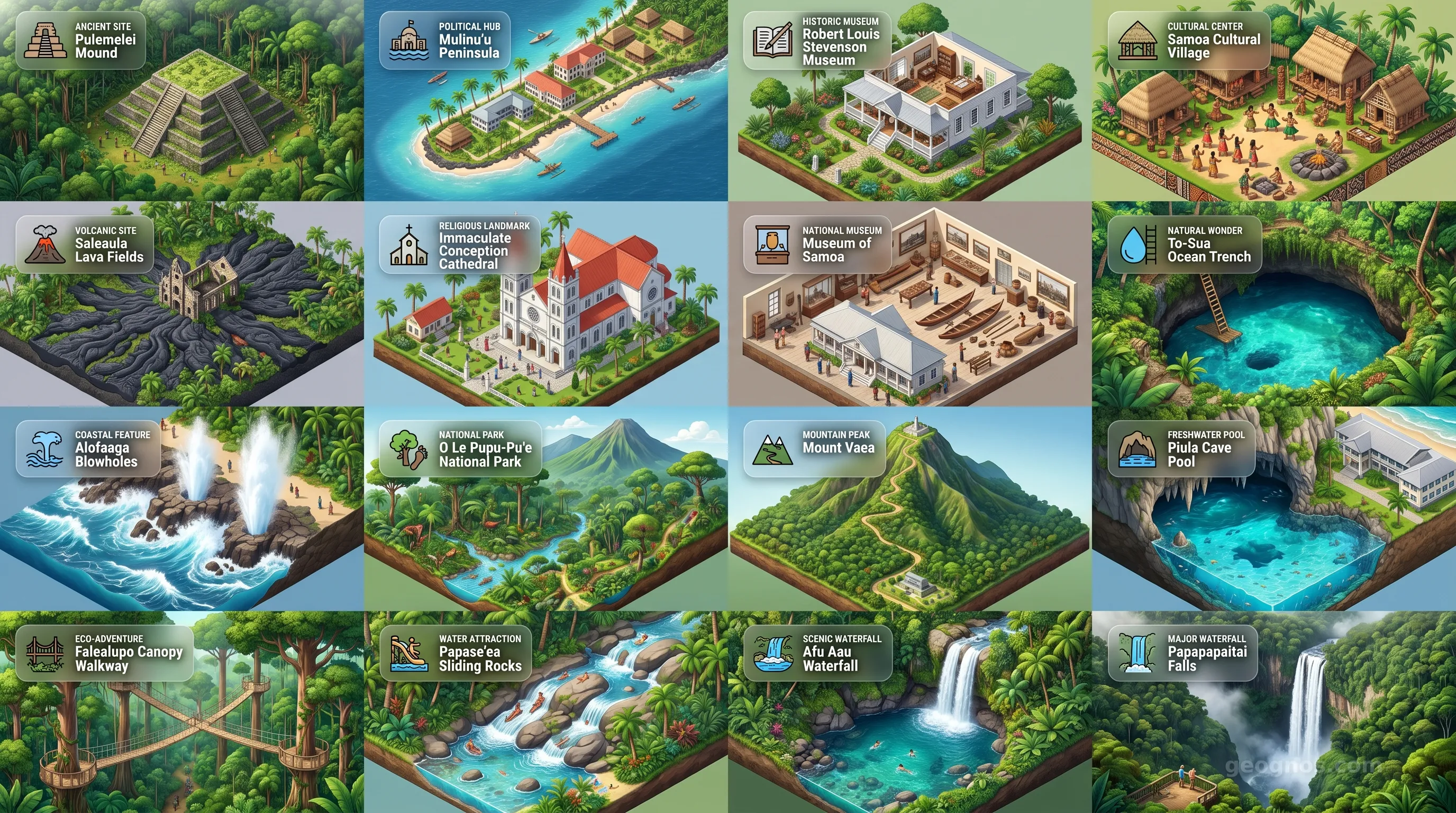
As the largest and most ancient stone structure in Polynesia, the Pulemelei Mound is a massive basalt pyramid offering profound insights into pre-colonial Pacific history. Believed to date back to 1100-1400 AD, its exact original purpose remains a captivating mystery to scholars, though it likely served ceremonial functions. For history and anthropology students, it is an indispensable site. The best time to visit is during the dry season (May to October) when the rugged trails are passable. Tourist tip: The site is located on private plantation land and can be severely overgrown; hiring a knowledgeable local guide in Savai'i is highly recommended.
The Historic Seat of Samoan Power
Mulinu'u Peninsula is the traditional and political capital of Samoa. It holds immense historical gravity, featuring the sacred burial grounds of paramount chiefs (matai) and the Maota Fono, Samoa's modern Parliament building. Studying this area provides an understanding of the intricate Samoan chiefly system and the nation's peaceful transition to independence in 1962. It is easily accessible year-round. Tourist tip: Respect the solemnity of the royal tombs and observe the stunning architectural blend of traditional Samoan fale designs with modern structural engineering in the Parliament building.
Home of 'Tusitala' (The Teller of Tales)
Located in the beautiful Villa Vailima, this meticulously restored historic mansion was the final home of the famous Scottish author Robert Louis Stevenson ('Treasure Island'). He immersed himself in Samoan culture and advocated for the locals, earning the affectionate title 'Tusitala'. The museum is perfect for literature students and cultural enthusiasts wanting to explore the intersection of colonial and Samoan histories. Open year-round, but mornings offer the most pleasant weather for exploring the botanical gardens. Tourist tip: Combine the museum tour with the hike up Mount Vaea to visit his tomb.
The Heart of Fa'a Samoa
Located in central Apia, the Samoa Cultural Village is an interactive living museum and the absolute best place to witness 'Fa'a Samoa' (The Samoan Way) in action. Visitors and researchers can observe master craftsmen engaging in traditional woodcarving, siapo (tapa cloth) making, and the sacred art of tatau (tattooing). It provides critical cultural context for any visitor. The cultural shows generally run from Tuesday to Thursday. Tourist tip: Arrive early for the guided tour to fully experience the traditional 'umu' (hot stone oven) preparation and enjoy a complimentary traditional feast at the end.
Villages Frozen in Volcanic Stone
Between 1905 and 1911, the continuous eruption of Mt Matavanu buried five villages in northern Savai'i under a thick layer of molten rock. Today, the Saleaula Lava Fields stand as a stark, rippling expanse of black basalt. The ruins of an LMS church and the 'Virgin's Grave' protruding through the lava offer haunting visuals and incredible geological and sociological study opportunities regarding natural disaster recovery in indigenous communities. Best visited during early morning or late afternoon, as the black rock absorbs tremendous heat. Tourist tip: Wear sturdy, closed-toe walking shoes to navigate the sharp, uneven terrain safely.
Apia's Architectural Masterpiece
This awe-inspiring Catholic cathedral in Apia is a monumental architectural landmark that tells the story of Christianity's deep roots in Samoa. Recently rebuilt and restored after earthquake damage, the structure boasts a magnificent interior featuring stained-glass windows, intricate wooden ceilings mimicking traditional Samoan fale construction, and stunning religious art adapted to Pacific culture. It stands as a prime example of architectural syncretism. Any season is fine for a visit. Tourist tip: Ensure your shoulders and knees are covered when entering, respecting local religious customs.
The National Repository of Samoan Heritage
Housed in a colonial-era building that once served as a German school, this museum holds a modest but crucial collection tracing 3,000 years of Samoan history. Exhibits range from ancient Lapita pottery fragments and pre-colonial tools to photographic archives of the Mau independence movement. It is a vital stop for historians and students of Pacific studies. Open year-round, it offers a cool, air-conditioned retreat in downtown Apia. Tourist tip: Entry is usually free, but donations are highly appreciated and help preserve these fragile artifacts.
Samoa's Iconic Swimming Hole
To-Sua, translating to 'Giant Swimming Hole', is a 30-meter deep, perfectly symmetrical sinkhole filled with crystal-clear ocean water, surrounded by lush, draping vegetation. Connected to the ocean via an underwater lava tube, the water pulses with the tides. It is a world-class example of volcanic limestone geology and arguably Samoa's most photographed site. The best time to swim is during mid-to-high tide. Tourist tip: Accessing the pool requires descending a steep, long wooden ladder, which can be slippery. Only strong swimmers should venture into the water during strong tidal surges.
Nature's Roaring Water Cannons
Located on the southwestern coast of Savai'i, these spectacular blowholes were formed by ancient lava flows creating underwater tubes. When the powerful ocean swells crash into the cliffs, water is forced upward through these vents, erupting into roaring geysers up to 30 meters high. It provides a thrilling lesson in coastal geomorphology. Visit during high tide for the most explosive displays. Tourist tip: For a small tip, locals will throw coconuts into the blowholes right before a wave hits, launching them into the sky like cannonballs—a uniquely Samoan spectacle.
The South Pacific's First National Park
Established in 1978 and on the UNESCO Tentative List, this national park stretches from the highest peaks of Mount Fito down to the rugged southern lava coast. It is a sanctuary for tropical biodiversity, protecting old-growth rainforests and numerous endemic bird species, making it an exceptional destination for ecology and biology students. The dry season (May to October) is best for hiking its extensive trail network. Tourist tip: Hike the Coastal Walk to witness surreal, jagged black lava cliffs clashing with the deep blue Pacific Ocean.
The Trail of Loving Hearts
Overlooking Apia, Mount Vaea is famous as the final resting place of Robert Louis Stevenson. The hike to the summit, known as the 'Trail of Loving Hearts', was originally cleared by Samoans out of respect for the author. The ascent offers physical recreation alongside cultural homage, culminating in spectacular panoramic views of Upolu's northern coast. Early morning is the best time to hike to avoid the midday equatorial heat. Tourist tip: There are two paths to the top; the short one is steep and strenuous, while the longer path is much more gradual and scenic.
A Hidden Freshwater Oasis
Situated beneath the historic Piula Theological College, this natural freshwater pool is fed by an underground spring flowing from a lava tube. The cool, incredibly clear water is a popular gathering spot for locals and visitors alike. It highlights the unique hydrology of volcanic islands where rainwater filters through porous rock. It's a fantastic spot year-round. Tourist tip: Bring snorkeling gear to view the fish and explore the short underwater connection between the two main cave chambers.
Suspended Over the Gateway to the Underworld
Located in the remote westernmost tip of Savai'i, this rainforest reserve features a hanging bridge strung up to 40 meters high among giant Banyan trees. Culturally, Falealupo is profoundly significant as the site of 'Fafā O Sauali'i', the mythological entrance to the Samoan underworld. The creation of the reserve is also a famous indigenous conservation success story against commercial logging. Any season is fine, but the sunset here (one of the last places on earth to see the sun set) is magical. Tourist tip: The swaying bridge requires a degree of physical confidence and is not for those with extreme vertigo.
Nature's Waterpark
Tucked away in the hills of Faleata, Papase'ea features natural rock formations polished smooth by centuries of flowing water. These natural slides drop into refreshing plunge pools. The site highlights the recreational relationship Samoans have with their lush inland waterways. It is highly recommended to visit during the wet season (November to April) when water levels are sufficient. Tourist tip: Always check the water depth before sliding, as sliding during the dry season can be dangerous due to shallow pools and exposed rocks.
Savai'i's Plunge Pool Paradise
Also known as Olemoe Falls, this spectacular waterfall emerges from the lush rainforest of southeastern Savai'i and cascades into a deep, turquoise plunge pool. Managed by the local village, it is a brilliant example of sustainable, community-run eco-tourism. The pool's varying depths make it perfect for studying local freshwater ecosystems and for an idyllic swim. It flows beautifully year-round but is most spectacular right after heavy rains. Tourist tip: The water is surprisingly cold—a perfect, refreshing shock after a hot day exploring the island.
The Great Gorge Cascade
Plunging over 100 meters down into a sheer, forested volcanic gorge, Papapapaitai Falls is one of the highest waterfalls in Samoa. Easily viewed from the Cross Island Road, it offers geology and geography students a textbook visual of extreme water erosion acting upon a volcanic caldera over millennia. The view is frequently shrouded in ethereal mist, adding to its majesty. Best viewed during or just after the wet season. Tourist tip: There is no trail to the base of the falls; it is purely a viewpoint experience. Pull over carefully on the side of the road to take photos.