🇳🇿

New Zealand

Australia-Oceania Countries
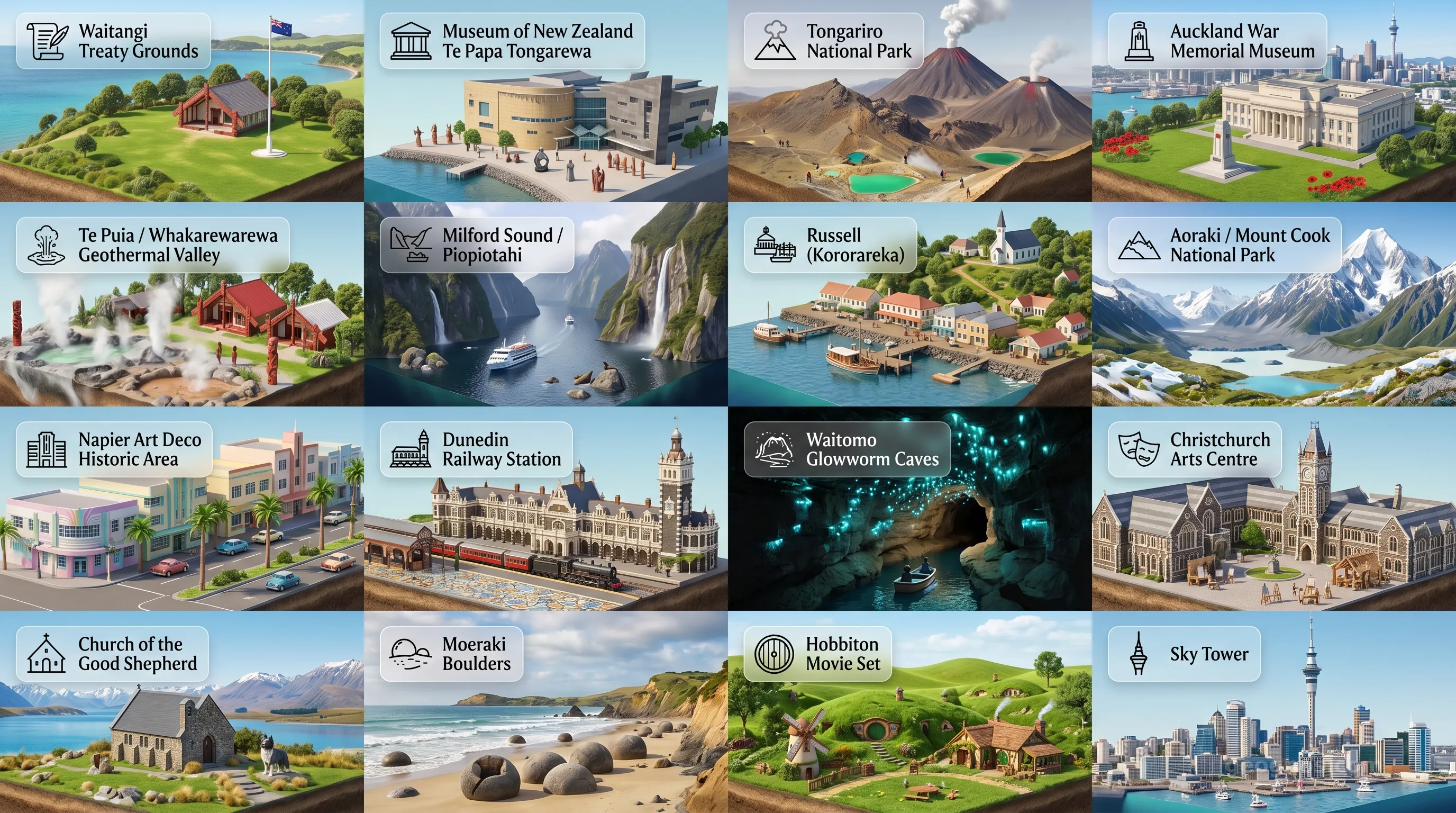
New Zealand - Panoramic Places of Interest Atlas including Waitangi Treaty Grounds, Museum of New Zealand Te Papa Tongarewa, Tongariro National Park, Auckland War Memorial Museum, Te Puia / Whakarewarewa Geothermal Valley, Milford Sound / Piopiotahi, Russell (Kororareka), Aoraki / Mount Cook National Park, Napier Art Deco Historic Area, Dunedin Railway Station, Waitomo Glowworm Caves, Christchurch Arts Centre, Church of the Good Shepherd, Moeraki Boulders, Hobbiton Movie Set, Sky Tower

Top Sights & Landmarks

01

Waitangi Treaty Grounds

Birthplace of the Nation

02

Museum of New Zealand Te Papa Tongarewa

National Museum of New Zealand

03

Tongariro National Park

Sacred Volcanic Wonderland

04

Auckland War Memorial Museum

Guardian of Pacific Culture and History

05

Te Puia / Whakarewarewa Geothermal Valley

Heart of Māori Culture and Geothermal Activity

06

Milford Sound / Piopiotahi

Eighth Wonder of the World

07

Russell (Kororareka)

The Hell Hole of the Pacific

08

Aoraki / Mount Cook National Park

New Zealand's Highest Peaks

09

Napier Art Deco Historic Area

1930s Architectural Time Capsule

10

Dunedin Railway Station

Gingerbread George's Masterpiece

11

Waitomo Glowworm Caves

Subterranean Starry Nights

12

Christchurch Arts Centre

Gothic Revival Heritage Hub

13

Church of the Good Shepherd

Pioneer Memorial by the Lake

14

Moeraki Boulders

Ancient Spheres of the Koekohe Coast

15

Hobbiton Movie Set

The Real Middle-earth

16

Sky Tower

Icon of the Auckland Skyline

Background

Polynesians settled New Zealand between the late 1200s and the mid-1300s. They called the land Aotearoa, which legend holds is the name of the canoe that Kupe, the first Polynesian in New Zealand, used to sail to the country; the name Aotearoa is now in widespread use as the local Maori name for the country. By the 1500s, competition for land and resources led to intermittent fighting between different Maori tribes as large game became extinct. Dutch explorer Abel TASMAN was the first European to see the islands in 1642 but left after an encounter with local Maori. British sea captain James COOK arrived in 1769, followed by whalers, sealers, and traders. The UK only nominally claimed New Zealand and included it as part of New South Wales in Australia. Concerns about increasing lawlessness led the UK to appoint its first British Resident in New Zealand in 1832, although the position had few legal powers. In 1835, some Maori tribes from the North Island declared independence. Fearing an impending French settlement and takeover, the majority of Maori chiefs signed the Treaty of Waitangi with the British in 1840. Land tenure issues stemming from the treaty are still being actively negotiated in New Zealand. The UK declared New Zealand a separate colony in 1841 and granted limited self-government in 1852. Different traditions of authority and land use led to a series of wars between Europeans and various Maori tribes from the 1840s to the 1870s. Along with disease, these conflicts halved the Maori population. In the 1890s, New Zealand initially expressed interest in joining independence talks with Australia but ultimately opted against it and changed its status to an independent dominion in 1907. New Zealand provided more than 100,000 troops during each World War, many of whom fought as part of the Australia and New Zealand Army Corps (ANZAC). New Zealand reaffirmed its independence in 1947 and signed the Australia, New Zealand, and US (ANZUS) Treaty in 1951. Beginning in 1984, New Zealand began to adopt nuclear-free policies, contributing to a dispute with the US over naval ship visits that led the US to suspend its defense obligations to New Zealand in 1986, but bilateral relations and military ties have been revitalized since the 2010s with new security agreements. A key challenge for Auckland that has emerged over the past decade is balancing concerns over China’s growing influence in the Pacific region with its role as New Zealand's largest export destination. New Zealand has close ties with Australia based to a large extent on the two nations’ common origins as British colonies and their shared military history.

Location

Latitude
-41° N
Longitude
174° E
N S W E
World Map Location
Geographic Location

Oceania, islands in the South Pacific Ocean, southeast of Australia

Map Reference
Oceania

Area

Total Area
268,838 sq km
Land (98%)
Land: 264,537 sq km
Water: 4,301 sq km

Elevation

Highest Point
Aoraki/Mount Cook
Aoraki/Mount Cook 3,724 m; note - the mountain's height was 3,764 m until 14 December 1991 when it lost about 10 m in an avalanche of rock and ice; erosion of the ice cap since then has brought the height down another 30 m
Lowest Point
Pacific Ocean
Pacific Ocean 0 m
Mean Elevation
388 m

Detailed Geography Information

Coastline

15,134 km

Geography - note

note 1: consists of two main islands and a number of smaller islands; South Island, the larger main island, is the 12th-largest island in the world and is divided along its length by the Southern Alps; North Island is the 14th-largest island in the world and is not as mountainous, but it is marked by volcanism note 2: New Zealand lies along the Ring of Fire, which is a belt bordering the Pacific Ocean that contains about 75% of the world's volcanoes and up to 90% of the world's earthquakes note 3: almost 90% of the population lives in cities and over three-quarters on North Island; Wellington is the southernmost national capital in the world

Irrigated land

7,000 sq km (2014)

Land boundaries

total: 0 km

Major lakes (area sq km)

fresh water lake(s): Lake Taupo - 610 sq km

Maritime claims

territorial sea: 12 nm contiguous zone: 24 nm exclusive economic zone: 200 nm continental shelf: 200 nm or to the edge of the continental margin

Natural hazards

earthquakes are common, though usually not severe; volcanic activity volcanism: significant volcanism on North Island; Ruapehu (2,797 m) has a history of large eruptions in the past century; Taranaki has the potential to produce dangerous avalanches and lahars; other historically active volcanoes include Okataina, Raoul Island, Tongariro, and White Island; see note 2 under "Geography - note"

Natural resources

natural gasiron oresandcoaltimberhydropowergoldlimestone

Terrain

predominately mountainous with large coastal plains

Population & Growth

+0.80% Growth
5,207,259
Total inhabitants (2025 est.)
Male: 50.1% (2,607,574) Female: 49.9% (2,599,685)

Age Distribution

0-14 years
19.0%
~989,379
15-64 years
64.2%
~3,343,060
65 years
16.9%
~880,027
Note: 2024 est.

Demographic Longevity

Median Age
38.1 years
Male
37.2 yrs
Female
38.6 yrs
Life Expectancy
82.9 years
Male
81.2 yrs
Female
84.8 yrs

Vital Dynamics

Birth Rate
12.4
births per 1,000 people
Death Rate
6.93
deaths per 1,000 people
Net Migration
+2.83
migrants per 1,000 people
Fertility Rate
1.84
children born per woman

Detailed People & Society Information

Alcohol consumption per capita

9.17 liters of pure alcohol (2019 est.)

Currently married women (ages 15-49)

57.7% (2018 est.)

Dependency ratios

total dependency ratio: 56.3 (2025 est.) youth dependency ratio: 29.3 (2025 est.) elderly dependency ratio: 26.9 (2025 est.) potential support ratio: 3.7 (2025 est.)

Education expenditure

5.3%

5.3% of GDP (2023 est.) 12.7% national budget (2023 est.)

Ethnic groups

European
64.1%
Maori
16.5%
Chinese
4.9%
Indian
4.7%
Samoan
3.9%
Tongan
1.8%
Cook Islands Maori
1.7%
English
1.5%
Filipino
1.5%
New Zealander
1%
other
13.7%

Gross reproduction rate

0.9 (2025 est.)

Health expenditure

10%

10% of GDP (2021) 19.8% of national budget (2022 est.)

Hospital bed density

2.7 beds/1,000 population (2021 est.)

Infant mortality rate

total: 3.3 deaths/1,000 live births (2025 est.) male: 3.5 deaths/1,000 live births female: 3.1 deaths/1,000 live births

Languages

English
95.4%
Maori
4%
Samoan
2.2%
Northern Chinese
2%
Hindi
1.5%
French
1.2%
Yue
1.1%
New Zealand Sign Language
0.5%
other or not stated
17.2%

Major urban areas - population

1.673 million Auckland, 422,000 WELLINGTON (capital) (2023)

Maternal mortality ratio

7 deaths/100,000 live births (2023 est.)

Mother's mean age at first birth

27.8 years

Nationality

noun: New Zealander(s) adjective: New Zealand

Obesity - adult prevalence rate

30.8% (2016)

Physician density

3.61 physicians/1,000 population (2022)

Population distribution

over three quarters of New Zealanders, including the Maori, live on the North Island, primarily in urban areas

Refugees and internally displaced persons

Total Displaced & Vulnerable Persons
5,677 individuals
Refugees
99.0%
5,622
5,622 (2024 est.)
Internally Displaced Persons (IDPs)
0.5%
26
26 (2024 est.)
Stateless Persons
0.5%
29
29 (2024 est.)

Religions

Christian (Catholic
37.3%
Anglican
6.8%
Presbyterian and Congregational
5.2%
Pentecostal
1.8%
Methodist
1.6%
Church of Jesus Christ
1.2%
other
10.7%
Hindu
2.7%
Maori
1.3%
Buddhist
1.1%
other religion (includes Judaism
1.6%
no religion
48.6%
objected to answering
6.7%

School life expectancy (primary to tertiary education)

total: 19 years (2023 est.) male: 19 years (2023 est.) female: 20 years (2023 est.)

Sex ratio

at birth: 1.05 male(s)/female 0-14 years: 1.06 male(s)/female 15-64 years: 1.02 male(s)/female 65 years and over: 0.88 male(s)/female total population: 1 male(s)/female (2024 est.)

Tobacco use

total: 10% (2025 est.) male: 11.2% (2025 est.) female: 8.9% (2025 est.)

Climate & Issues

Climate Profile

temperate with sharp regional contrasts

Key Environmental Issues
water quality and availability rapid urbanization deforestation soil erosion and degradation native flora and fauna hard-hit by invasive species

Land Cover

Coverage Distribution
Agri (37%)
Forest (39%)
Other (25%)
Arable: 2.0%
Crops: 0.3%
Pasture: 34.6%
Forest: 38.6%

Air & Carbon Emissions

Annual CO2 Output 2023 est.
33.506 million
Coal (13%) Oil (65%) Gas (22%)
PM2.5 Exposure 8.7 µg/m³
0 5 (WHO Limit) 15 25 35+
Methane Emissions
energy: 95.4 kt (2022-2024 est.)

Water Resources & Use

Renewable Water Resources 327 billion cubic meters (2022)
Annual Water Withdrawal
municipal: 547 million cubic meters (2022)
Municipal (11%) Ind (24%) Agri (65%)

Detailed Environmental Information

International environmental agreements

Antarctic-Environmental ProtectionAntarctic-Marine Living ResourcesAntarctic TreatyBiodiversityClimate ChangeClimate Change-Kyoto ProtocolClimate Change-Paris AgreementComprehensive Nuclear Test BanDesertificationEndangered SpeciesEnvironmental ModificationHazardous WastesLaw of the SeaMarine Dumping-London ConventionMarine Dumping-London ProtocolNuclear Test BanOzone Layer ProtectionShip PollutionTropical Timber 2006WetlandsWhaling

Urbanization

urban population: 87% of total population (2023) rate of urbanization: 0.92% annual rate of change (2020-25 est.)

Waste and recycling

municipal solid waste generated annually: 3.405 million tons (2024 est.) percent of municipal solid waste recycled: 22% (2022 est.)

Capital & State Profile

Capital City
Wellington
-41.3° N, 174.7833° E
Timezone UTC+12
Daylight Saving +1hr
Government Type
parliamentary democracy under a constitutional monarchy; a Commonwealth realm
Independence 1907-09-26
National Holiday 02-06

Executive Branch

Chief of State
King CHARLES III (since 8 September 2022); represented by Governor-General Dame Cindy KIRO
Head of Government
Prime Minister Christopher LUXON (since 27 November 2023)
Cabinet Executive Council appointed by the governor-general on the recommendation of the prime minister

Legislative Branch

unicameral
Legislature Name House of Representatives
Seats & Term
120 (all directly elected) seats / 3 years
Women in Chamber
45.1% Representation
Electoral System mixed system
Parties Composition
National Party 49Labour Party 34Green Party 14ACT New Zealand 11New Zealand First 8Te Pāti Māori 4Others 2

National Identity & Symbols

National Flag Description

blue with the UK flag in the upper-left quadrant, with four five-pointed red stars edged in white centered in the right half of the flag

Symbolic Meaning the stars represent the Southern Cross constellation
National Symbol Southern Cross constellation (four five-pointed stars), kiwi (bird), silver fern
National Colors black, white, red (ochre)
National Anthem God Defend New Zealand

Detailed Government Information

Administrative divisions

16 regions and 1 territory*; Auckland, Bay of Plenty, Canterbury, Chatham Islands*, Gisborne, Hawke's Bay, Manawatu-Wanganui, Marlborough, Nelson, Northland, Otago, Southland, Taranaki, Tasman, Waikato, Wellington, West Coast

Citizenship

citizenship by birth: no citizenship by descent only: at least one parent must be a citizen of New Zealand dual citizenship recognized: yes residency requirement for naturalization: 3 years

Constitution

history: New Zealand has no single constitution document; the Constitution Act 1986, effective 1 January 1987, includes only part of the uncodified constitution; others include a collection of statutes or "acts of Parliament," the Treaty of Waitangi, Orders in Council, letters patent, court decisions, and unwritten conventions amendment process: proposed as bill by Parliament or by referendum called either by the government or by citizens; passage of a bill as an act normally requires two separate readings with committee reviews in between to make changes and corrections, a third reading approved by the House of Representatives membership or by the majority of votes in a referendum, and assent of the governor-general; passage of amendments to reserved constitutional provisions affecting the term of Parliament, electoral districts, and voting restrictions requires approval by 75% of the House membership or the majority of votes in a referendum

Country name

conventional long form: none conventional short form: New Zealand former: Nieuw Zeeland abbreviation: NZ etymology: the name is an anglicized form of the Dutch name Nieuw Zeeland, or "New Sea Land," which was first used in 1643 in honor of the Dutch province of Zeeland

Dependent areas

Tokelau (1)

International law organization participation

accepts compulsory ICJ jurisdiction with reservations; accepts ICCt jurisdiction

International organization participation

Judicial branch

highest court(s): Supreme Court (consists of 5 justices, including the chief justice) judge selection and term of office: justices appointed by the governor-general upon the recommendation of the attorney- general; justices appointed until compulsory retirement at age 70 subordinate courts: Court of Appeal; High Court; tribunals and authorities; district courts; specialized courts for issues related to employment, environment, family, Maori lands, youth, military; tribunals

Legal system

common law system, based on English model, with special legislation and land courts for the Maori

National heritage

total World Heritage Sites: 3 (2 natural, 1 mixed) selected World Heritage Site locales: Te Wahipounamu – South West New Zealand (n); Tongariro National Park (m); New Zealand Sub-Antarctic Islands (n)

Political parties

ACT New Zealand Green Party New Zealand First Party or NZ First Labor Party National Party Te Pāti Māori

Suffrage

18 years of age; universal

Economic Overview

high-income, globally integrated Pacific island economy; strong agriculture, manufacturing, and tourism sectors; reliant on Chinese market for exports; recovery trajectory following deep post-pandemic recession; challenges of fiscal deficits, below-average productivity, cost of living, and drop in net migration

Size & Performance

Real GDP (PPP)
$257.117 billion
Latest available estimate (2024)
2023: $257.443 billion2022: $253.903 billion
Real GDP Growth
-0.1% (2024 est.)
-0.1%
GDP Per Capita (PPP)
$48,200
2023: $49,1002022: $49,600

GDP Sector Breakdown

Agriculture: 4.6%Industry: 19.6%Services: 67.4%
Origin GDP %
Agriculture 4.6%
Industry 19.6%
Services 67.4%

Trade Balance

Trade Position
Trade Deficit
$6.20 billion
Total Exports
$61.799 billion (2024 est.)
Total Imports
$67.998 billion (2024 est.)
Exports (48%) Imports (52%)

Budget Balance

Budget Position
Budget Deficit
-$8.62 billion
Revenues
$83.167 billion (2022 est.)
Expenditures
$91.782 billion (2022 est.)
Revenues (48%) Expenditures (52%)

Export Profile

Top Export Partners

Note: 2023; top five export partners based on percentage share of exports

Major Export Commodities

milkwoodbeefbuttersheep and goat meat

Import Profile

Top Import Partners

Note: 2023; top five import partners based on percentage share of imports

Major Import Commodities

refined petroleumcarsgas turbinesbroadcasting equipmenttrucks

Labor & Employment

Total Labor Force 3.124 million (2024 est.)
General Unemployment Rate 4.9%
Youth Unemployment (Ages 15-24) 14.3%

Income Inequality

Detailed Economic Data

Agricultural products

milkbeefkiwifruitapplesgrapeslambpotatoeswheatbarleychicken

Current account balance

-$15.978 billion (2024 est.) -$17.065 billion (2023 est.) -$21.627 billion (2022 est.) note: balance of payments - net trade and primary/secondary income in current dollars

Exchange rates

New Zealand dollars (NZD) per US dollar - Exchange rates: 1.652 (2024 est.) 1.628 (2023 est.) 1.577 (2022 est.) 1.414 (2021 est.) 1.542 (2020 est.)

GDP - composition, by end use

Industrial production growth rate

-1% (2023 est.) note: annual % change in industrial value added based on constant local currency

Industries

agricultureforestryfishinglogs and wood articlesmanufacturingminingconstructionfinancial servicesreal estate servicestourism

Inflation rate (consumer prices)

2.9% (2024 est.) 5.7% (2023 est.) 7.2% (2022 est.) note: annual % change based on consumer prices

Public debt

54% of GDP (2022 est.) note: central government debt as a % of GDP

Remittances

0.3% of GDP (2023 est.) 0.2% of GDP (2022 est.) 0.3% of GDP (2021 est.) note: personal transfers and compensation between resident and non-resident individuals/households/entities

Reserves of foreign exchange and gold

$22.065 billion (2024 est.) $15.487 billion (2023 est.) $14.4 billion (2022 est.) note: holdings of gold (year-end prices)/foreign exchange/special drawing rights in current dollars

Taxes and other revenues

29.6% (of GDP) (2022 est.) note: central government tax revenue as a % of GDP

Grid Infrastructure

Electricity Access 100%
Capacity 10.643 million kW (2023 est.)
Consumption 40.794 billion kWh (2023 est.)
Grid Losses: 3.058 billion kWh (2023 est.)

Generation Mix

Percentage Share of Production
hydroelectricity 59.7%
geothermal 17.6%
fossil fuels 12.4%
wind 8%
biomass and waste 1.5%
solar 0.8%

Fossil Fuels Production

Petroleum
Production 12,000 bbl/day (2023 est.)
Consumption 154,000 bbl/day (2024 est.)
Proven Reserves 40.993 million barrels (2021 est.)
Natural Gas
Production 3.97 billion cubic meters (2023 est.)
Consumption 3.891 billion cubic meters (2023 est.)
Proven Reserves 31.149 billion cubic meters (2021 est.)
Coal
Production 3.011 million metric tons (2023 est.)
Consumption 2.696 million metric tons (2023 est.)
Exports 906,000 metric tons (2023 est.)
Imports 283,000 metric tons (2023 est.)
Proven Reserves 6.75 billion metric tons (2023 est.)

Intensity & Nuclear

Energy Consumption Per Capita 121.647 million Btu/person (2023 est.)
No nuclear energy infrastructure or reactor operations reported in this country dossier.

Digital Access

.nz
Internet Usage 96%

Active internet users as a percentage of the total population.

Fixed Broadband

Penetration Rate 37 / 100
Total Subscriptions 1.93 million (2023 est.)

Mobile Cellular

Penetration Rate 115 / 100
Total Subscriptions 6.78 million (2024 est.)

Broadcast Media

state-owned Television New Zealand operates multiple TV networks; state-owned Radio New Zealand operates 3 radio networks and an external shortwave radio service to the South Pacific region; a small number of national commercial TV and radio stations and many regional commercial TV and radio stations are available; cable and satellite TV systems are available (2019)

Aviation

ZK
Airports
206
As of 2025
Heliports
62
As of 2025

Railways

Total Track Length
4,128 km
National Network Data from 2018

Ports & Harbors

Ports Count 22
Hover for breakdown & key ports As of 2024

Merchant Marine

Commercial Fleet
117 ships
Hover for vessel types breakdown As of 2023

Military Expenditures

GDP Allocation 1.2%
1.2% of GDP (2024 est.) 1.3% of GDP (2023 est.) 1.3% of GDP (2022 est.) 1.3% of GDP (2021 est.) 1.5% of GDP (2020 est.)

Active Duty Strengths

approximately 8,800 active (Regular Force) New Zealand Defense Forces (4,300 Army; 2,100 Navy; 2,400 Air Force) (2025) note: the total NZDF complement is about 15,300 including the Regular Force, Reserves, and civilians

Refers to active military personnel.

Service & Defense Details

Military and security forces

New Zealand Defense Force (NZDF): New Zealand Army, Royal New Zealand Navy, Royal New Zealand Air Force (2025) note: the New Zealand Police, under the Minister of Police, is the primary law enforcement body agency of New Zealand and responsible for internal security

Military deployments

small numbers of NZ military personnel are deployed on a variety of international missions in Africa, Antarctica, the Asia-Pacific region, and the Middle East (2025)

Military equipment inventories and acquisitions

the NZDF's inventory is comprised of domestically produced and Western-supplied weapons and equipment, including from Australia, Canada, the UK, and the US (2025)

Military - note

the NZDF is responsible for protecting New Zealand’s sovereignty, promoting its interests, safeguarding peace and security, and conducting peacekeeping, humanitarian, and other international missions New Zealand is a member of the Five Powers Defense Arrangements (FPDA), a series of mutual assistance agreements reached in 1971 embracing Australia, Malaysia, New Zealand, Singapore, and the UK; the FPDA commits the members to consult with one another in the event or threat of an armed attack on any of the members and to mutually decide what measures should be taken, jointly or separately; there is no specific obligation to intervene militarily New Zealand has been part of the Australia, New Zealand, and US Security (ANZUS) Treaty since 1951; however, the US suspended its ANZUS security obligations to New Zealand in 1986 after Auckland implemented a policy barring nuclear-armed and nuclear-powered warships from its ports; the US and New Zealand signed the Wellington Declaration in 2010, which reaffirmed close ties between the two countries, and in 2012 signed the Washington Declaration, which provided a framework for future security cooperation and defense dialogues; in 2016, a US naval ship conducted the first bilateral warship visit to New Zealand since the 1980s; New Zealand has Major Non-NATO Ally (MNNA) status with the US, a designation under US law that provides foreign partners with certain benefits in the areas of defense trade and security cooperation (2025)

Military service age and obligation

17 years of age for voluntary military service for men and women; soldiers cannot be deployed until the age of 18; no conscription (2025) note: New Zealand opened up all military occupations to women in 2000; as of 2024, women accounted for about 20% of Regular Force personnel

Space Agency

New Zealand Space Agency (NZSA; established 2016 under the Ministry of Business, Innovation, and Employment) (2025)

Program Overview

has a national space program focused largely on the development of a commercial space sector, particularly in the field of satellites and satellite launch vehicles (SLV); manufactures and launches commercial satellites and SLVs; researches and develops a range of other space-related technologies, including propulsion systems; participates in international programs and partners with a range of foreign space agencies and industries, including those of Australia, Canada, the EU, the ESA, individual European countries, South Africa, and the US; has a growing commercial space sector (2025)

Program Milestones

2009 launched a 2-stage suborbital sounding rocket (Atea-1)
2018 placed satellite in orbit on rocket built by a New Zealand-US commercial company and launched from a privately owned domestic launch site
2019 began operations of the Kiwi Space Radar, which is designed to track debris in low Earth orbit
2021 signed the US-led Artemis Accords for space and lunar exploration
2024 first domestically made science payload sent to International Space Station on US rocket