Tonga
Top Sights & Landmarks
The Stonehenge of the Pacific
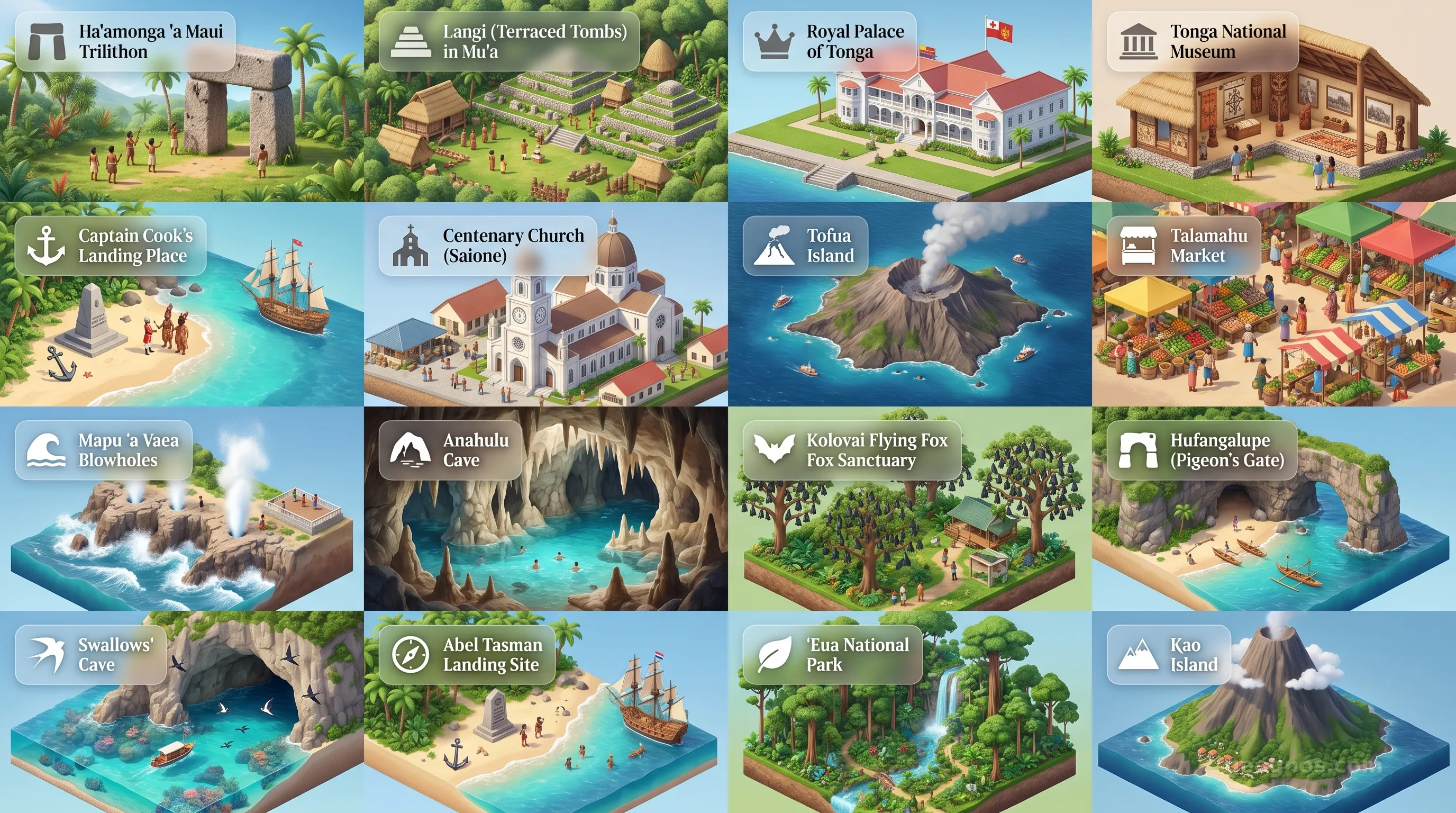
Constructed in the 13th century under the 11th Tu'i Tonga (king), this massive coral limestone trilithon is the most significant archaeological monument in Polynesia. Historically, it served as a royal gateway and a seasonal calendar to mark solstices. For students of history and archaeology, it represents the peak of the Tu'i Tonga Empire's engineering capabilities. The best time to visit is during the dry season (May to October), particularly around the winter solstice when the sun aligns with the structure. Tourist tip: Hire a local guide to fully appreciate the complex oral histories and legends of Maui associated with the stones.
Ancient Royal Burial Grounds
Located in the ancient capital of Mu'a, the Langi are massive, terraced stone tombs built for the Tu'i Tonga kings between the 12th and 19th centuries. Some of the coral slabs weigh several tons and were transported by sea from neighboring islands. Studying these structures offers profound insights into the hierarchical and deeply reverent society of early Tonga. Visit during the cooler, dry months for comfortable exploration. Tourist tip: Mu'a is a sacred site; visitors should maintain a respectful demeanor and dress modestly, covering shoulders and knees.
Seat of the Tongan Monarchy
Erected in 1867, this white timber Victorian-style palace is the official residence of the King of Tonga. It stands as a symbol of Tonga's unique status as the only Pacific nation never to lose its indigenous governance to colonization. While the interior is closed to the public, the stunning historic facade set against the Pacific Ocean makes it a prime subject for architectural and cultural study. The best time to visit is in July during the King's birthday celebrations, when the surrounding area comes alive with parades and festivals. Tourist tip: The best photo opportunities are from the waterfront promenade outside the perimeter fence.
Preserver of Tongan Heritage
Housing an impressive collection of artifacts, including ancient Lapita pottery, traditional weaponry, and royal heirlooms, the Tonga National Museum is essential for anyone studying the cultural evolution of the Polynesian people. It provides vital context to the archaeological sites scattered across the islands. The museum is a great year-round destination, perfect for rainy days. Tourist tip: Check the opening hours locally, as they can sometimes vary, and don't miss the exhibition on traditional tapa cloth making.
Site of the 'Friendly Islands' Naming
A banyan tree marks the approximate location where British explorer Captain James Cook landed in 1777 during his third voyage. It was here that he dubbed Tonga the 'Friendly Islands' after being invited to the 'Inasi festival, unaware that the chiefs were allegedly plotting to kill him. This site is pivotal for historians studying early European-Polynesian contact. Accessible year-round. Tourist tip: The site is quiet and marked by a memorial plaque; combine this visit with a trip to the nearby Mu'a royal tombs.
The Royal Church of Tonga
This imposing Free Wesleyan church in Nuku'alofa is the site of Tongan royal coronations and marriages. Built to accommodate thousands, its architecture reflects the deep integration of Christian faith and Tongan royal authority since the 19th century. Studying this landmark provides insight into Tonga's post-contact religious transformation. The best time to visit is on a Sunday morning. Tourist tip: Attend a Sunday service to hear the magnificent a cappella harmonies of the choir; visitors must wear formal attire (suit and tie or a traditional ta'ovala).
Site of the Mutiny on the Bounty
Tofua is a perfectly shaped active volcanic caldera and the infamous site where Captain William Bligh and his loyalists landed after the 1789 Mutiny on the Bounty, resulting in the death of quartermaster John Norton. For geologists and historians alike, Tofua is a captivating destination. The island is incredibly rugged, with a volcanic crater lake at its center. The dry season (May to October) is the only realistic time to attempt a visit. Tourist tip: Tofua is uninhabited and highly inaccessible; reaching it requires chartering a private vessel from Ha'apai and demands excellent physical fitness.
The Heartbeat of Nuku'alofa
As Tonga's main fresh produce and central market, Talamahu offers an immersive look into modern Tongan daily life, agriculture, and commerce. Visitors and students of cultural anthropology will find an abundance of traditional crafts, root crops, and local interactions here. It is historically significant as the traditional gathering place for local trade. Open year-round, but Saturday mornings are the most vibrant. Tourist tip: Bring cash in Tongan Pa'anga and go early in the morning for the best selection of fresh fruits, vanilla beans, and handcrafted bone carvings.
The Chief's Whistles
Stretching for over 5 kilometers along the rugged southern coast of Tongatapu, these spectacular blowholes launch water up to 30 meters into the air as ocean swells force water through ancient coral reef tubes. The site, translating to 'Chief's Whistles', demonstrates the powerful erosive forces of the Pacific Ocean, making it a stellar study site for coastal geology. Best visited during high tide on a windy day for maximum effect. Tourist tip: Wear sturdy shoes as the coastal coral rocks are exceedingly sharp, and keep a safe distance from the edge.
Ancient Limestone Fortress and Pool
Anahulu Cave is a network of limestone caverns featuring stunning stalactite and stalagmite formations, leading down to deep, crystal-clear freshwater pools. Historically, the cave was used as a fortress and refuge during inter-tribal wars in the 19th century. It is a fantastic site for speleology and history enthusiasts. Open year-round, though navigating it during heavy rains can be slippery. Tourist tip: Bring your swimsuit for a refreshing dip in the underground pools, and carry a reliable waterproof flashlight, as the cave's generator lighting is sometimes inconsistent.
The Sacred Bats of Tonga
In the village of Kolovai, hundreds of Pacific flying foxes (fruit bats) roost in the casuarina trees. In Tongan culture, these bats are considered sacred—gifts from a Samoan princess to the Tongan king—and only members of the royal family are permitted to hunt them. This sanctuary is an excellent location for wildlife biology students to observe bat behavior in a protected environment. The best viewing time is late afternoon when the bats begin to stir. Tourist tip: Park quietly and look up; the bats are largely inactive during the day but provide a stunning silhouette against the sky.
A Dramatic Natural Land Bridge
Formed by the collapse of a massive sea cave roof, Hufangalupe is a dramatic natural coral limestone bridge spanning over the crashing Pacific waves. The site is frequently referenced in Tongan folklore and songs, symbolizing romantic trysts and nature's raw power. Geologists study the site to understand coastal karst erosion. Ideal to visit year-round. Tourist tip: There are no safety barriers at the cliff edges, so extreme caution is advised, especially if visiting with children or during high winds.
Vava'u's Illuminated Sea Cavern
Located in the Vava'u archipelago, Swallows' Cave is a magnificent sea cavern accessible only by boat. Historically used as a sheltering spot by local fishermen, it gets its name from the hundreds of swiftlets that nest within. The afternoon sun penetrates the cave mouth, illuminating the deep blue water and schools of fish below, creating a surreal environment for marine biology and geology students. Best visited from July to October (coinciding with whale season). Tourist tip: Go in the late afternoon for the best lighting, and bring a mask and snorkel to observe the incredible underwater topography.
The First European Encounter
A monument in the Hihifo district marks the area where Dutch explorer Abel Tasman anchored his ships in 1643, making him the first European to make contact with Tonga. He traded iron and goods for fresh water and food. This site is crucial for maritime historians examining the age of European exploration in the Pacific. Best visited year-round. Tourist tip: The site is modest, but a great stopping point on a driving tour of Tongatapu's western historical and natural landmarks.
Tonga's Oldest Geological Formation
Unlike the rest of Tonga, which is composed of low-lying coral atolls or active volcanoes, 'Eua is an ancient, raised volcanic island with diverse topography including dense rainforests, caves, and towering limestone cliffs. It holds great significance in Tongan mythology as the first island created. It is the premier destination in Tonga for ecological study, trekking, and bird watching. Best season to visit is during the cooler dry months (June-October). Tourist tip: The dramatic Fangatave cliffs offer incredible land-based whale watching during the humpback migration season; hiring a local 4WD guide is highly recommended.
The Highest Peak in Tonga
Rising a dramatic 1,030 meters directly out of the ocean, Kao is a dormant stratovolcano featuring a near-perfect symmetrical cone. Culturally, it holds a place in Tongan folklore as a geographical marker created by the gods. For vulcanologists and extreme adventurers, it represents the raw geological origins of the Tofua volcanic arc. The climb is extremely challenging. Best attempted in the dry season. Tourist tip: Climbing Kao is not for the faint-hearted; there are no paths, and it requires machetes for the lower jungle and exceptional stamina for the steep scree slopes near the summit.