Tuvalu
Top Sights & Landmarks
Darwin's Atoll Theory Testing Site
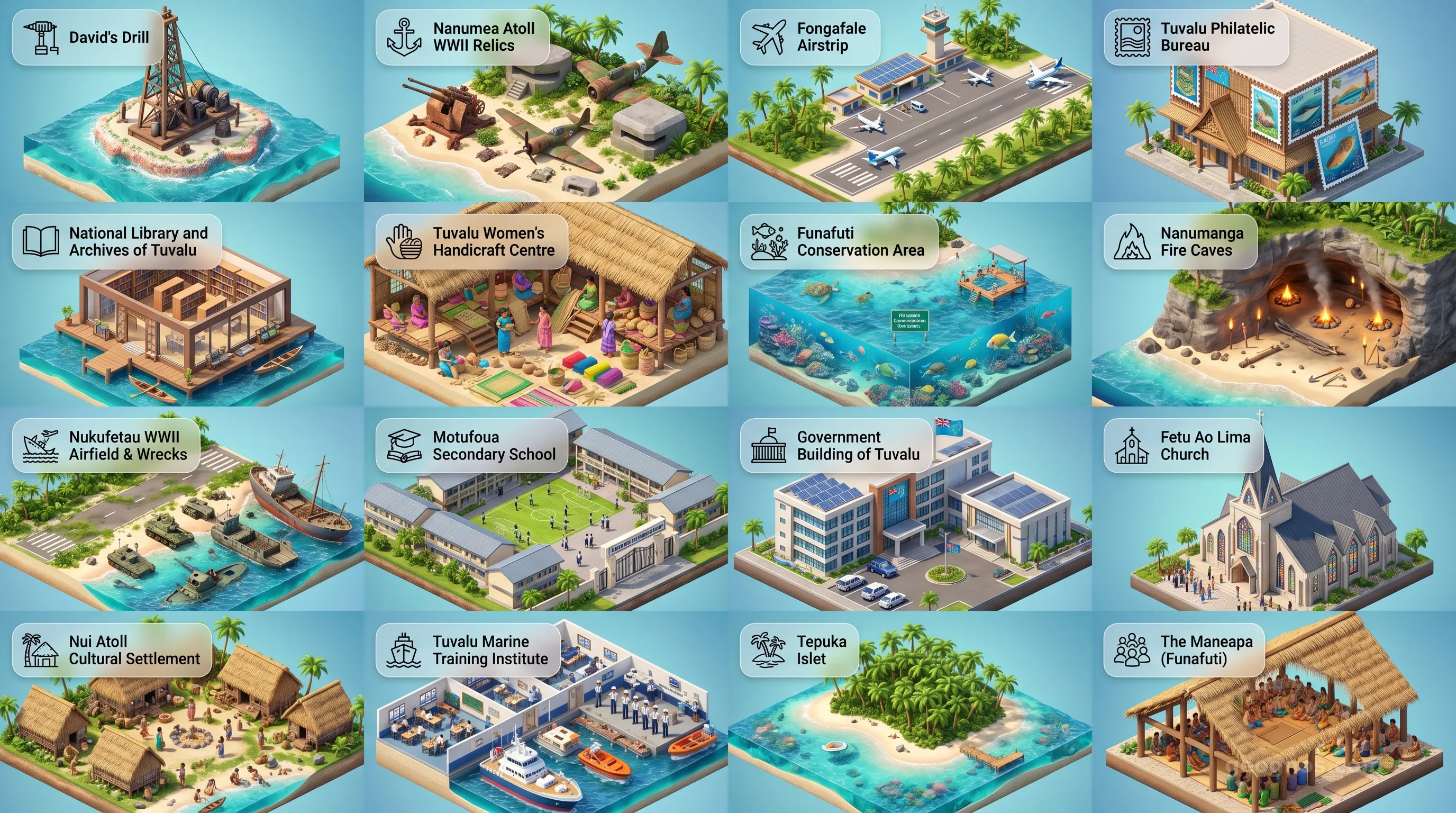
In 1896, the Royal Society of London conducted geological drilling on Fongafale islet to test Charles Darwin's theory of atoll formation through subsidence. Reaching a depth of 340 meters, the expedition found traces of shallow-water organisms, providing critical evidence for modern marine geology. For students of earth sciences, this is a seminal historical site. The actual boreholes are mostly obscured today, but the location remains a focal point for understanding coral reef evolution. The best time to visit is during the dry season (May to October). Tourist tip: Visit the local government offices to learn about the exact historical markers and pair your visit with a discussion on how climate change currently impacts this very same geological foundation.
American Pacific Theater Graveyard
During World War II, Nanumea served as a critical forward operating base for American forces. Today, the atoll is a living museum of the Pacific War, featuring the rusted remains of B-24 Liberator bombers, a wrecked landing craft, and the remnants of an old airfield. Studying this site provides invaluable insights into the logistical strategies of the Allies and the profound impact the war had on remote Polynesian populations. The best season to explore is between June and September to avoid heavy rains. Tourist tip: Access to Nanumea requires a multi-day ferry ride from Funafuti; bring provisions, a good camera, and seek permission from the local Kaupule (island council) before exploring the wrecks.
The Living Runway of Funafuti
Originally built by the US Navy's Seabees during WWII, Funafuti International Airport's runway is the most unique architectural and cultural landmark in Tuvalu. Because land is incredibly scarce on the narrow atoll, the runway serves as a communal hub. When the bi-weekly flights are not scheduled, the tarmac transforms into a public park where locals play football, volleyball, and gather for evening socialization. It is a brilliant case study in spatial adaptation and community resilience. The best time to witness this is late afternoon year-round. Tourist tip: Listen for the siren that sounds when an aircraft is approaching; you must clear the runway immediately!
World-Famous Stamp Collection
Tuvalu is internationally renowned among philatelists for its rare and beautifully designed postage stamps, which are a vital source of national income. The Philatelic Bureau in Funafuti serves as both a functional post office and an informal museum of the nation's postal history, showcasing limited edition releases that commemorate global events, local flora, and traditional culture. For historians and art students, it offers a fascinating look at micro-economy and cultural export. Open year-round on weekdays. Tourist tip: Purchase a set of collectible stamps and mail a postcard to yourself; it will bear the unique Tuvalu postmark, a rare souvenir for any traveler.
Keeper of Tuvaluan Heritage
Situated in Funafuti, the National Library and Archives is the primary repository for Tuvalu's cultural, historical, and governmental documents. It houses invaluable records concerning the colonial era (when Tuvalu was the Ellice Islands), traditional land ownership, and early missionary correspondence. For researchers and students of Pacific history, it is an indispensable resource. Visiting here sheds light on the nation's transition to independence in 1978. The site is accessible year-round. Tourist tip: The facility is small and operates on island time; call ahead or ask your accommodation to arrange a formal visit if you wish to study specific archival materials.
Preserving Indigenous Polynesian Arts
Located near the airport in Funafuti, this vital cultural center empowers local women while preserving traditional Tuvaluan craftsmanship. The gallery showcases intricate woven mats, shell necklaces, carved wooden artifacts, and traditional fans made from pandanus leaves. It is an excellent study site for anthropologists and art historians interested in material culture and sustainable local economies. Visitors can watch artisans at work and purchase authentic, ethically sourced souvenirs. Visit year-round, particularly on flight days when the center is bustling. Tourist tip: Cash (Australian Dollars) is required for purchases, and buying directly from the center ensures the money goes straight to the local families.
Pristine Marine Biodiversity Park
Encompassing 33 square kilometers of the western Funafuti lagoon, this conservation area includes six uninhabited islets and a rich array of coral reefs, coconut crabs, nesting sea turtles, and tropical fish. Established in 1996 to combat overfishing, it is a living laboratory for environmental scientists studying marine conservation and the devastating impacts of coral bleaching. Snorkeling or diving here offers an unparalleled look at a fragile ecosystem. The dry season (May to October) provides the best water visibility. Tourist tip: You must hire a local boat to reach the conservation area; ask the town council in Vaiaku for approved eco-guides and bring your own snorkeling gear.
Submerged Ancient Habitation Site
Discovered by scuba divers in 1986, the Nanumanga Fire Caves sit more than 40 meters underwater. Inside, explorers found blackened areas believed to be ancient fire pits, alongside stalactites, suggesting the caves were inhabited thousands of years ago when sea levels were significantly lower. This site revolutionized the archaeological understanding of early Polynesian migration and settlement timelines. Because of the depth and strong currents, the site is strictly for highly experienced divers and requires specialized expeditions. Tourist tip: Even if you cannot dive it, discussing the caves with local elders offers a profound insight into Tuvaluan mythology and the history of Pacific sea-level rise.
The Hidden Atoll Base
Motulalo, the largest islet of the Nukufetau atoll, was chosen by the US military to construct a massive X-shaped airfield during WWII to support the Gilbert and Marshall Islands campaigns. Today, the jungle has reclaimed much of the site, but visitors can still find aircraft engine blocks, rusted artillery, and ammunition bunkers scattered throughout the dense tropical foliage. It is a surreal landscape that juxtaposes wartime destruction with island tranquility, perfect for military history enthusiasts. The dry season is recommended for exploration. Tourist tip: Access involves a long boat ride from Funafuti; bring insect repellent and thick-soled shoes for navigating the jungle and rusted debris.
Tuvalu's Premier Educational Hub
Located on Vaitupu atoll, Motufoua Secondary School is the largest educational institution in the country, founded in 1905 by the London Missionary Society. Almost every prominent Tuvaluan leader has walked its halls. The school represents the intersection of traditional community values and modern education in a remote island setting. For educational researchers, it offers a profound case study on distance learning, boarding school culture in the Pacific, and climate adaptation in infrastructure. Best visited during school terms. Tourist tip: Visitors are welcome but must seek permission from the headmaster. A respectful dress code (modest clothing covering shoulders and knees) is required.
The Administrative Heart of the Nation
Situated in Vaiaku on Funafuti, the Tuvalu Government Building is the only three-story structure in the country and houses almost all national ministries. Architecturally, it stands out against the low-lying palm trees and traditional houses. Studying this building and its operations provides insight into the bureaucratic management of a micro-state facing existential threats from climate change. It is the diplomatic and administrative core of the nation. Best visited during working hours (Monday to Friday). Tourist tip: While you cannot wander into ministerial offices uninvited, the ground floor often features public notices, and the building is a great orientation point in Funafuti.
The Morning Star Church
The Church of Tuvalu (Ekalesia Kelisiano Tuvalu) is the spiritual center of the nation, and the Fetu Ao Lima in Funafuti is its most prominent building. Featuring striking white walls, a distinctive clock tower, and an airy, open-plan interior designed to capture sea breezes, it is a cornerstone of Tuvaluan social life. Understanding the deep integration of Protestant Christianity with local custom is essential for any cultural study of Tuvalu. The best time to visit is on a Sunday morning to hear the incredible, harmonious congregational singing. Tourist tip: Sunday is strictly observed as a day of rest; visitors should dress conservatively and are highly encouraged to attend a service for the musical experience.
A Micronesian Enclave in Polynesia
Unlike the rest of Tuvalu, which is culturally and linguistically Polynesian, the people of Nui Atoll trace their ancestry back to Micronesian settlers from the Gilbert Islands (now Kiribati). The local language, customs, and traditional dances here are distinctly different from the rest of the country. For ethnographers and cultural anthropologists, Nui is a fascinating anomaly of Pacific migration and assimilation. The landscape is incredibly lush, dotted with breadfruit trees. Visit during the dry season. Tourist tip: Due to the infrequency of inter-island ferries, a trip to Nui requires significant time flexibility. Be prepared to immerse yourself fully in village life.
Forging Tuvalu's Seafarers
Located on the small islet of Amatuku within the Funafuti atoll, the Tuvalu Marine Training Institute (TMTI) is economically vital to the country. It trains young Tuvaluan men to become merchant seafarers, whose remittances form a massive part of the nation's GDP. The campus features maritime training facilities, simulated ship environments, and historic colonial-era architecture. It is an excellent study site for maritime economics and sociology. Year-round accessibility depending on school terms. Tourist tip: You must arrange a short boat ride from the main settlement of Fongafale to reach Amatuku; call ahead to request a tour of the training facilities.
WWII Underground Bunkers
Tepuka is an islet on the northwestern rim of Funafuti atoll. During WWII, the US military utilized it as a strategic communications and defensive hub, constructing a network of underground bunkers and concrete pillboxes. Today, coastal erosion is slowly consuming these historic structures, making Tepuka a poignant study site that bridges 20th-century military history with 21st-century climate change realities. The island also boasts a pristine beach. Best visited during calm weather. Tourist tip: Hire a local fisherman to take you out; bring plenty of water, as the island is entirely uninhabited and lacks any facilities.
The Traditional Meeting Hall
The Maneapa is the traditional communal meeting hall found in every Tuvaluan village. The main Maneapa in Funafuti is a large, open-sided structure with a soaring roof. It is the heart of local governance, dispute resolution, and celebrations (fatele). For sociologists and political science students, observing a meeting or celebration here provides a masterclass in consensus-based Pacific governance and community cohesion. Activity occurs year-round. Tourist tip: If invited to an event at the Maneapa, remove your shoes before stepping onto the mats, sit cross-legged, and never point the soles of your feet at anyone.