Ireland
Top Sights & Landmarks
Ancient Prehistoric Passage Tombs
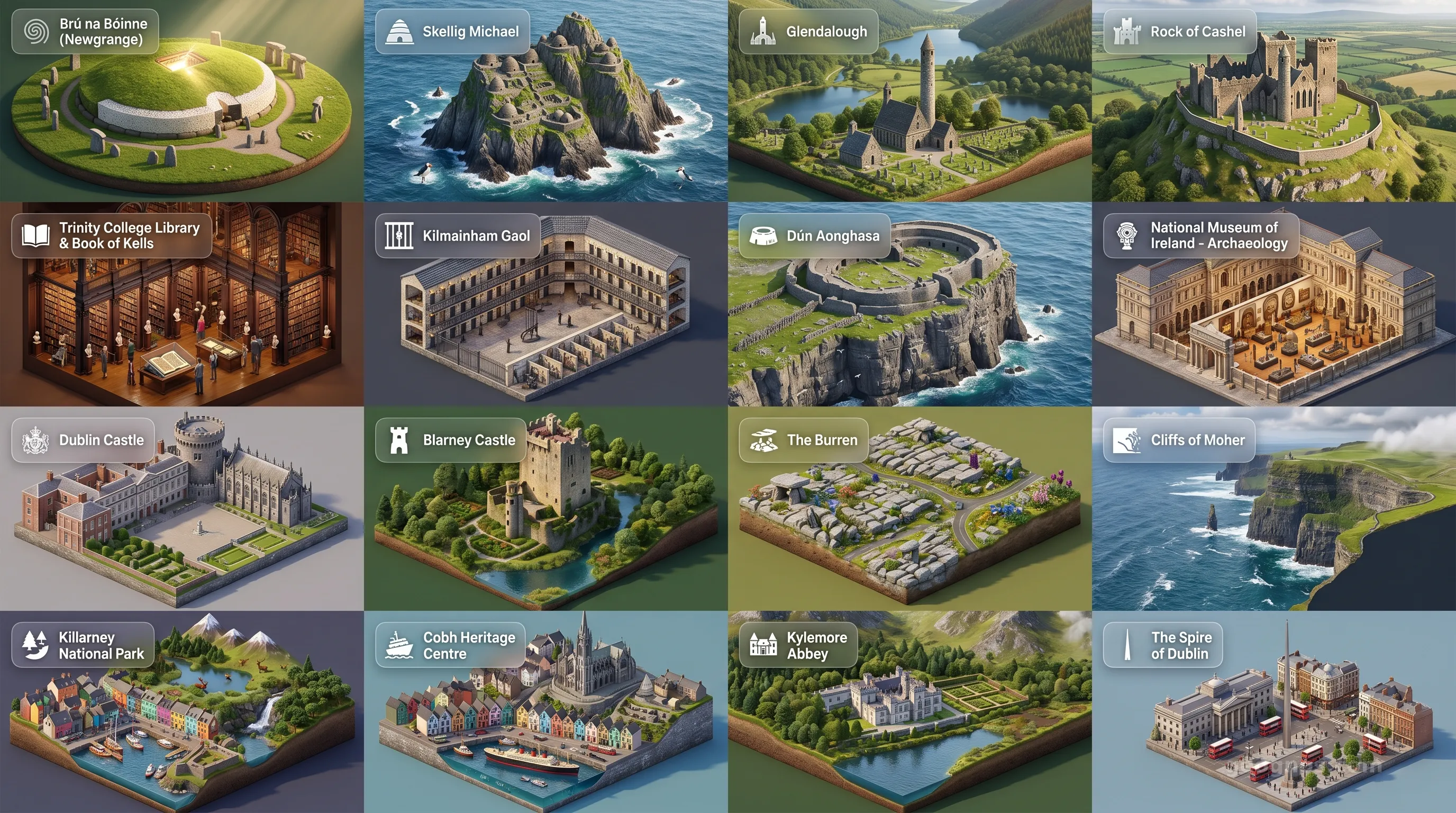
Older than Stonehenge and the Great Pyramids, this sprawling neolithic complex is the pinnacle of Ireland's ancient history. It offers an unparalleled opportunity to study prehistoric engineering, art, and astronomy through the mysterious passage tombs of Newgrange, Knowth, and Dowth, famous for their winter solstice alignment. Best visited in spring or autumn to avoid heavy crowds. Tourist tip: Access to the monuments is exclusively via guided tours from the visitor centre; book your tickets months in advance, especially if you wish to enter the lottery for the winter solstice illumination.
Isolated 6th-Century Monastic Settlement
A dramatic, jagged island jutting from the fierce Atlantic Ocean, home to an exceptionally well-preserved early Christian monastic settlement. Its stark isolation provides deep insights into the extreme asceticism and architectural ingenuity of early Irish monks who built beehive huts on sheer cliffs. Best visited between late May and September when sea conditions allow safe boat landings. Tourist tip: The ascent involves climbing 618 steep, ancient stone steps without handrails; wear sturdy footwear and book boat tours early, as environmental protections strictly cap daily visitor numbers.
Monastic City of the Two Lakes
Nestled in a glacially carved valley within the Wicklow Mountains, this early medieval monastic settlement was founded by St. Kevin in the 6th century. It features a spectacular round tower, ancient Celtic crosses, and ruined stone churches, serving as an outdoor classroom for Ireland's 'Golden Age' of saints and scholars. The surrounding landscape makes it perfect for geography and history enthusiasts alike. Best visited in autumn when the surrounding foliage erupts in vibrant colors. Tourist tip: Arrive early in the morning to enjoy serene, mist-covered lakeside walks before the main influx of tour buses.
Ancient Seat of the Kings of Munster
A spectacular cluster of medieval buildings set dramatically on a limestone outcrop in the Golden Vale. Once the traditional seat of the Kings of Munster, it holds immense political and religious importance, bridging the Celtic and medieval Christian eras. Students of architecture will marvel at the 12th-century Romanesque chapel and 13th-century Gothic cathedral. Best visited in late spring for lush, green surrounding views. Tourist tip: Make sure to secure a guided tour to view Cormac's Chapel, which houses Ireland's only surviving Romanesque frescoes, as access is restricted to preserve the art.
Historic Library and Illuminated Manuscript
An essential pilgrimage for literature, art, and history students. The library houses the magnificent Book of Kells, an illuminated gospel manuscript created by Celtic monks around 800 AD, renowned for its intricate knotwork. Upstairs, the breathtaking Long Room is a masterclass in architectural grandeur, filled with marble busts of great philosophers and 200,000 of the library's oldest books. Best visited in the colder months for a cozy, dark-academia atmosphere. Tourist tip: Book your timed-entry tickets online well in advance, and spend time wandering the broader cobbled squares of the historic university campus.
The Crucible of Irish Independence
No study of modern Irish history is complete without visiting this imposing former prison. Kilmainham Gaol held many of the most famous political and military leaders in Irish history, and it was the execution site of the leaders of the 1916 Easter Rising. The chilling, atmospheric Victorian architecture provides a visceral connection to the struggles for Irish independence. Best visited year-round, as the experience is entirely indoors. Tourist tip: Tickets are released 28 days in advance and sell out incredibly fast; plan ahead and prepare for an emotionally heavy but profoundly educational guided tour.
Prehistoric Clifftop Ring Fort
Perched precariously on a 100-meter sheer cliff edge on Inishmore (the largest of the Aran Islands), this magnificent Iron Age fort dates back over 3,000 years. It offers a fascinating study of ancient defense mechanisms, specifically its defensive 'chevaux de frise' (upright jagged stones). The island itself is a Gaeltacht (Irish-speaking) area, offering a deep dive into living Celtic culture. Best visited in summer for optimal cycling and weather conditions. Tourist tip: Rent a bicycle at the ferry port in Kilronan to reach the fort; beware of the sheer cliff edge at the site, as there are no safety barriers.
Treasury of Celtic and Viking Artifacts
This museum is the definitive repository of the nation's archaeological treasures, making it indispensable for students of history and anthropology. The exhibitions feature incredible Iron Age 'bog bodies' naturally preserved in peat, exquisite Celtic metalwork like the Ardagh Chalice and the Tara Brooch, and extensive Viking artifacts unearthed from Dublin. Best visited on a rainy afternoon in Dublin. Tourist tip: Admission is completely free. Don't miss the 'Kingship and Sacrifice' exhibition to see the fascinating, albeit eerie, bog bodies up close.
Historical Seat of British Rule
From 1204 until 1922, Dublin Castle was the fortified seat of British rule in Ireland. Today, it stands as a complex architectural mosaic, featuring the medieval Record Tower, subterranean Viking defenses, and the opulent State Apartments used for presidential inaugurations. It is a critical site for understanding the long, complex political relationship between Britain and Ireland. Best visited in early autumn. Tourist tip: Opt for the guided tour rather than the self-guided option, as it grants you access to the fascinating subterranean Viking excavation and the Chapel Royal.
Legendary Medieval Stronghold
Built nearly six hundred years ago by one of Ireland's greatest chieftains, Cormac MacCarthy, Blarney Castle is a quintessential medieval ruin. While world-famous for the Blarney Stone—which supposedly grants the 'gift of the gab' to those who kiss it—the site also offers expansive, meticulously themed gardens (including a Poison Garden) perfect for botanical studies and exploring Irish folklore. Best visited in late spring or summer when the gardens are in full bloom. Tourist tip: If you want to kiss the stone, arrive right when the castle opens to bypass the notoriously long queues that form along the castle's narrow spiral staircases.
Otherworldly Glaciated Karst Landscape
The Burren is a vast, lunar-like landscape of glaciated karst limestone. It is a world-class destination for geologists, botanists, and ecologists due to its unique ecosystem where Arctic, Alpine, and Mediterranean flora mysteriously grow side-by-side in the rock fissures (grikes). It is also dotted with megalithic tombs like the Poulnabrone Dolmen. Best visited in May, when the unique wildflowers are at their peak blooming season. Tourist tip: Visit the Burren Centre in Kilfenora first for crucial ecological context, and wear sturdy, flat shoes, as the limestone pavements are highly uneven and slippery when wet.
Iconic Ocean Cliffs
Rising 214 meters above the crashing Atlantic Ocean and stretching for 8 kilometers, the Cliffs of Moher are Ireland's most famous natural attraction. They offer a breathtaking lesson in coastal erosion, geology, and ornithology, housing significant colonies of nesting seabirds, including Atlantic Puffins. Best visited in late spring or summer during the evening to catch spectacular sunsets over the Aran Islands. Tourist tip: Skip the crowded central visitor center viewpoint and hike the cliff path from Doolin for a more rugged, tranquil, and rewarding experience.
Lakes, Mountains, and Ancient Woodlands
Ireland's first national park is a stunning expanse of rugged mountains, pristine lakes, and the last surviving indigenous oak and yew woodlands in the country. It is a haven for environmental studies and history, featuring the 15th-century Ross Castle and the elegant Muckross House. The park's diverse habitats support the country's only remaining wild herd of native red deer. Best visited in early autumn during the deer rutting season. Tourist tip: Rent a bike to explore the expansive trails, or hire a traditional 'jaunting car' (horse-drawn carriage) for a historic mode of transport through the Gap of Dunloe.
The Departure Point for Millions
Located in a beautifully restored Victorian railway station, this center details the heart-wrenching history of Irish emigration. Cobh (formerly Queenstown) was the departure point for 2.5 million Irish people fleeing famine and poverty, as well as the final port of call for the RMS Titanic. It provides an essential genealogical and historical perspective on the Irish diaspora. Best visited year-round. Tourist tip: Combine your visit with a walk up the steep, colorful streets to the magnificent St. Colman's Cathedral for panoramic views of the world's second-largest natural harbor.
Neo-Gothic Castle by the Lake
Set dramatically against the mountains of Connemara and reflecting perfectly in a glass-like lake, Kylemore Abbey is a striking neo-Gothic estate turned Benedictine monastery. It offers insights into 19th-century aristocratic life, Victorian walled gardening, and the resilience of the Benedictine nuns who fled Belgium during WWI. Best visited in summer to fully enjoy the expansive Victorian Walled Gardens. Tourist tip: Take the shuttle bus from the abbey to the walled gardens, but walk the scenic woodland trail back to fully appreciate the tranquility of the estate.
Premier Collection of Irish and European Art
Housing the national collection of Irish and European fine art, this gallery is a must-visit for art historians and culture lovers. It spans works from the 14th to the 20th century, boasting masterpieces by Caravaggio, Vermeer, and an extensive collection of works by Jack B. Yeats, offering a visual journey through Ireland's shifting cultural identity. Best visited during weekdays for a quiet, contemplative experience. Tourist tip: General admission is free. Make sure to seek out Caravaggio's 'The Taking of Christ', a masterpiece that hung unrecognized in a Dublin Jesuit house until the 1990s.