Nicaragua
Top Sights & Landmarks
Nicaragua's First Capital
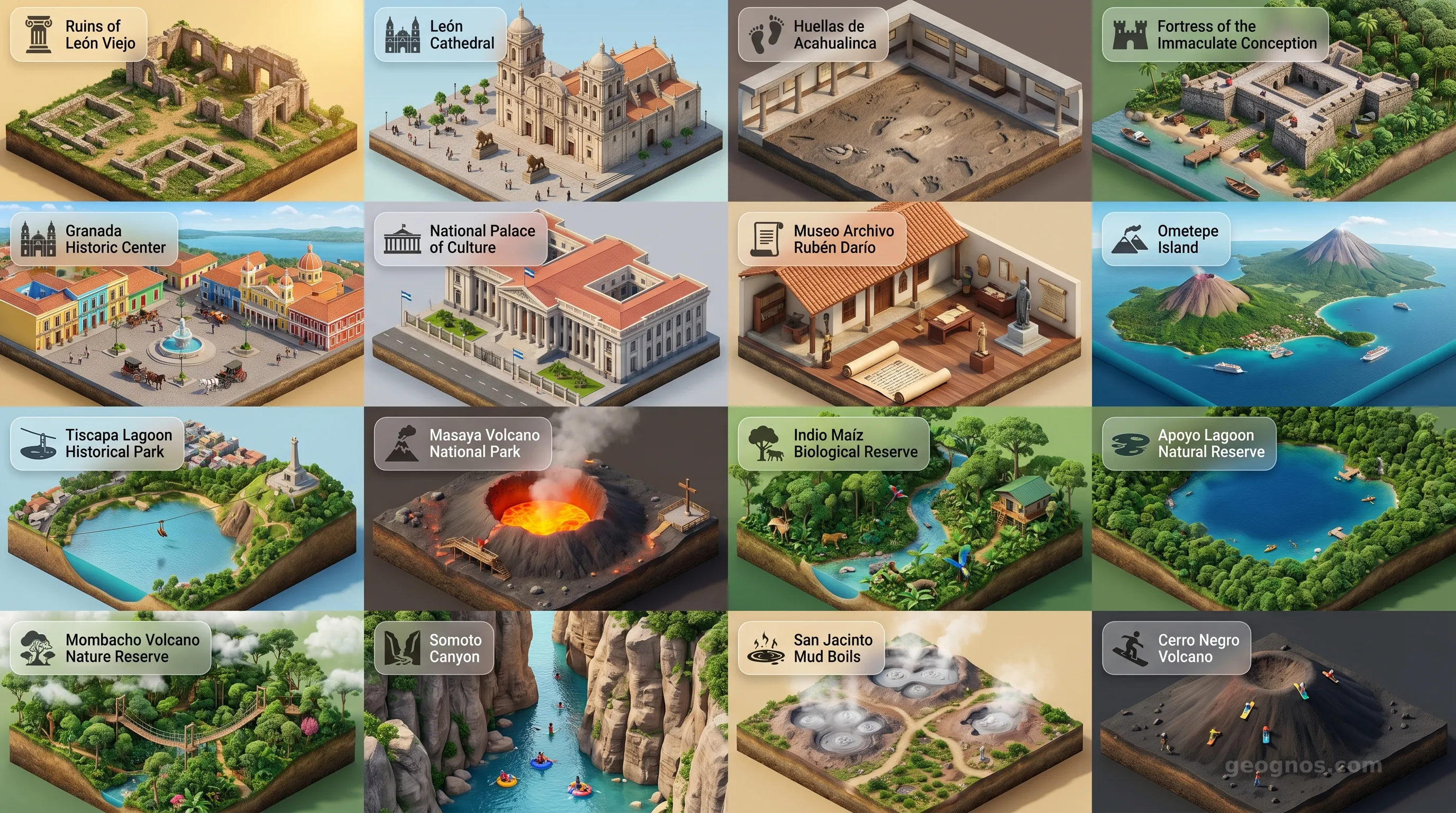
Historically significant as one of the oldest Spanish colonial settlements in the Americas, León Viejo was founded in 1524 but tragically abandoned in 1610 following a series of devastating earthquakes and eruptions from the Momotombo volcano. For students of archaeology and colonial history, it offers an unfiltered glimpse into 16th-century Spanish urban planning, as the ruins were never built over. The site provides a profound educational experience regarding the catastrophic forces of nature that shaped Nicaraguan history. The best season to visit is the dry season from December to April. Tourist tip: Hire an on-site local guide to truly bring the excavated foundations to life, and bring sun protection as the site offers very little shade.
Largest Cathedral in Central America
The Cathedral of the Assumption of Mary in León is an architectural masterpiece that seamlessly blends Baroque and Neoclassical styles. Built between 1747 and 1814, it holds immense cultural weight as the final resting place of revered poet Rubén Darío and other prominent Nicaraguan figures. It is a vital study site for ecclesiastical architecture and Latin American literary history. A major highlight is walking on the cathedral's brilliant white rooftop, which offers breathtaking, panoramic views of the city's red-tile roofs and surrounding volcanoes. The ideal time to visit is from November to April. Tourist tip: You must remove your shoes to walk on the pristine white roof, so bring a pair of thick socks to protect your feet from the hot sun.
Ancient Footprints in Volcanic Mud
Discovered in Managua, the Footprints of Acahualinca are fossilized tracks left by a group of Paleo-Indians roughly 6,000 years ago as they walked toward Lake Managua. Preserved perfectly in volcanic ash and mud, they are among the oldest and most significant evidence of prehistoric human existence in the Americas. Anthropology and archaeology students will find immense value in studying the ancient migration patterns preserved here. The accompanying museum houses artifacts from various pre-Columbian sites. It is accessible year-round. Tourist tip: Check ahead to ensure the museum is fully open, as it periodically undergoes preservation maintenance to protect the delicate tracks from erosion.
Colonial Pirate Defense on the River
Situated in the remote village of El Castillo along the Río San Juan, this formidable Spanish fortress was completed in 1675 to defend Granada from pirate attacks and British invasions coming from the Caribbean Sea. It is famously the site where a young Horatio Nelson fought in 1780. History enthusiasts will be captivated by the strategic military architecture and the tales of Rafaela Herrera, a 19-year-old heroine who successfully defended the fort. The dry season (February to May) is optimal for avoiding heavy tropical downpours. Tourist tip: Access to El Castillo is strictly by boat from San Carlos; enjoy the scenic river journey and look out for caimans and howler monkeys along the banks.
The Oldest Colonial City on Mainland America
Founded in 1524 by Francisco Hernández de Córdoba, Granada is the crown jewel of Nicaraguan colonial architecture. Its cobblestone streets, brightly painted homes, and ornate courtyards have survived centuries of pirate attacks and the infamous burning by American filibuster William Walker in 1856. Today, it stands as a living museum of colonial and post-colonial resilience. It is an essential stop for anyone studying the economic and political history of Central America. Best visited between November and May. Tourist tip: Climb the bell tower of the Iglesia de La Merced at sunset for the most spectacular golden-hour view of the city and the nearby Mombacho Volcano.
Heart of Nicaraguan Heritage
Located in Managua's Plaza de la Revolución, the National Palace of Culture is one of the few buildings to survive the devastating 1972 earthquake. Originally serving as the governmental seat for the Somoza dynasty, it was famously seized by Sandinista rebels in 1978. Today, it houses the National Museum, offering extensive exhibits on paleontology, pre-Columbian ceramics, and national art. It is a critical center for studying Nicaragua's complex sociopolitical evolution. Available for visits year-round. Tourist tip: Combine this visit with the nearby Old Cathedral of Managua to fully grasp the impact of the 1972 earthquake on the capital's historic core.
Birthplace of Literary Modernism
Located in the historic city of León, this museum is situated in the childhood home of Rubén Darío, the undisputed 'Prince of Castilian Letters' and founder of the Spanish-language literary movement known as Modernismo. The museum preserves his personal artifacts, original manuscripts, and period furnishings, offering profound insights into the mind of a poet who transformed Latin American literature in the late 19th and early 20th centuries. Literature students will find this site incredibly inspiring. Accessible year-round. Tourist tip: Read a few translated poems of Darío, such as 'Margarita, está linda la mar', prior to visiting to fully appreciate the cultural reverence the local guides have for him.
Island of Twin Volcanoes
Rising majestically from Lake Nicaragua, Ometepe is formed by two towering volcanoes, Concepción and Maderas. This UNESCO Biosphere Reserve is culturally invaluable for its ancient pre-Columbian petroglyphs and stone statues scattered across the island, evidence of early indigenous tribes who considered the island a sacred promised land. It is an exceptional destination for eco-tourists and anthropologists alike. The dry season (December to April) provides the best conditions for hiking and exploring. Tourist tip: Rent a scooter or a rugged dirt bike to navigate the island's unpaved roads, and do not miss the chance to swim in the cool, crystal-clear waters of Ojo de Agua.
Iconic Sandino Monument over a Crater Lake
Overlooking the capital city of Managua, the Tiscapa Lagoon is a tranquil crater lake with a dark and intense history. The rim was the site of the Somoza family's presidential palace and infamous subterranean torture prisons. Today, it is crowned by the massive, iconic black silhouette statue of revolutionary hero Augusto C. Sandino, visible from almost anywhere in the city. It offers a poignant educational experience regarding Nicaragua's turbulent 20th-century political struggles and revolutions. Year-round access. Tourist tip: Take the canopy zipline that runs directly over the lagoon for an exhilarating blend of history and adventure.
The Mouth of Hell
Masaya is one of the most accessible active volcanoes on earth, where visitors can drive directly to the rim of the Santiago crater and peer into a churning lake of molten lava. Historically, indigenous people offered sacrifices to the volcano, and Spanish friars, believing it to be the entrance to hell, erected 'La Cruz de Bobadilla' on its edge to exorcise the devil. It is an unparalleled site for geological study. The experience is best during the dry season. Tourist tip: Visit at sunset and stay until dark for the famous night tour, when the glowing magma and sulfurous plumes create an unforgettable, otherworldly spectacle.
Untamed Pristine Rainforest
Often referred to as the 'gem of Central American nature reserves', Indio Maíz contains more species of trees, birds, and insects than all of Europe combined. Historically and culturally, it overlaps with the autonomous territory of the indigenous Rama people and Afro-descendant communities. For biology students and serious eco-tourists, it is a masterclass in biodiversity, home to jaguars, harpy eagles, and manatees. The 'dry' season (February to April) is the most manageable time to visit, though rain is always possible. Tourist tip: You must hire a local Rama or Rama-Kriol guide from the town of El Castillo or San Juan del Norte to enter the reserve; their tracking skills are phenomenal.
Ancient Sapphire Crater Lake
Formed over 20,000 years ago by a massive volcanic explosion, Laguna de Apoyo is a deep crater lake renowned for its pristine, thermally heated, mineral-rich waters. It is an isolated ecosystem boasting several endemic species of cichlid fish, making it a fascinating subject for evolutionary biologists. Culturally, indigenous artifacts have been found along its shores. It is an idyllic spot for swimming, kayaking, and relaxing in nature. Visit anytime, but the skies are clearest from December to March. Tourist tip: Access the lagoon through one of the many eco-lodges that offer day passes, which usually include kayaks, inner tubes, and a comfortable spot to lounge by the water.
Mystical Cloud Forest Above Granada
Standing guard over the city of Granada, the dormant Mombacho Volcano is draped in a dense, mystical cloud forest that contrasts sharply with the dry tropical plains below. It is an ecological island supporting unique flora and fauna, including the endemic Mombacho salamander. The lower slopes are historically significant for coffee production, introduced in the 19th century. Environmental science students will appreciate the stark microclimate shifts. Ideal to visit from November to April. Tourist tip: The drive up is incredibly steep; use the reserve's official transport trucks. Bring a light jacket, as the summit is surprisingly cool and often blanketed in mist.
A Geological Wonder in the North
Though locals have known about it for centuries, the spectacular Somoto Canyon was 'discovered' by international scientists only in 2004. Carved over millions of years by the Coco River, the canyon features towering vertical rock walls that reach up to 100 meters high. It offers an incredible field study of water erosion and geological strata for science students. Today, it is a premier destination for canyoning—swimming, hiking, and jumping through the narrow gorges. Best visited during the dry season (December to May) to avoid dangerous flash floods. Tourist tip: Wear sturdy water shoes and be prepared to swim for extended periods; waterproof bags for cameras are absolutely essential.
Geothermal Vents of the Telica Volcano
Located a short drive from León, the Hervideros de San Jacinto are a field of violently bubbling mud pits and steaming fumaroles connected to the underlying magma of the nearby Telica Volcano. This geothermal field acts as 'breathing holes' for the volcanoes, preventing larger eruptions. It is a fantastic, accessible location for learning about geothermal energy and volcanology. Local children often act as informal guides, throwing stones into the mud to demonstrate the heat. Best to visit year-round in the early morning. Tourist tip: Stay strictly on the designated pathways; the crust around the mud boils is thin and the underlying mud is boiling hot.
The Youngest Volcano in Central America
Born in 1850, Cerro Negro is an extraordinary geological phenomenon characterized by its completely barren, jet-black slopes of loose volcanic scree. It is one of the most active volcanoes in Nicaragua. For thrill-seekers and extreme sports enthusiasts, it is globally famous as the birthplace of 'volcano boarding'—sliding down the 45-degree slope on a wooden sled at speeds up to 50 mph. The stark contrast between the black ash and surrounding green landscape makes it visually stunning. Dry season is best for boarding. Tourist tip: You will get intensely dirty. Wear closed-toe shoes, use the provided protective jumpsuit and goggles, and keep your mouth shut on the way down!