Costa Rica
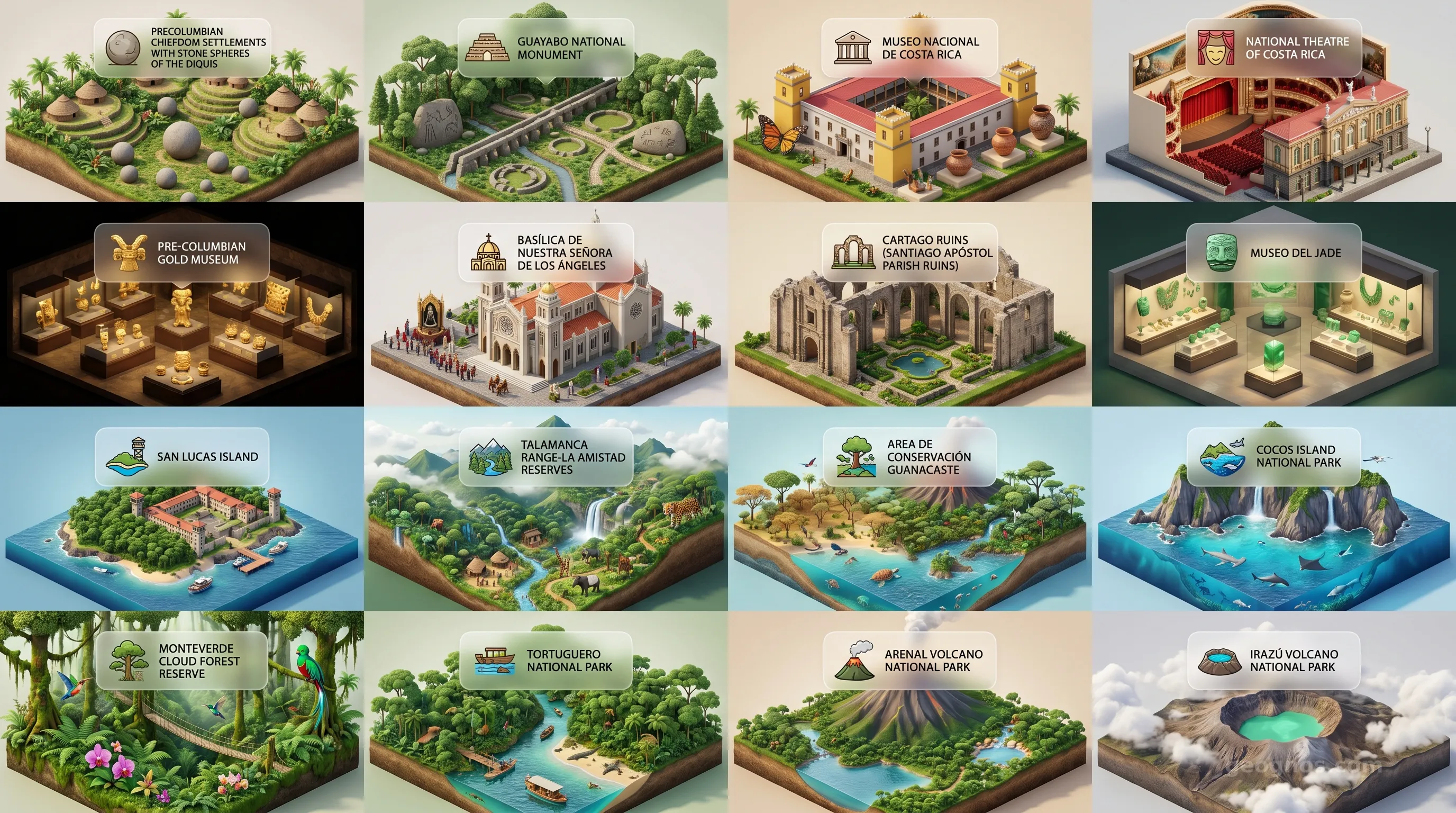
Top Sights & Landmarks
Ancient Stone Spheres
This incredible archaeological site features the enigmatic petrospheres (stone spheres) of the Diquís culture, dating back to 500-1500 AD. For history students and archaeologists, it offers invaluable insights into the complex social, economic, and political systems of pre-Columbian chiefdoms. The perfection of the spheres remains a subject of intense academic study. The best time to visit is during the dry season (December to April) to explore the Finca 6 museum and grounds comfortably. Tourist tip: Hire a local guide to fully appreciate the astronomical and cultural theories surrounding these ancient marvels.
Largest Ancient Ruin
As Costa Rica's largest and most important archaeological site, Guayabo was a major cultural and political center between 1000 BC and 1400 AD. It is celebrated as a milestone of ancient civil engineering, featuring functioning aqueducts, stone-paved streets, and intricate petroglyphs. It provides an exceptional educational experience for engineering and anthropology students. Visit during the dry season (January-April) for accessible trails. Tourist tip: The site limits daily visitors to protect the ruins, so arrive early in the morning and bring binoculars to spot toucans and sloths in the surrounding forest.
National History Hub
Housed in the bright yellow Bellavista Fortress, this museum is the epicenter of Costa Rican history. The building itself is a historical marvel; its walls still bear bullet holes from the 1948 civil war. Most importantly, it is the exact location where José Figueres Ferrer abolished the national army in 1948, a defining moment in Costa Rica's peaceful modern identity. Inside, students can study extensive exhibits ranging from pre-Columbian artifacts to modern history. Open year-round, it includes a beautiful butterfly garden. Tourist tip: Don't miss the panoramic views of San José from the fortress towers.
Architectural Crown Jewel
Constructed in 1897 and funded by a tax on coffee exports, the Teatro Nacional is a testament to the nation's late 19th-century economic boom and cultural aspirations. Featuring exquisite Neoclassical architecture, Italian marble, and the famous mural 'Allegory of Coffee and Bananas', it is a premier study subject for architecture and art history students. Located in the heart of San José, it is accessible year-round. Tourist tip: Even if you don't attend a performance, take the guided daytime tour and enjoy a gourmet coffee at the opulent on-site café.
Ancient Gold Craftsmanship
Located in a fascinating subterranean complex beneath the Plaza de la Cultura, this museum houses an extraordinary collection of over 1,600 pre-Columbian gold artifacts dating from 500 to 1500 AD. It provides vital context regarding the spiritual beliefs, social hierarchies, and metallurgical techniques of Costa Rica's indigenous peoples. It is a fantastic year-round destination, perfect for rainy afternoons in San José. Tourist tip: The complex also houses the Numismatic Museum; a combined ticket offers a deep dive into the evolution of Costa Rican currency.
Spiritual Center of Costa Rica
This stunning Byzantine-style basilica in Cartago is the spiritual heart of Costa Rica. It houses 'La Negrita', a small black statue of the Virgin Mary discovered in 1635 by an indigenous girl. Historically and culturally, it is paramount; every August 2nd, over two million people participate in a nationwide pilgrimage to the basilica. For cultural anthropology students, observing this devotion is profound. Open year-round. Tourist tip: Dress modestly when visiting, and be sure to visit the holy water spring located beneath the church, which locals believe has healing properties.
Unfinished Colonial Ruins
Located in the former capital city of Cartago, these hauntingly beautiful ruins are not actually an ancient structure, but the remains of a Romanesque church whose construction was repeatedly halted by earthquakes, finally being abandoned after the devastating Santa Marta earthquake of 1910. The site serves as a poignant reminder of Costa Rica's volatile tectonic geography and its impact on colonial and modern history. The interior has been transformed into a tranquil botanical garden. Tourist tip: A quick, highly photogenic stop; combine it with a visit to the nearby Basílica.
World's Largest Jade Collection
Housed in a striking modern building designed to look like a raw block of jade, this museum boasts the largest collection of pre-Columbian jade artifacts in the world (over 7,000 pieces). It highlights the importance of jade as a symbol of status and mysticism, often considered more valuable than gold by Mesoamerican cultures. The interactive exhibits make it highly engaging for students of archaeology and history. Tourist tip: Allocate at least two hours to explore all five floors. It is centrally located in San José, making it an easy walk from the National Museum.
Costa Rica's Alcatraz
Operating as a brutal penal colony from 1873 to 1991, San Lucas Island holds a dark but significant place in Costa Rican history. It gained literary fame through the novel 'The Island of Lonely Men' by former inmate José León Sánchez. Today, it is a National Park where visitors can explore the haunting cell blocks covered in historical graffiti alongside recovering native wildlife. Perfect for history and criminology students. Tourist tip: Access is via boat from Puntarenas. Hire a knowledgeable guide to translate the historical graffiti and share the harrowing tales of the prison's past.
Transboundary Conservation
Shared with Panama, this massive reserve is a cultural and ecological powerhouse. It protects the largest tracts of virgin cloud forest in Central America and is the ancestral home to four indigenous tribes (including the Bribri and Cabécar). It is a living laboratory for biology, ecology, and anthropology students. Due to its rugged terrain, it is best visited in the dry season (Jan-April). Tourist tip: This is a remote and wild area. Guided tours are strictly necessary for deep exploration; consider visiting an indigenous community for an authentic cultural exchange.
Historic Dry Forest
This area is crucial for both its ecological achievement—restoring the endangered tropical dry forest—and its historical significance. It encompasses Santa Rosa National Park, the site of the famous 1856 Battle of Santa Rosa where a Costa Rican militia defeated the American filibuster William Walker, defending the nation's sovereignty. Students of both history and environmental science will find this site incredibly rich. Tourist tip: Visit La Casona, the historical hacienda where the battle took place, which now serves as an excellent museum. The dry season (Dec-April) ensures the roads are fully passable.
Pirate Lore and Sharks
Located 550 km off the Pacific coast, Cocos Island is steeped in legends of hidden pirate treasures (including the fabled Treasure of Lima). Today, its true treasure is its marine biodiversity, famously inspiring Michael Crichton's 'Jurassic Park'. It is a globally significant site for marine biology students studying pelagic species like scalloped hammerhead sharks. Tourist tip: Accessible only by liveaboard dive boats, this is an expensive, multi-day expedition strictly for advanced scuba divers. The rainy season (June-November) brings the largest schools of hammerheads.
Pioneer of Ecotourism
Founded in the 1950s by American Quakers avoiding the Korean War draft, Monteverde represents the birth of Costa Rica's globally renowned ecotourism and conservation movement. The unique atmospheric conditions create a rare cloud forest ecosystem, home to the elusive Resplendent Quetzal and thousands of orchid species. It is a premier destination for ecological studies. Can be visited year-round, though the dry season offers clearer trails. Tourist tip: Bring layers; the high elevation means it is cooler and perpetually misty. Night tours offer incredible opportunities to see nocturnal wildlife.
The Amazon of Costa Rica
Historically pivotal in the world of marine conservation, Tortuguero was the research base of Dr. Archie Carr, who spearheaded global sea turtle protection efforts in the 1950s. The park's vast network of navigable canals provides an extraordinary setting to study wetland ecosystems. Visit between July and October to witness the unforgettable Green Sea Turtle nesting season. Tourist tip: The park is accessible only by boat or small plane. Pack high-quality rain gear, as the Caribbean coast receives heavy rainfall year-round, ensuring its lush, vibrant ecosystem.
Iconic Stratovolcano
Arenal dramatically reshaped Costa Rica's economy and tourism industry following its unexpected, massive eruption in 1968, which wiped out the towns of Tabacón and Pueblo Nuevo. While it entered a resting phase in 2010, its perfect conical shape and surrounding geothermal hot springs make it a geological marvel. It offers an excellent case study on the socio-economic impacts of volcanism. Visit in the dry season for the best chance of clear volcano views. Tourist tip: Hike the 1968 Lava Flow trail to walk directly over the cooled magma rocks, then relax in the naturally heated river resorts.
Highest Volcano View
At 3,432 meters, Irazú is Costa Rica's highest volcano. It famously erupted in 1963 on the exact day U.S. President John F. Kennedy visited the country, blanketing the Central Valley in ash and significantly affecting local agriculture and infrastructure. The stark, lunar-like landscape at the summit provides an otherworldly experience for geology enthusiasts. On a clear day, visitors can see both the Pacific and Atlantic oceans. Tourist tip: Arrive as early as possible (the park opens at 8 AM) before the clouds roll in to obscure the crater and the ocean views. Dress warmly.