Panama
Top Sights & Landmarks
First European Settlement on the Pacific
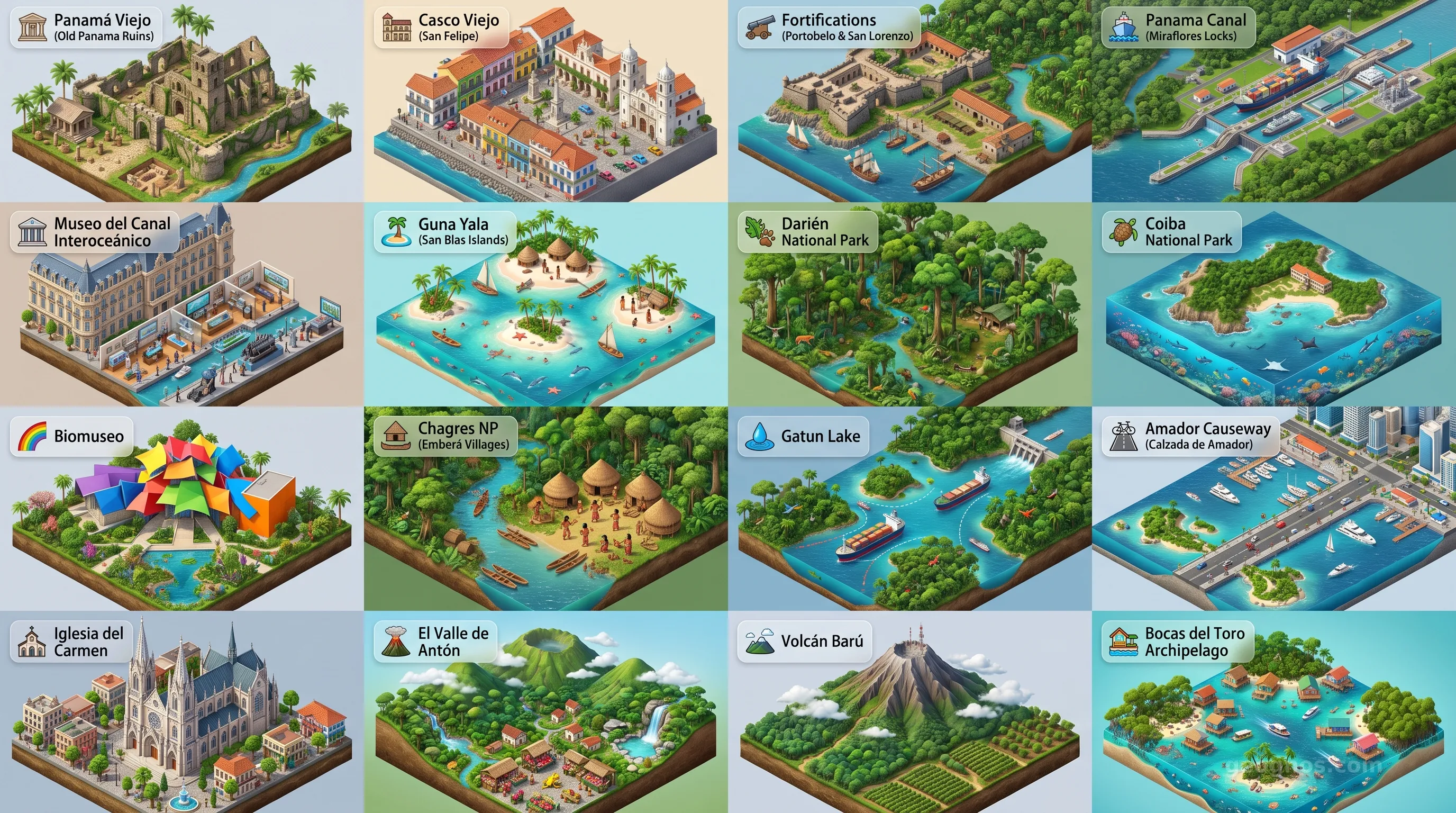
Founded in 1519 by Pedro Arias Dávila, Panamá Viejo is the oldest European settlement on the Pacific coast of the Americas. It served as the crucial starting point for expeditions that conquered the Inca Empire and was a vital node in the Spanish silver trade route. The city was tragically destroyed in 1671 by the infamous Welsh privateer Captain Henry Morgan. Today, it offers unparalleled educational value for history students analyzing Spanish colonial trade networks. The best time to visit is during the dry season (mid-December to mid-April) to explore the ruins comfortably. Tourist tip: Climb the restored cathedral tower for a spectacular panoramic view contrasting the 16th-century ruins against Panama City's modern skyline.
Panama City's Historic Heart
Established in 1673 following the destruction of Panamá Viejo, Casco Viejo was built on a peninsula completely surrounded by a protective wall. It boasts a beautiful fusion of Spanish, French, and early American architectural styles, reflecting the various eras of Panamanian history, including the French attempt to build the canal. The district is rich in cultural heritage, housing the Presidential Palace and the Metropolitan Cathedral. It's a living classroom for architecture and urban planning students. Visit year-round, but late afternoons offer the best lighting for photography and a cooler climate for walking. Tourist tip: Try the local Geisha coffee in one of the neighborhood's boutique cafes, renowned as some of the world's most premium coffee.
Colonial Caribbean Defense Network
These magnificent 17th- and 18th-century military fortifications were built by the Spanish Crown to protect transatlantic trade routes from pirates and privateers. Portobelo was the site of the famous trade fairs where Peruvian silver was exchanged for European goods. The ruins stand as a monumental testament to colonial military architecture and global economic history. Students of military history will marvel at the strategic placements of the cannons and bastion designs. The dry season (January to April) is optimal, as the Caribbean coast receives heavy rainfall the rest of the year. Tourist tip: Combine your historical tour of Portobelo with a visit to the nearby pristine Caribbean beaches, accessible via short boat rides.
The Marvel of Modern Engineering
Opened in 1914, the Panama Canal revolutionized global trade and travel by connecting the Atlantic and Pacific Oceans. The Miraflores Locks offer the most accessible and dramatic viewpoint of this engineering marvel in action. The on-site visitor center is an educational treasure trove, detailing the tragic and triumphant history of the canal's construction, the eradication of yellow fever, and the monumental effort of the laborers. It is essential viewing for engineering and history students alike. The site is spectacular year-round. Tourist tip: Time your visit between 9:00 AM - 11:00 AM or 3:00 PM - 5:00 PM to ensure you witness massive cargo ships transiting the locks.
Chronicle of the Interoceanic Passage
Located in a stunningly restored 1874 building in Casco Viejo that originally served as the headquarters for the French canal company (and later the US Isthmian Canal Commission), this museum provides a deep, comprehensive dive into the sociopolitical, economic, and engineering history of the Panama Canal. It is arguably the most culturally significant museum in the country, detailing not just the canal's construction, but Panama's struggle for sovereignty. The museum is a must-visit for political science and history students. Open year-round. Tourist tip: While most exhibits are in Spanish, the museum offers excellent English audio guides that are highly recommended for non-Spanish speakers.
Indigenous Autonomy and Pristine Archipelagos
Comprising 365 islands in the Caribbean Sea, Guna Yala is a semi-autonomous region governed by the indigenous Guna people. The region is culturally profound, offering a rare glimpse into a society that has fiercely and successfully protected its traditions, language, and environment from modern homogenization. The famous 'mola' textiles, characterized by intricate reverse-appliqué, are crafted here. Students of anthropology will find the matriarchal societal structure fascinating. The best time to visit is during the dry, windy season (January to April). Tourist tip: Respect local customs; always ask for permission before taking photographs of the Guna people, and bring cash as ATMs are non-existent.
The Impenetrable Wilderness
As the largest national park in Panama and the natural land bridge connecting North and South America, the Darién is a UNESCO World Heritage site and Biosphere Reserve of staggering ecological and anthropological significance. It contains diverse habitats—from sandy beaches to premontane tropical forests—and is home to indigenous communities like the Emberá and Wounaan. Its history as the 'Darién Gap' makes it an unparalleled case study for ecology and geography students. Due to its extreme remoteness, it should only be visited with certified, specialized guides during the dry season (December to April). Tourist tip: Prepare for an intense, rugged expedition; this is a destination for serious eco-adventurers, not casual tourists.
The Galapagos of Central America
Once an infamous penal colony (which inadvertently protected its environment from development), Coiba is now a pristine marine reserve and UNESCO World Heritage site. Because the island was isolated for thousands of years, it harbors endemic species of fauna and serves as a vital refuge for crested eagles and scarlet macaws. Its surrounding waters protect the second-largest coral reef in the Eastern Pacific. It is a premier destination for marine biology students. The dry season (January to April) offers the best visibility for diving. Tourist tip: Book a multi-day scuba or snorkeling tour from Santa Catalina to experience the incredible migrations of whale sharks and humpback whales.
The Bridge of Life
Designed by world-renowned architect Frank Gehry (his only work in Latin America), the Biomuseo's striking, vibrantly colored, crumpled-metal canopy stands out on the Amador Causeway. The museum's core educational narrative focuses on the Isthmus of Panama's emergence from the ocean 3 million years ago—a geological event that changed global climate patterns and triggered the Great American Biotic Interchange. It's a phenomenal resource for geology, ecology, and biology students. It's a perfect year-round indoor activity. Tourist tip: Step outside to the botanical garden surrounding the museum, which is free to the public and offers stunning views of the Panama City skyline and the canal entrance.
Living Indigenous Culture in the Rainforest
Chagres National Park was created to protect the watershed of the Chagres River, which is the primary source of water for the Panama Canal. Within this lush rainforest live communities of the Emberá indigenous people, who migrated from the Darién region. Visiting an Emberá village offers an immersive cultural exchange where tourists and anthropology students can learn about traditional plant medicine, music, and body painting (jagua). The park is accessible year-round, though the river journey is more thrilling during the green season (May to November). Tourist tip: Buy traditional woven baskets or wood carvings directly from the artisans here; it supports the community and ensures authenticity.
The Artificial Lake that Changed the World
Created between 1907 and 1913 by the damming of the Chagres River, Gatun Lake was the largest artificial lake in the world at the time of its creation. It forms a major part of the Panama Canal, carrying ships 33 kilometers of their transit across the Isthmus. The lake is also an ecological haven; former hilltops became isolated islands (like the famous Barro Colorado Island, managed by the Smithsonian), creating unique, undisturbed ecosystems ideal for biological study. Visit year-round for eco-tours. Tourist tip: Take a small boat 'jungle tour' on the lake; you'll get incredibly close to massive Panamax cargo ships while spotting monkeys, sloths, and crocodiles on the shorelines.
A Gateway Forged from the Canal
The Amador Causeway is a picturesque 6-kilometer road connecting the mainland to four small islands in the Pacific Ocean. Historically significant, it was built using rock extracted from the Culebra Cut during the Panama Canal's construction and served as an American military defense site. Today, it is Panama City’s favorite recreational zone, lined with bike paths, restaurants, and marinas. Urban planners and history students can observe the transformation of military infrastructure into public space. Sunset is the best time to visit year-round. Tourist tip: Rent a bicycle or a surrey (multi-person bike) to ride the length of the causeway for the best views of ships waiting to enter the canal.
Gothic Revival Masterpiece in a Modern City
Standing in stark contrast to the modern glass skyscrapers of Panama City's financial district, the Iglesia del Carmen is the most beautiful church in the country. Built in the 20th century, its architecture mimics the grand Gothic style of the Middle Ages, featuring towering twin spires, stunning stained glass windows, and intricate stone carvings. It serves as an architectural anomaly and a focal point for the nation's strong Catholic heritage. It provides excellent study material for architecture students analyzing Gothic Revivalism. Open year-round. Tourist tip: Visit during the late afternoon to see the sunlight beautifully illuminate the interior through the grand stained glass windows.
Town Inside a Volcanic Crater
El Valle de Antón is a uniquely situated town nestled entirely within the caldera of an extinct volcano, the largest continuously inhabited volcanic crater in the world. It holds great cultural importance due to the ancient pre-Columbian petroglyphs (La Piedra Pintada) found in the surrounding hills. Its rich volcanic soil creates a lush microclimate, perfect for botany students studying cloud forest flora, including the rare golden frog (now mostly found in conservation centers). The climate is comfortably cool year-round. Tourist tip: Visit the Sunday artisan market for authentic local handicrafts, and hike the 'India Dormida' trail for a spectacular sunrise view over the crater.
The Roof of Panama
At 3,474 meters (11,398 feet), Volcán Barú is the highest peak in Panama and a dormant stratovolcano. It holds unique geological and geographical prestige: on a clear day, hikers at the summit can see both the Pacific Ocean and the Caribbean Sea simultaneously. The dramatic volcanic history has created highly fertile soils in the surrounding Chiriquí province, driving Panama's world-class coffee industry. Geology and ecology students will find the changing biomes at varying altitudes fascinating. The dry season (December to April) provides the clearest skies. Tourist tip: The hike is grueling; start at midnight from the town of Boquete to reach the summit just in time for an unforgettable sunrise.
Afro-Caribbean Culture meets Island Ecology
This stunning archipelago near the Costa Rican border is characterized by dense rainforests meeting crystal-clear Caribbean waters. Historically, it was visited by Christopher Columbus in 1502 and later became a hub for the United Fruit Company. Today, its culture is a vibrant mix of Afro-Caribbean, indigenous Ngäbe, and expatriate influences. The region is a vital living laboratory for biology students, particularly for studying mangrove ecosystems and poison dart frog evolution. It has its own microclimate; September and October are surprisingly the driest and best months to visit. Tourist tip: Take water taxis to remote areas like Starfish Beach or Zapatilla Cays for a pristine, less crowded experience.