Ecuador
Top Sights & Landmarks
The First UNESCO World Heritage City
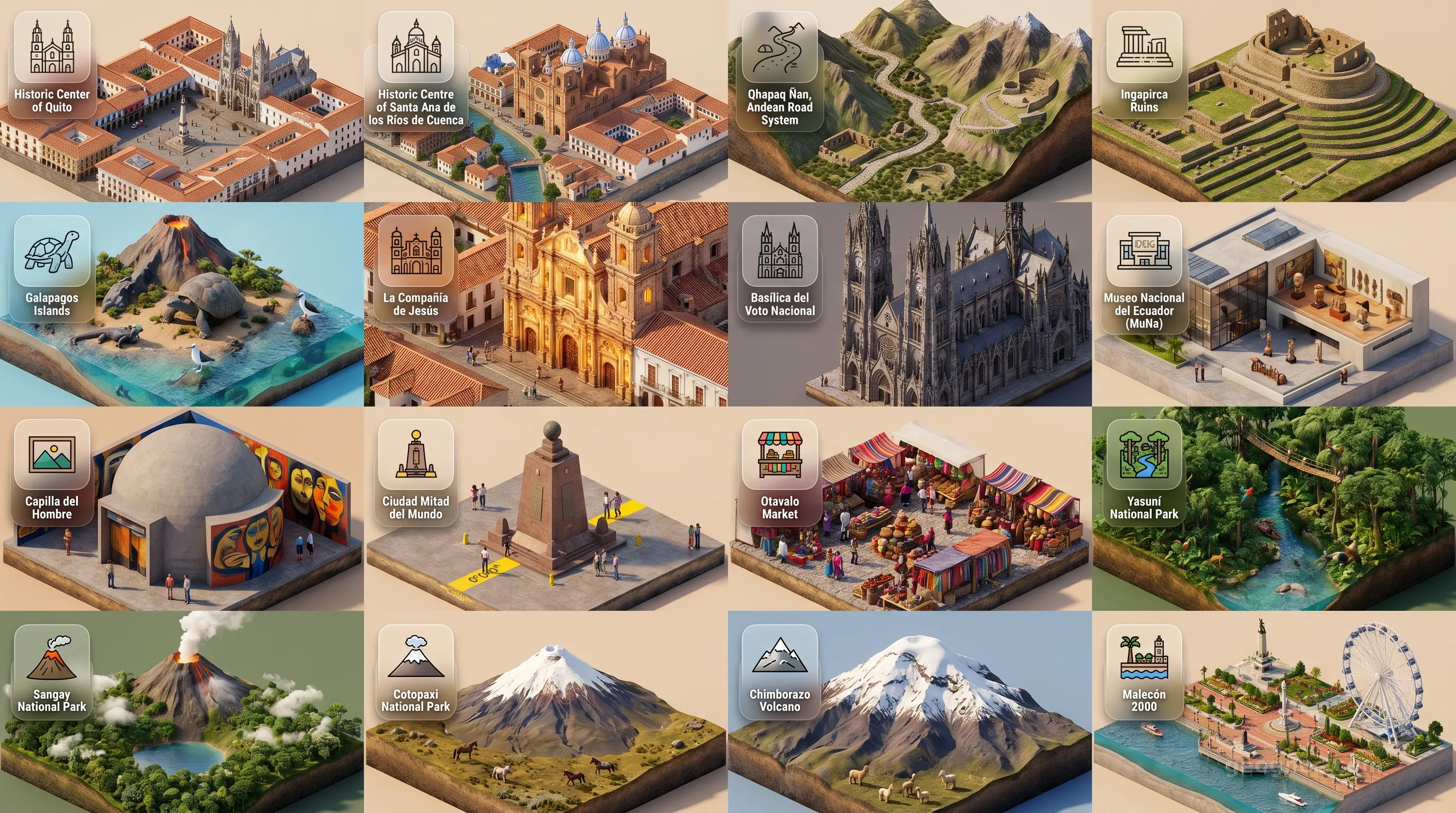
Constructed on the ruins of an Inca city in the 16th century, Quito possesses the best-preserved, least altered historic center in the Americas. This monumental city is a living museum of the 'Baroque school of Quito', merging Spanish, Moorish, Italian, and indigenous artistic traditions. For history and architecture students, it provides an unparalleled case study in colonial urban planning. The ideal time to visit is during the dry season from June to September. Tourist tip: Given the city's altitude of 2,850 meters, take your first day slow to acclimatize before walking its steep cobblestone streets.
Colonial Jewel of the Andes
Founded in 1557, Cuenca exemplifies Renaissance urban planning in the Americas. Its formal orthogonal town plan, mandated by Charles V, has been strictly respected for over 400 years. The city is renowned for its magnificent cathedrals, flowered plazas, and historical role as an agricultural and administrative center connecting the coast to the highlands. It is an excellent destination for sociology and urbanism students. June to December is the best season to explore. Tourist tip: Do not miss the local workshops making the famous 'Panama hats', which originated in Ecuador, not Panama.
The Mighty Incan Road Network
The Qhapaq Ñan is a sprawling, extraordinary ancient communication and trade network engineered by the Incas across the varied, rugged terrain of the Andes. Extending over 30,000 kilometers across six countries, the Ecuadorian segment connects significant pre-Hispanic administrative and religious centers. It offers an invaluable educational experience for archaeology and engineering students studying ancient infrastructure. The dry season (June-September) is optimal for hiking portions of this trail. Tourist tip: Hire a local indigenous guide to understand the deep spiritual and historical context of the paths.
Ecuador's Largest Incan Archaeological Site
Ingapirca represents a unique historical compromise between the expanding Inca empire and the indigenous Cañari people. The site's elliptical Temple of the Sun stands as a testament to advanced Incan masonry, constructed without mortar so perfectly that a blade cannot fit between the stones. It is highly significant for students of pre-Columbian history and astronomy. Visit between May and November for the best weather. Tourist tip: The ruins are situated at over 3,100 meters; bring a warm jacket as the Andean winds can be surprisingly cold.
The Crucible of Evolutionary Theory
This isolated archipelago is a living museum and showcase of evolution. Its unique geographic location at the confluence of three ocean currents makes it one of the richest marine ecosystems in the world. Charles Darwin's visit in 1835 deeply influenced his theory of natural selection. For students of biology, ecology, and geology, this is the ultimate living laboratory. The warm season (December to May) offers calm seas and great underwater visibility. Tourist tip: Book a multi-day liveaboard or island-hopping tour well in advance, and strictly follow conservation rules to protect the endemic wildlife.
The Golden Church of Quito
Widely considered the finest example of Spanish Baroque architecture in South America, this Jesuit church took 160 years to build. Its interior is almost entirely covered in gold leaf, blending European aesthetics with indigenous symbols, such as local flora and sun motifs hidden within the elaborate carvings. It is a masterpiece for art history students analyzing the syncretism of the Quito School. Visit year-round. Tourist tip: Photography is strictly prohibited inside the nave to preserve the delicate gold leaf and sacred atmosphere; instead, purchase an authorized guidebook.
Neo-Gothic Marvel with an Ecuadorian Twist
This monumental Roman Catholic church is the largest neo-Gothic basilica in the Americas. It holds high cultural significance because, unlike traditional European cathedrals adorned with mythological gargoyles, its façade features grotesques of endemic Ecuadorian animals like armadillos, iguanas, and Galapagos tortoises. It provides a fascinating study in architectural adaptation. Can be visited year-round. Tourist tip: Climb the steep ladders up the clock towers for a breathtaking panoramic view of Quito, but beware if you suffer from vertigo.
The Keeper of Ecuadorian Heritage
MuNa houses the country's largest and most significant collection of art and artifacts, ranging from pre-Columbian ceramics and goldwork to colonial masterpieces and contemporary art. It is the premier institution for anyone studying Ecuador's deep anthropological roots and national identity evolution. The museum is indoors and ideal for a rainy afternoon in Quito year-round. Tourist tip: Dedicate at least three hours to fully appreciate the Hall of Gold, which displays astonishing metallurgical techniques of ancient Andean societies.
A Monument to Latin American Humanity
Designed by the internationally acclaimed Ecuadorian artist Oswaldo Guayasamín, the 'Chapel of Man' is an art museum dedicated to the indigenous people of Latin America. The massive, striking paintings depict the struggles, pain, and resilience of the oppressed throughout the continent's history. It is a profound emotional and educational experience for students of art, sociology, and political science. Best visited year-round. Tourist tip: Combine this visit with Guayasamín's former home and studio, located just next door, to understand the artist's personal life.
The Center of the Earth
This monument highlights the exact location of the Equator (from which Ecuador takes its name) and commemorates the 18th-century Franco-Spanish Geodesic Mission that determined the Earth's shape. It is a fantastic site for geography and history students. While modern GPS places the true equator a few hundred meters away at the Intiñan Museum, the grand monument remains culturally iconic. Visit year-round. Tourist tip: You can get your passport stamped with a unique 'Middle of the World' seal at the nearby pavilions.
South America's Largest Indigenous Market
The Otavalo Market is a vibrant hub of living indigenous culture, where the local Otavaleños have been trading textiles since pre-Inca times. The market is culturally crucial, allowing visitors and anthropology students to witness the preservation of traditional Kichwa language, dress, and weaving techniques in a modern economic setting. Saturdays are the main market days when the stalls spill across the entire town. Tourist tip: Arrive early in the morning (around 7 AM) to see the traditional animal market and avoid the largest tourist crowds.
The Apex of Amazonian Biodiversity
Designated a UNESCO Biosphere Reserve, Yasuní is arguably the most biologically diverse spot on Earth. It is also home to two uncontacted indigenous tribes, the Tagaeri and the Taromenane. The park is a vital focal point for global ecological studies, botany, and the complex socio-political debates regarding oil drilling in indigenous territories. Best visited from December to February for fewer rains. Tourist tip: Access to deep Yasuní requires a guided tour from a reputable eco-lodge; ensure your tourism dollars support local indigenous conservation efforts.
From Snow-Capped Peaks to Amazonian Forests
This spectacular national park exhibits an incredible range of ecosystems, containing two active volcanoes (Sangay and Tungurahua), glaciers, and vast tracts of pristine tropical rainforest. Its isolation has allowed indigenous species like the mountain tapir and Andean condor to thrive. It offers unparalleled fieldwork opportunities for environmental science and ecology students. The dry season (December to April) is safer for high-altitude treks. Tourist tip: Trekking the El Altar volcano caldera is highly rewarding but requires excellent physical conditioning and a local guide.
The Majestic Active Stratovolcano
Cotopaxi is one of the world's highest active volcanoes, boasting a nearly perfectly symmetrical snow-capped cone. It holds immense geological and cultural significance, historically revered by indigenous populations as a rain-sender and a deity. Geology students can study recent volcanic activity, glacial retreat, and páramo ecosystems here. The clearest skies are usually from June to October. Tourist tip: Dress in layers and pack cocoa leaves or altitude sickness medication, as the parking lot alone sits at an elevation of 4,500 meters.
The Closest Point to Space
Due to the Earth's equatorial bulge, the summit of this massive inactive stratovolcano is the farthest point on the Earth's surface from its center—meaning it is closer to space than Mount Everest. It has historically attracted legendary explorers like Alexander von Humboldt, making it a pivotal site for the history of scientific exploration and mountaineering. Best weather windows are December-January and July-August. Tourist tip: You do not need to be a mountaineer to enjoy it; mountain biking down its slopes offers an exhilarating, accessible adventure.
The Revitalized Heart of Guayaquil
This extensive boardwalk overlooking the Guayas River is a triumph of urban renewal and a focal point for Ecuador's largest city. Historically, it is the site of the famous 'Guayaquil Conference' of 1822 between liberators Simón Bolívar and José de San Martín, commemorated by the grand La Rotonda monument. It is excellent for urban studies and history students analyzing modern Latin American cityscapes. Warm year-round, best visited in the late afternoon. Tourist tip: Stroll into the nearby historic neighborhood of Las Peñas for a colorful glimpse of colonial-era Guayaquil architecture.