Honduras
Top Sights & Landmarks
The Paris of the Maya World
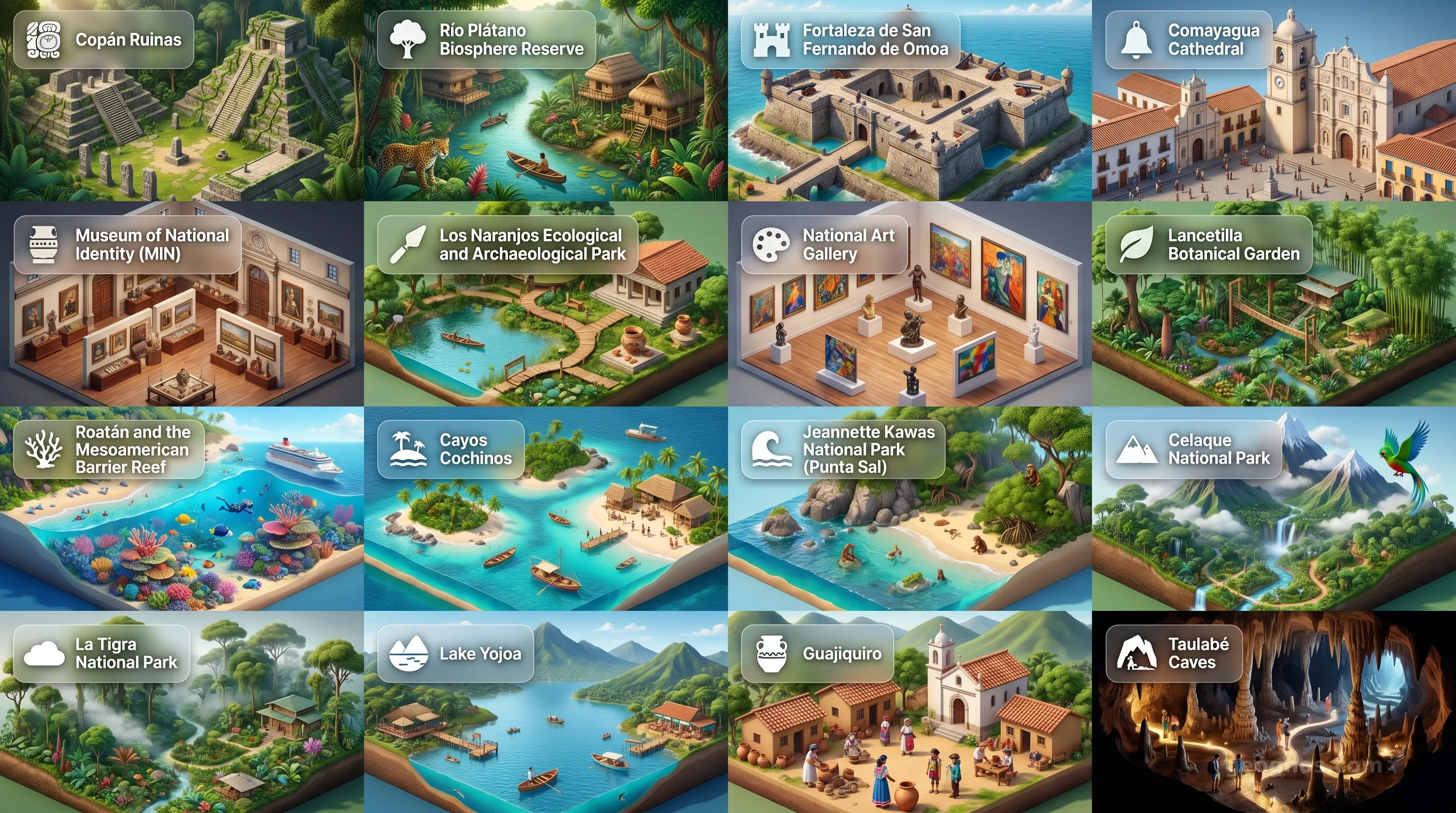
Renowned for its breathtakingly intricate stone sculptures, Copán is an essential archaeological site for studying ancient Mesoamerican art, astronomy, and hieroglyphics. Acting as the capital of a major Classic period kingdom from the 5th to 9th centuries, it holds immense historical significance. Researchers and visitors are captivated by the Hieroglyphic Stairway, which contains the longest known Mayan text in the world. The best season to visit is during the dry months from November to April. Tourist tip: Hire an expert local guide to decipher the complex iconography of the stelae, and visit early in the morning to enjoy the vibrant scarlet macaws flying overhead.
Pristine Jungle and Ancient Heritage
As one of the few remaining tropical rainforests in Central America, this reserve is a critical site for ecological study and conservation. Historically, it is home to over 2,000 indigenous people—including the Pech, Tawahka, and Miskito—who have preserved their traditional lifestyles for centuries. It also shelters mysterious ancient ruins hidden deep within the jungle, famously linked to the legend of the 'White City'. The optimal time to visit is during the drier season from February to May. Tourist tip: Access is highly restricted and remote; visiting requires booking an authorized multi-day eco-tour departing from La Ceiba or Palacios.
Colonial Caribbean Defense
Constructed in the late 18th century by the Spanish Crown, this formidable fort is the largest of its kind in Central America. It was built to protect the wealthy coastal trade routes from British pirates and buccaneers. Today, it stands as a prime educational destination for understanding Spanish colonial military architecture and the turbulent maritime history of the Caribbean. The climate is warm year-round, but November to February offers milder temperatures. Tourist tip: Explore the adjacent museum before walking the fort's ramparts to fully grasp the strategic importance of the site's unique, semi-circular defensive design.
Colonial Epicenter with an Ancient Clock
The Cathedral of the Immaculate Conception is the architectural jewel of Comayagua, the former capital of Honduras. Built between 1634 and 1715, it is a magnificent example of Spanish colonial baroque architecture. Historically, it is famous for housing what is widely considered the oldest working clock in the Americas, originally built by the Moors in the 12th century and donated by King Philip III of Spain. The absolute best time to visit is during Holy Week (Semana Santa), when the surrounding streets are decorated with elaborate, colorful sawdust carpets. Tourist tip: Climb the bell tower for a small fee to see the ancient clock's inner workings up close.
The Heart of Honduran Heritage
Located in a beautifully restored 19th-century colonial building (the former Palace of Ministries) in Tegucigalpa, the MIN is the premier institution for studying Honduran history, culture, and art. The museum provides a comprehensive timeline of the nation, from its geological formation and pre-Columbian roots to contemporary society. It features a spectacular virtual auditorium offering a 3D tour of Copán. The museum is a great year-round indoor destination. Tourist tip: Check the museum's calendar before visiting, as they frequently host vibrant temporary exhibitions, live concerts, and cultural nights in their open-air courtyard.
Proto-Maya and Lenca Settlement
Situated on the shores of Lake Yojoa, Los Naranjos is a fascinating archaeological site that bridges the gap between the ancient Lenca culture and the proto-Maya civilization. The settlement dates back to 800 BC, making it a crucial study site for early Mesoamerican societal development. Visitors can walk along elevated boardwalks through lush wetlands to view ancient earthen mounds that were once grand pyramids. The site is excellent to visit between November and April. Tourist tip: Combine your historical exploration with bird watching, as the park’s trails are renowned for spotting over 400 distinct avian species.
Chronicle of Honduran Artistic Evolution
Located in Tegucigalpa, the National Art Gallery houses the most comprehensive collection of Honduran art. Students of art history will find immense value in its chronological exhibitions, which range from pre-Columbian petroglyphs and colonial religious paintings to contemporary masterworks by celebrated Honduran painters like José Antonio Velásquez. The gallery is housed in a historic building that originally served as a colonial convent and later as the country's first university. Open year-round. Tourist tip: Take a guided tour to gain deeper context into the socio-political movements that shaped Honduras' modern art scene.
A Legacy of the Banana Republic Era
Established in 1926 by Dr. Wilson Popenoe for the United Fruit Company, Lancetilla is the second-largest tropical botanical garden in the world. Originally a research facility to study the viability of various fruit and timber crops in Central America, it is a living museum of Honduras' 'Banana Republic' economic history and a haven for agronomists and botanists. The vast bamboo tunnels and exotic fruit orchards are spectacular. Visit during the rainy season (September to November) to see the flora at its most vibrant. Tourist tip: Hire a local guide at the visitor center to point out rare poisonous plants and exotic fruits you can safely taste.
World-Class Diving and Afro-Caribbean History
Roatán is the largest of the Bay Islands and is enveloped by the Mesoamerican Barrier Reef, the second-largest coral reef system globally. Beyond its immense importance to marine biologists studying coral ecosystems, the island holds a complex history of indigenous Paya heritage, British piracy, and the rich Afro-Caribbean Garifuna culture. The best time to visit is from February to August for optimal diving visibility. Tourist tip: While West Bay is popular for its pristine beaches, head to Punta Gorda to experience authentic Garifuna drumming and traditional cuisine like machuca (mashed plantain soup).
Protected Marine Archipelago
Cayos Cochinos is an archipelago consisting of two small islands and 13 coral cays. It is a strictly protected marine biological reserve, making it a critical hub for scientists studying reef conservation and endemic species, such as the pink boa constrictor. It is also a stronghold of Garifuna culture, with small, traditional fishing villages dotting the cays. The calmest seas for the boat crossing are found between March and May. Tourist tip: There are no cars or roads here. Bring plenty of reef-safe sunscreen, cash for the local Garifuna food stands, and prepare for a completely off-the-grid eco-tourism experience.
Coastal Biodiversity and Conservation
Named after a tragically assassinated environmental activist, this national park near Tela is a testament to the fight for ecological preservation in Central America. It features a stunning mix of tropical rainforest, mangrove swamps, coastal lagoons, and pristine beaches. The area is highly significant for biological studies due to its diverse population of howler monkeys, manatees, and marine turtles. The dry season (February to June) is ideal for exploring. Tourist tip: The boat ride to Punta Sal can be bumpy; secure your belongings in dry bags and keep your camera ready for playful dolphins in the bay.
The Cloud Forest and the Lenca Heartland
Home to Cerro Las Minas, the highest peak in Honduras at 2,870 meters, Celaque National Park is a rugged, mystical cloud forest. 'Celaque' means 'box of water' in the indigenous Lenca language, highlighting the mountain's critical role as a watershed for the surrounding ancient Lenca communities. It is a phenomenal site for studying montane ecosystems and endemic orchids. Hiking is best done during the dry season (November to April) to avoid muddy trails. Tourist tip: The hike to the summit is a strenuous two-day trek requiring a guide, but the lower visitor center trails offer beautiful, accessible walks through dense, mist-shrouded forests.
Honduras' First National Park and Mining History
Just a short drive from Tegucigalpa, La Tigra was the first national park established in Honduras. Its lush cloud forests are essential for the capital's water supply and serve as a sanctuary for pumas, quetzals, and rich flora. Intriguingly, the park also hides the crumbling infrastructure of the Rosario Mining Company, an American silver mining operation from the late 19th century that profoundly impacted the Honduran economy. Visit between January and May for the best birdwatching opportunities. Tourist tip: Start at the El Rosario visitor center to combine a lesson in mining history with a hike to stunning hidden waterfalls.
A Pre-Columbian Crossroads and Birding Mecca
Lake Yojoa is the largest natural lake in Honduras, situated in a depression formed by volcanoes. Historically, its shores were a vibrant crossroads for various pre-Columbian trade routes. Today, it is internationally recognized as a birdwatching paradise, hosting over 50% of the bird species found in Honduras. Limnologists and ornithologists flock here to study its rich biodiversity. The lake is enjoyable year-round, but migratory birds are most plentiful from November to February. Tourist tip: Rent a rowboat or kayak at dawn to observe the wildlife in serene silence, and don't leave without eating the locally famous deep-fried bass at the lakeside restaurants.
Living Lenca Traditions in the Highlands
Perched high in the rugged mountains of the La Paz department, Guajiquiro is a vital center for the contemporary indigenous Lenca population. The town and its surrounding hamlets offer sociologists, anthropologists, and respectful travelers a unique opportunity to study living Mesoamerican traditions, particularly the region's famous unglazed pottery and intricate textile weaving. The climate is refreshingly cool year-round due to the high elevation. Tourist tip: Visit during the local patron saint festival in late January to witness syncretic religious ceremonies, traditional dances, and vibrant indigenous markets. Bring a jacket, as mountain nights get cold.
An Underworld of Stalactites and History
The Taulabé Caves are a magnificent network of underground limestone caves renowned for their stunning stalactite and stalagmite formations. For speleologists and geology students, it provides a striking look into karst topography. Culturally, the caves have colorful lore, rumored to have been a hiding spot for the loot of infamous bank robber William Walker (not the filibuster, but a local mid-20th-century outlaw). The caves offer a cool escape from the heat year-round. Tourist tip: The first 300 meters are paved, lit, and highly accessible. For the more adventurous, hire a specialized guide to explore the deeper, unlit chambers where rivers flow in total darkness.