Kiribati
Top Sights & Landmarks
Vast Marine Wilderness
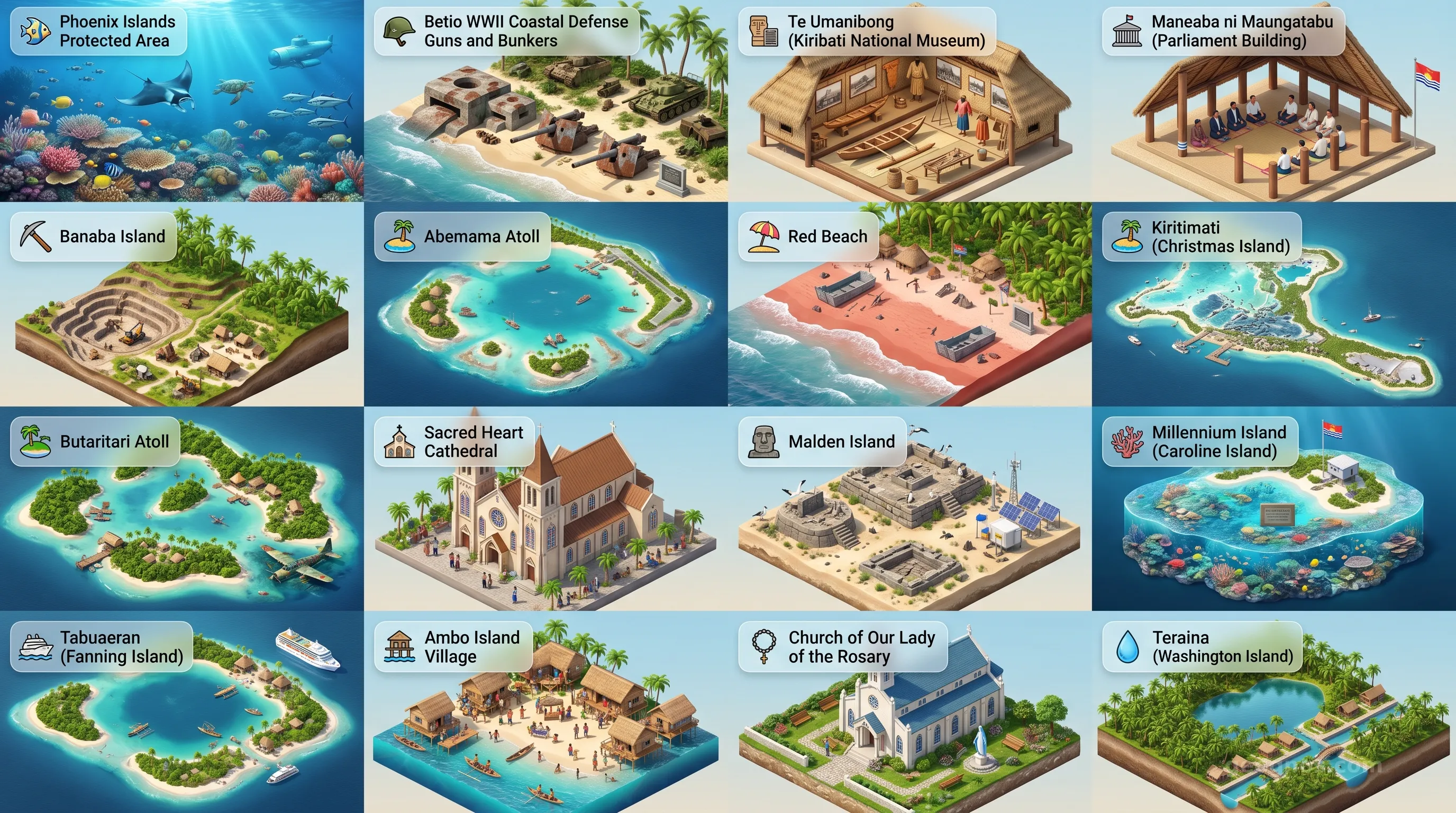
As one of the largest marine protected areas in the world, PIPA is a pristine oceanic wilderness encompassing diverse coral archipelagos and submerged volcanic seamounts. It is an unparalleled destination for marine biologists and environmental students to study untouched coral ecosystems and the impacts of global climate change in a highly controlled environment. Historically, these islands have seen minimal human habitation, preserving their ecological integrity. The best season to visit is during the drier months from May to November. Tourist tip: Access is extremely limited and requires organizing a specialized expedition or liveaboard dive boat with explicit permits from the Kiribati government.
Relics of the Pacific War
Betio Island in South Tarawa is essentially an open-air museum detailing the fierce 1943 Battle of Tarawa. Visitors and historians can explore rusted Japanese 8-inch coastal defense guns, fortified pillboxes, and half-submerged Sherman tanks. It provides profound historical insights into the strategic Pacific theater of World War II. The best time to visit is from May to October when the humidity is slightly lower. Tourist tip: Hire a local guide to respectfully navigate the villages where many of these relics are integrated into modern daily life, and avoid removing any artifacts.
Heart of Gilbertese Heritage
Located in Bikenibeu on Tarawa, Te Umanibong serves as the ultimate repository for Kiribati's rich cultural and historical artifacts. Students of anthropology will marvel at the displays of traditional Gilbertese armor made from woven coconut fiber and porcupine fish helmets, alongside intricate woven crafts and historical photographs. It is crucial for understanding the deep-rooted navigation and voyaging history of the Micronesian people. The museum is indoors and can be visited year-round. Tourist tip: Call ahead to confirm opening hours, as they can be irregular, and consider leaving a small donation to support the preservation of local heritage.
Modern Gilbertese Governance
Situated in Ambo, South Tarawa, the National Parliament building is a striking architectural feat designed to resemble a traditional 'maneaba' (community meeting house). It represents the intersection of customary island governance and modern democratic practices. Studying its architecture reveals the profound cultural importance of community consensus in Kiribati. Visit year-round, though the best views are on sunny days between May and October. Tourist tip: While you cannot always go inside during sessions without prior arrangement, the exterior architecture and the surrounding lagoon views make for excellent photography.
The Phosphate Island
Banaba is an isolated, raised coral island with a tragic yet fascinating history. Once heavily strip-mined for phosphate by the British Phosphate Commission in the 20th century, the island’s interior is now a striking, jagged lunar landscape of exposed coral pinnacles. It is a vital study site for environmental science and colonial history, reflecting the severe ecological and human costs of resource extraction. The dry season (May-November) is best for visiting. Tourist tip: Reaching Banaba is incredibly challenging due to a lack of regular transport; visitors must charter a boat and carry all their own provisions.
Isle of Stevenson and Kings
Abemama Atoll holds immense historical significance as the location where the British Protectorate over the Gilbert Islands was formally declared in 1892. Furthermore, famed author Robert Louis Stevenson lived here in 1889, documenting the rule of the tyrannical High Chief Binoka. The atoll is perfect for literature students and historians. Its wide lagoons offer stunning tropical beauty. Visit during the trade wind season (May-October) for pleasant weather. Tourist tip: Seek out the site of Stevenson’s former residence and ask locals about the legends of Chief Binoka.
Site of the Tarawa Landings
Red Beach on Betio was the primary landing site for the US Marines during the Battle of Tarawa in November 1943. Today, the peaceful lapping waves contrast sharply with its violent history, where thousands lost their lives in a matter of days over a tiny strip of sand. It is a sobering place of reflection and an essential stop for military historians studying amphibious assault tactics. Accessible year-round. Tourist tip: Visit at low tide when more of the sunken war debris and defensive structures become visible along the shoreline.
World's Largest Coral Atoll
Accounting for over 70% of Kiribati's total land area, Kiritimati is a world-renowned destination for fly-fishing (especially bonefish) and ornithology, boasting millions of seabirds. Historically, it was the site of British and American atmospheric nuclear tests in the 1950s and 60s, offering a unique study angle for modern historians and ecologists. The best time to visit is from June to November. Tourist tip: Book fishing and bird-watching guides well in advance, and remember that flights here are separate from the rest of Kiribati, typically routed through Fiji or Hawaii.
The Lush Atoll and Makin Raid
Known historically as Makin Atoll, Butaritari is much greener and lusher than the rest of Kiribati due to higher rainfall, making it ideal for agricultural studies. Historically, it is famous for the 1942 'Makin Raid' by US Marine Raiders led by Evans Carlson, an early and significant morale-boosting operation in the Pacific. Visitors can see crashed flying boats and memorials. The best season is between May and October. Tourist tip: Because of the higher rainfall, mosquitoes can be plentiful; bring strong insect repellent and lightweight rain gear.
Catholic Center of Kiribati
Located in Teaoraereke, South Tarawa, this expansive cathedral serves as the seat of the Roman Catholic Bishop of Tarawa and Nauru. It is culturally significant as Catholicism is one of the dominant religions in the country, heavily influencing modern Gilbertese social structures. The architecture features an open, airy design adapted to the tropical climate, reflecting local construction philosophies. Open year-round. Tourist tip: Attend a Sunday service to experience the incredibly powerful, harmonious a cappella singing of the local congregation.
Mysterious Polynesian Marae
An uninhabited atoll in the Line Islands, Malden is home to enigmatic prehistoric Polynesian stone temples (marae) and platform structures, making it an extraordinary archaeological site. It provides critical evidence of ancient Polynesian voyaging and settlement patterns before European contact. It was also a 19th-century guano mining hub and a UK nuclear test site. Best explored by organized scientific expeditions. Tourist tip: There is no infrastructure here; visits require a chartered vessel and special permission from the Kiribati government.
First Sunrise of the Millennium
Formerly known as Caroline Island, this uninhabited crescent of coral reefs gained international fame when a 1995 time zone realignment made it the first point of land on Earth to see the sunrise of the year 2000. Ecologically, it is one of the world's most pristine tropical islands, perfect for studying untouched terrestrial and marine biodiversity, including coconut crabs and seabird colonies. Tourist tip: Access is strictly for scientific researchers, high-end expedition cruises, or private yachts, requiring significant advance planning.
The Footprint Lagoon
Tabuaeran is a footprint-shaped atoll famous for its incredibly deep, vibrant blue enclosed lagoon. It has a unique history, having been discovered by American whaler Edmund Fanning and later serving as an important relay station for the trans-Pacific telegraph cable. Today, it is a favored, albeit infrequent, stop for Pacific cruise ships. The beautiful beaches are ideal for tourism and studying isolated community economics. Tourist tip: Purchase traditional Kiribati knives carved from shark teeth and local woven goods when cruise ship markets are active.
Ground Zero for Climate Change
Ambo, part of the South Tarawa continuous settlement, offers a sobering, firsthand look at the realities of rising sea levels and coastal erosion. For environmental science students and climate researchers, observing the seawalls, flooded properties during king tides, and mangrove planting initiatives here is an essential case study in climate adaptation and vulnerability. The best time to visit is during the dry season, though king tides (often in early months) show the extreme vulnerability. Tourist tip: Be highly respectful when photographing homes or seawalls, as this is a living community facing existential threats.
Coral Stone Mission
Situated in the village of Koinawa on Abaiang Atoll, this stunning church was built by the first Catholic missionaries to the region in the late 19th century. Remarkably, it was constructed using hand-cut coral blocks. It stands as a profound monument to the introduction of Christianity in Kiribati and European-Gilbertese historical intersections. Best visited in the cooler dry season. Tourist tip: While on Abaiang, also visit the memorial for Reverend Hiram Bingham, the first Protestant missionary who arrived in 1857.
Freshwater Lake on an Atoll
Teraina is a geological anomaly: unlike most coral atolls that feature a saltwater lagoon, Teraina encloses a large, freshwater lake surrounded by dense peat bogs and lush vegetation. This creates a highly unique ecosystem, fascinating for geologists and botanists studying island formation and hydrology. The island's remote nature has preserved much of its traditional lifestyle. Tourist tip: Navigating to Teraina requires passage on intermittent supply ships from Kiritimati; bring all essential supplies and water purification equipment.