Vanuatu
Top Sights & Landmarks
Ancient Chief's Legacy
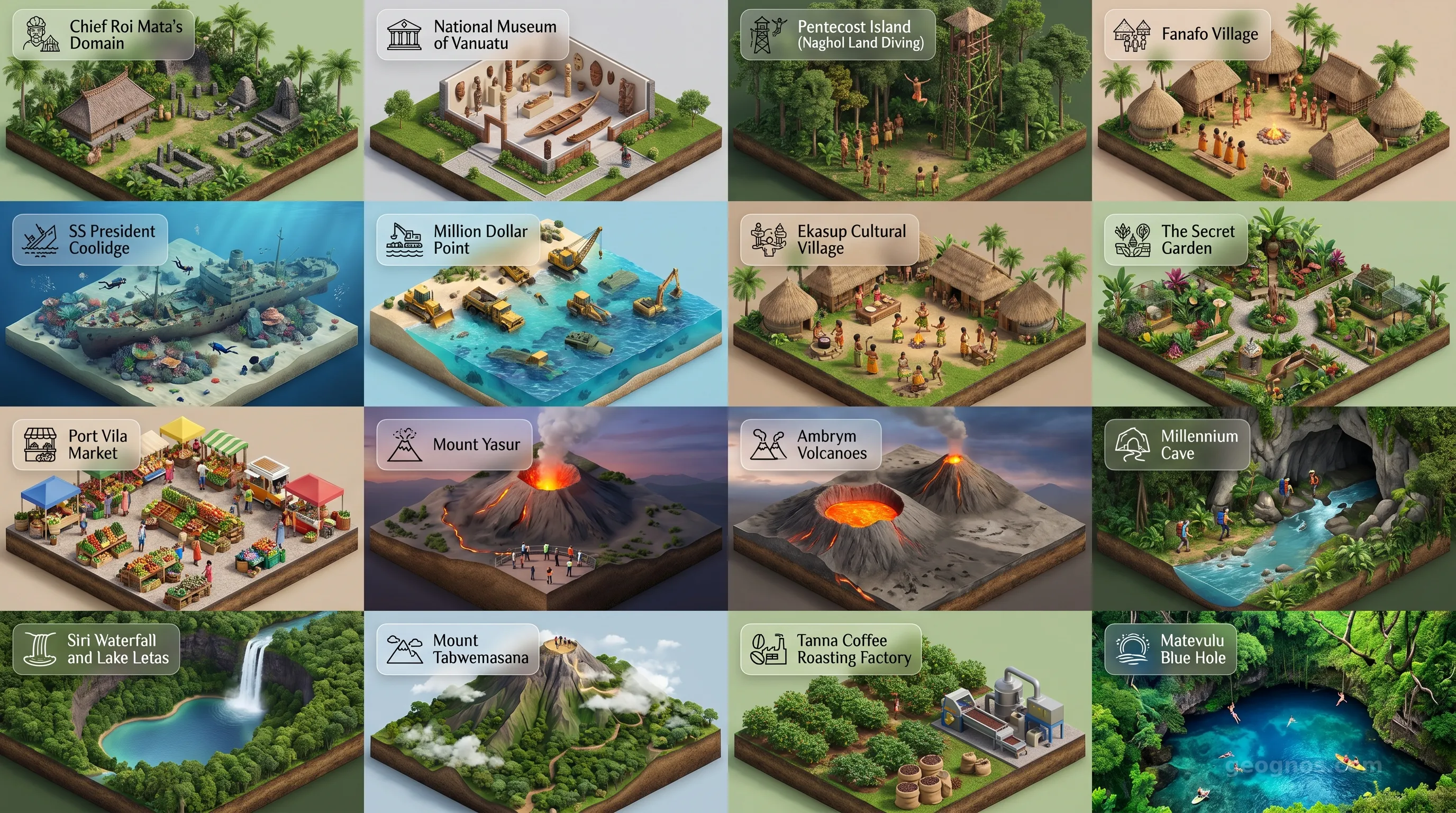
Chief Roi Mata's Domain is Vanuatu's first UNESCO World Heritage site, comprising the residence, site of death, and mass burial site of the legendary 17th-century paramount chief. It is a vital study location for anthropologists and historians interested in Pacific island societal structures and conflict resolution, as Roi Mata famously united warring tribes. The best season to visit is during the dry months from May to October. Tourist tip: Accessing the burial site on Artok (Hat) Island requires an official local guide; it is considered highly sacred, so respectful attire and behavior are mandatory.
Keeper of Ni-Vanuatu Culture
Located in Port Vila, this museum provides an essential foundation for understanding the diverse cultures of Vanuatu's 83 islands. It houses invaluable artifacts, including ancient Lapita pottery, traditional slit gongs (tamtams), and outrigger canoes. It is historically significant for preserving indigenous traditions that survived both colonial administration and modern globalization. It is excellent to visit year-round. Tourist tip: Make this your very first stop upon arriving in Vanuatu to gain vital cultural context before visiting remote villages.
Birthplace of Bungee Jumping
Pentecost Island is globally renowned for the Naghol (land diving) ceremony, a profound cultural ritual and yam harvest festival where men leap from towering wooden platforms with only vines tied to their ankles. It holds immense anthropological importance as the inspiration for modern bungee jumping and a testament to Ni-Vanuatu spiritual resilience. The ceremony only takes place between April and June. Tourist tip: Witnessing this requires careful planning and immense respect; book domestic flights and village fees well in advance as spots are strictly limited.
Heart of the Nagriamel Movement
Fanafo on Espiritu Santo island is deeply tied to the modern history of Vanuatu. It was the headquarters of the Nagriamel movement led by Jimmy Stevens, which sought to maintain customary land rights and temporarily declared the independent 'Republic of Vemerana' in 1980. Students of post-colonial history and Pacific politics will find it an incredible site of study. The dry season (May to October) is the most comfortable time to visit. Tourist tip: It operates as a strict 'custom village', so you must ask permission before entering and strictly adhere to the chief's rules.
World's Largest Accessible Shipwreck
The SS President Coolidge was an American luxury ocean liner requisitioned as a troopship, which struck friendly mines and sank off the coast of Espiritu Santo in 1942. Today, it is an underwater archaeological treasure trove containing jeeps, artillery, and medical supplies, offering a vivid study of WWII Pacific Theater logistics. Best dived between April and November when water visibility is highest. Tourist tip: This is a deep dive site; while beginners can do shallow orientations, you need advanced scuba certification to explore the fascinating internal holds.
WWII Sunken Fortune
At the end of World War II, rather than leaving equipment behind or paying to ship it back, the US military drove millions of dollars' worth of bulldozers, trucks, and supplies directly into the ocean. It stands as a surreal historical monument to the economics and abrupt endings of global conflicts. The site is accessible year-round. Tourist tip: You don't need to scuba dive to appreciate this site; snorkeling right off the beach is sufficient to see the massive piles of submerged industrial machinery.
Living Ancestral Traditions
Located just outside Port Vila, Ekasup offers an immersive educational experience regarding traditional Melanesian lifestyles, including food preservation, hunting techniques, and traditional medicine. It serves as a living museum of pre-colonial survival strategies and social structures. It is a fantastic year-round destination. Tourist tip: Go for the Friday night Melanesian feast and fire-walking demonstration to experience an unforgettable evening of ancestral storytelling.
Botanical and Historical Haven
This unique outdoor museum intricately weaves Vanuatu's history, folklore, and biodiversity into an engaging tropical garden walk. It features educational placards detailing everything from local cannibalism lore and WWII impacts to the complex biology of the region's flora and fauna. Best visited during the dry season to enjoy the outdoor paths comfortably. Tourist tip: It's heavily shaded by massive banyan trees, making it a great midday activity when the sun is too harsh for the beach, but don't forget to wear mosquito repellent.
Vibrant Heart of Local Commerce
The Port Vila Market is a bustling center of daily life and micro-economics in Vanuatu. It provides an unpolished, authentic look at agricultural practices and the central role of women in the Ni-Vanuatu economy. Historically, markets here have been crucial for inter-village communication and trade. Open year-round. Tourist tip: Visit early on a Wednesday or Saturday morning to see the widest array of exotic produce like lap-lap, taro, and fresh seafood; remember that haggling is not a part of Vanuatu culture.
The Lighthouse of the Pacific
Mount Yasur on Tanna Island is one of the world's most accessible active volcanoes. Culturally, it is deeply intertwined with the local John Frum 'cargo cult' movement, whose followers believe the volcano is a sacred site. Geologically, its continuous Strombolian eruptions offer researchers incredible insights into volcanic activity. Best visited from May to October. Tourist tip: Book the twilight tour; watching the dramatic lava fireworks transition from daylight into the pitch-black night sky is a truly awe-inspiring experience.
The Black Magic Island
Ambrym is known culturally as the center of Vanuatu's 'black magic' and sorcery, heavily influenced by its dramatically volatile landscape. The twin active volcanoes, Marum and Benbow, feature terrifying, mesmerizing lava lakes. Studying the intersection of these intense geological forces with indigenous spiritual beliefs provides a profound cultural experience. Best hiked in the cooler dry season. Tourist tip: This is an extreme hike requiring good fitness and a mandatory local guide. Prepare for challenging terrain and unpredictable weather.
Jungle Canyon and Cave Expedition
Hidden deep in the jungle of Espiritu Santo, Millennium Cave is Vanuatu's largest cave. Exploring it involves a trek through local villages, learning about community-led eco-tourism, followed by a descent into a massive subterranean river system. It offers a prime example of limestone karst geology and sustainable indigenous tourism. Best visited during the dry season, as heavy rains make the river too dangerous. Tourist tip: You will get completely wet and muddy; wear sturdy water shoes and be prepared for strenuous physical activity.
Gaua's Majestic Waters
Located on the remote island of Gaua, Lake Letas is Vanuatu's largest freshwater lake, sitting in a volcanic crater. The lake feeds the spectacular 120-meter Siri Waterfall. This area is culturally rich, featuring the traditional water music performed by the women of Gaua, making it a unique acoustic and anthropological study site. The dry season is necessary for safe trekking. Tourist tip: Reaching this remote wonder requires a multi-day commitment and hiring local guides for a challenging, muddy hike, but the isolation makes it incredibly rewarding.
Vanuatu's Highest Peak
At 1,879 meters, Mount Tabwemasana on Espiritu Santo is the highest mountain in Vanuatu. The mountain and its surrounding villages are steeped in local folklore and remain largely isolated from modern development, offering glimpses into ancient mountain tribal life. It is also an area of high endemism for biologists. Only attempt this hike in the dry season (June to September). Tourist tip: This is a serious expedition requiring several days, permission from the Kerepua village chief, and exceptional physical stamina.
Agricultural Resilience
Located in Port Vila, this facility processes the famous coffee grown in the volcanic soils of Tanna Island. It serves as an excellent case study in Vanuatu's modern agricultural history, economic resilience following cyclones, and fair-trade practices empowering rural farmers. Open year-round. Tourist tip: Take the short factory tour to learn the step-by-step process of coffee production, and buy freshly roasted beans straight from the source as a perfect, ethical souvenir.
Sapphire Jungle Spring
Espiritu Santo is famous for its 'blue holes'—freshwater springs filtered through underground limestone, resulting in breathtakingly clear, brilliant blue water. Matevulu is one of the largest, providing an excellent location to study karst hydrological systems and local ecology. Beautiful year-round, though the sun makes the colors pop best on clear days. Tourist tip: Rent a kayak from the coast and paddle up the serene, overhung river to arrive at the blue hole, making the journey just as magical as the destination.