Togo
Top Sights & Landmarks
Iconic Mud Tower-Houses
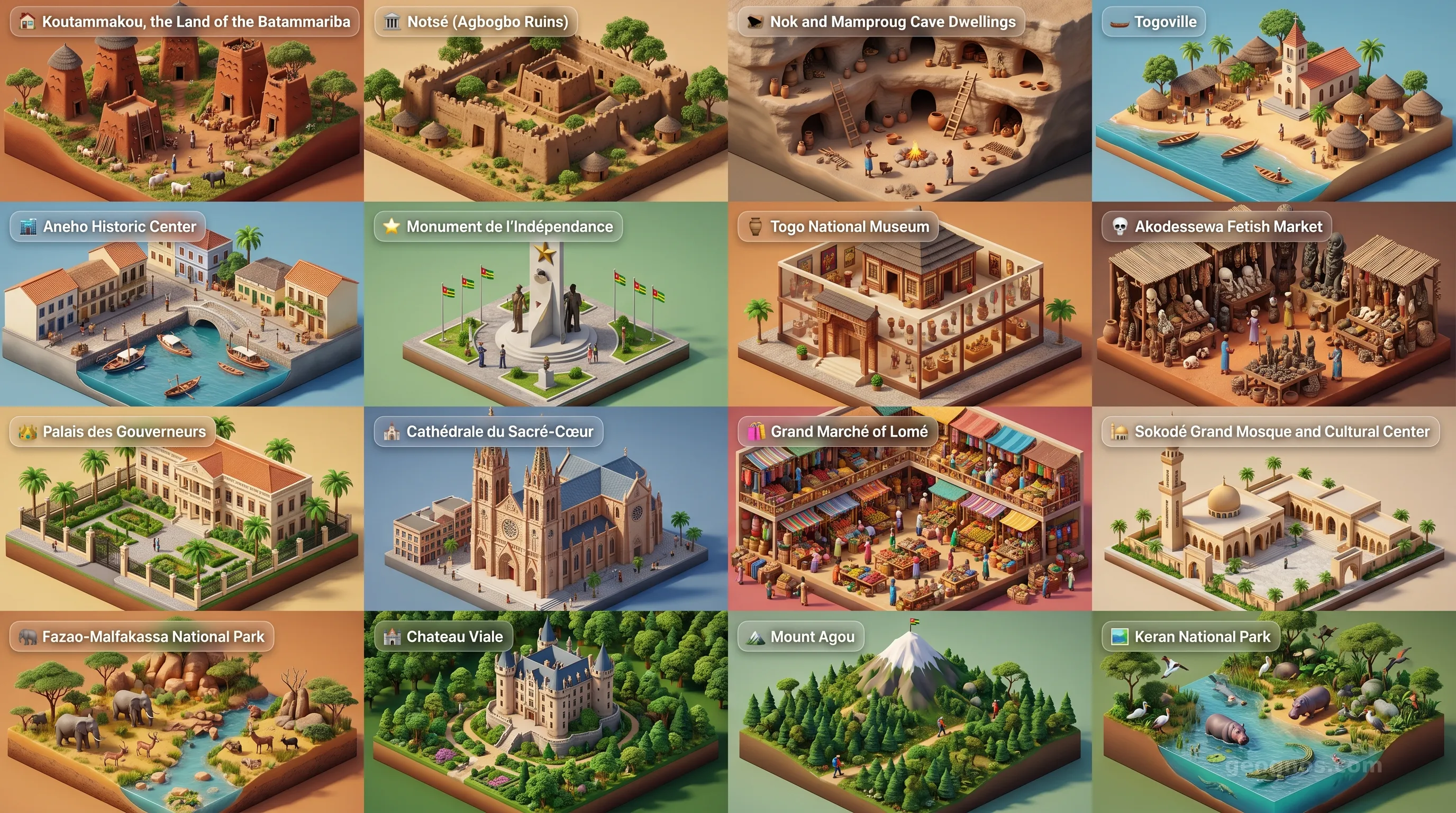
Koutammakou is Togo's cultural crown jewel, renowned for the remarkable Takienta—mud tower-houses built by the Batammariba people. These unique, fortress-like structures are a testament to human ingenuity and traditional architectural evolution, symbolizing the harmonious relationship between the community and their environment. For students of anthropology and architecture, this region offers unparalleled insights into ancient West African building techniques and animist spiritual practices. The best time to visit is during the dry season (November to February) when the roads are accessible and the weather is cooler. Visitors should hire a local guide out of respect for the community and to fully understand the deep symbolism behind the design of each home.
Ancestral Cradle of the Ewe People
Notsé holds immense historical weight as the ancestral home of the Ewe people, who migrated across West Africa. The ruins of the Agbogbo wall, built under the legendary and tyrannical King Agokoli, mark the site from which the Ewe famously escaped by walking backward to confuse their trackers. Studying the remnants of these ancient defensive walls provides an excellent window into 17th-century West African kingdoms and migration patterns. An annual cultural festival, Agbogbo-Za, takes place in September, making it the most vibrant time to visit. Tourists are advised to visit the local chief's palace to hear the oral histories directly from community elders.
Ancient Cliffside Refuges
Perched high in the cliffs of northern Togo, the Nok and Mamproug caves served as a vital sanctuary for local populations escaping slave raiders and warring tribes between the 17th and 19th centuries. Inside these geological marvels, visitors can study beautifully preserved cylindrical granaries crafted from clay and straw, offering profound insights into the survival strategies and food preservation techniques of historical West African societies. Placed on the UNESCO tentative list, the site is best explored during the dry season, as the ascent can be steep and slippery. Sturdy hiking boots and a knowledgeable local guide are essential for safely navigating the terrain.
The Town that Named a Nation
Situated on the northern shores of Lake Togo, Togoville is the historic town where King Mlapa III signed the 1884 treaty with German explorer Gustav Nachtigal, effectively granting Germany control over the territory and giving the modern country its name. The town is a fascinating study in religious syncretism, where deeply rooted Voodoo shrines stand mere steps away from the impressive colonial-era Cathédrale Notre-Dame du Lac Togo. To reach the town, visitors take a traditional pirogue (dugout canoe) across the lake, adding a scenic and authentic layer to the journey. Keep your camera ready, but always ask permission before photographing local Voodoo practitioners or shrines.
Togo's First Colonial Capital
Aneho, located near the Benin border where Lake Togo meets the Atlantic Ocean, served as the first capital of German Togoland in the late 19th century. The town is steeped in colonial and Afro-Brazilian history, visible in its decaying but beautiful colonial mansions and historic churches. Aneho was also a significant center during the transatlantic slave trade. Today, it offers students of history a poignant look at colonial administration and coastal erosion, as the sea continues to threaten the historic shoreline. Visit during late August to early September to witness the Epé-Ekpé festival, a deeply significant traditional New Year celebration for the local Guin-Mina people.
Symbol of Togolese Liberation
Located in the heart of Lomé, the Monument de l'Indépendance was unveiled on April 27, 1960, to commemorate Togo's liberation from French colonial rule. The intricate sculptural landmark features a human silhouette carved into a massive stone block, representing the breaking of chains and the birth of a free nation. Surrounded by well-kept gardens and fountains, it is an essential stop for understanding the country's modern political history and mid-century nationalistic art. The plaza is beautifully illuminated at night, making early evenings the best time for photography. Be mindful that it is situated near government buildings, so follow local security instructions.
Repository of National Heritage
Housed within the Palais des Congrès in Lomé, the Togo National Museum offers a comprehensive journey through the country's diverse cultural and historical landscape. The museum features extensive collections of pre-colonial artifacts, traditional musical instruments, intricate wood carvings, pottery, and contemporary art. It is an indispensable resource for students seeking to understand the ethnic diversity of Togo, from the Ewe in the south to the Kabye in the north. The museum is indoors and air-conditioned, making it a perfect educational retreat during the hottest parts of the day. Guided tours are highly recommended to contextualize the unlabelled artifacts.
The World's Largest Voodoo Market
The Akodessewa Fetish Market in Lomé is recognized as the largest Voodoo (Vodun) market in the world. It provides an intense, unparalleled look into the traditional animist beliefs that originated in West Africa. Vendors sell an astonishing array of talismans, animal skulls, herbs, and skins used by local healers and priests for medicine and spiritual protection. For cultural anthropologists, it is a living laboratory of indigenous religious practices. Visitors should come with an open mind and a strong stomach, as the sights and smells can be overwhelming. Always negotiate the photography fee at the entrance before taking out your camera.
The Palace of the Governors
Built between 1898 and 1905, the Palais des Gouverneurs in Lomé is an imposing remnant of German colonial ambition. Serving as the seat of the German, and later French, colonial administrations, the palace heavily influenced the urban development of Lomé. After independence, it was utilized as the presidential palace until the early 1990s. The sprawling building blends European architectural grandeur with tropical adaptations. Currently undergoing various stages of restoration to become an art and culture center, it offers architecture and history students a tangible look at imperial power dynamics in West Africa. Check local listings for art exhibitions that are occasionally hosted here.
Gothic Revival in West Africa
Constructed in 1902 by German Catholic missionaries, the Cathedral of the Sacred Heart stands out vibrantly in Lomé with its distinct Gothic Revival architecture and striking red-and-white facade. Beyond its religious function, the cathedral is a remarkable piece of architectural history, featuring beautifully carved wooden pews and stunning frescoes that have survived over a century in a harsh tropical climate. It remains a central place of worship for the city's Catholic population. Visitors are welcome to attend the lively Sunday mass, which beautifully integrates European liturgical traditions with vibrant Togolese choral music.
The Domain of the Nana Benz
The Grand Marché is the pulsing commercial heart of Lomé. Historically, it is famous as the domain of the 'Nana Benz'—a group of formidable Togolese women who gained immense wealth and political influence from the 1950s through the 1980s by monopolizing the trade of Dutch wax print textiles. For students of economics and gender studies, the market represents a powerful case study in female economic empowerment in post-colonial Africa. It is a chaotic, vibrant maze of colors, scents, and sounds. Tourists are advised to keep an eye on their belongings, bargain respectfully, and dive deep into the textile sections for authentic African prints.
Heart of the Kotokoli Islamic Culture
Sokodé is Togo's second-largest city and the cultural epicenter for the Islamic Kotokoli (Tem) people. The city's Grand Mosque is a beautiful example of Sahelian-influenced Islamic architecture. Historically, Sokodé was a vital trading hub linking the coastal regions with the Sahel. The city is also famous for the spectacular 'Fire Dance' (Gadao-Adossa festival) held usually around the Prophet Muhammad's birthday, where initiated dancers handle burning coals without suffering burns—a fascinating study of spiritual trance and physical endurance. When visiting religious sites, tourists should dress modestly and respect local Islamic customs.
Biodiversity Hotspot
As the largest of Togo’s national parks, Fazao-Malfakassa is unique in West Africa for encompassing both dense semi-mountainous forest ecosystems and lush savannahs. Included on the UNESCO tentative list for its biosphere value, the park has historically suffered from poaching but is currently undergoing significant rehabilitation. It is home to diverse primate species, antelope, and an incredible array of birdlife, making it a prime location for environmental and biological studies. The best time for wildlife viewing is the dry season (November to April) when animals congregate around water sources. Access requires a 4x4 vehicle and a mandatory park ranger guide.
The Mountain Fortress of Kpalimé
Perched on a hill near the city of Kpalimé, Chateau Viale is a European-style castle built in the early 1940s by a French eccentric. Following independence, it was acquired by the Togolese government and frequently used by former President Gnassingbé Eyadéma as a prominent retreat to host foreign dignitaries. The architecture is a fascinating anomaly in the lush West African landscape. While the interior is often closed to the public, the exterior and the panoramic views of the surrounding coffee and cocoa plantations are breathtaking. The cooler, elevated climate makes it a refreshing day trip from Lomé.
The Peak of Togo
Mount Agou is the highest peak in Togo, rising 986 meters above sea level. It is a striking geological marvel characterized by its dense, lush forests and terraced farming. The mountain is deeply intertwined with the cultural heritage of the Ewe people, who have established small, traditional villages along its slopes. Hiking to the summit offers eco-tourists and geography students a chance to observe specialized high-altitude tropical agriculture, including cocoa and coffee cultivation. The hike is moderately challenging but highly rewarding. Start early in the morning to avoid the midday heat and to catch the best panoramic views of the Volta region.
Northern Savannah Conservation Area
Located in the Oti River valley in northern Togo, Keran National Park is a crucial conservation area featuring sprawling Sudanian savannah and vital wetlands. Established in the 1960s, its history includes complex dynamics between wildlife conservation efforts and the displacement of local populations, making it an excellent case study for students of environmental policy and human geography. Today, it serves as a critical corridor for migratory elephants and a haven for ornithologists. The optimal time for a safari is the peak of the dry season (January to March) when the vegetation is sparse. Accommodation is basic, so visitors should plan for a rustic eco-tourism experience.