🇸🇱

Sierra Leone

Africa • Countries •
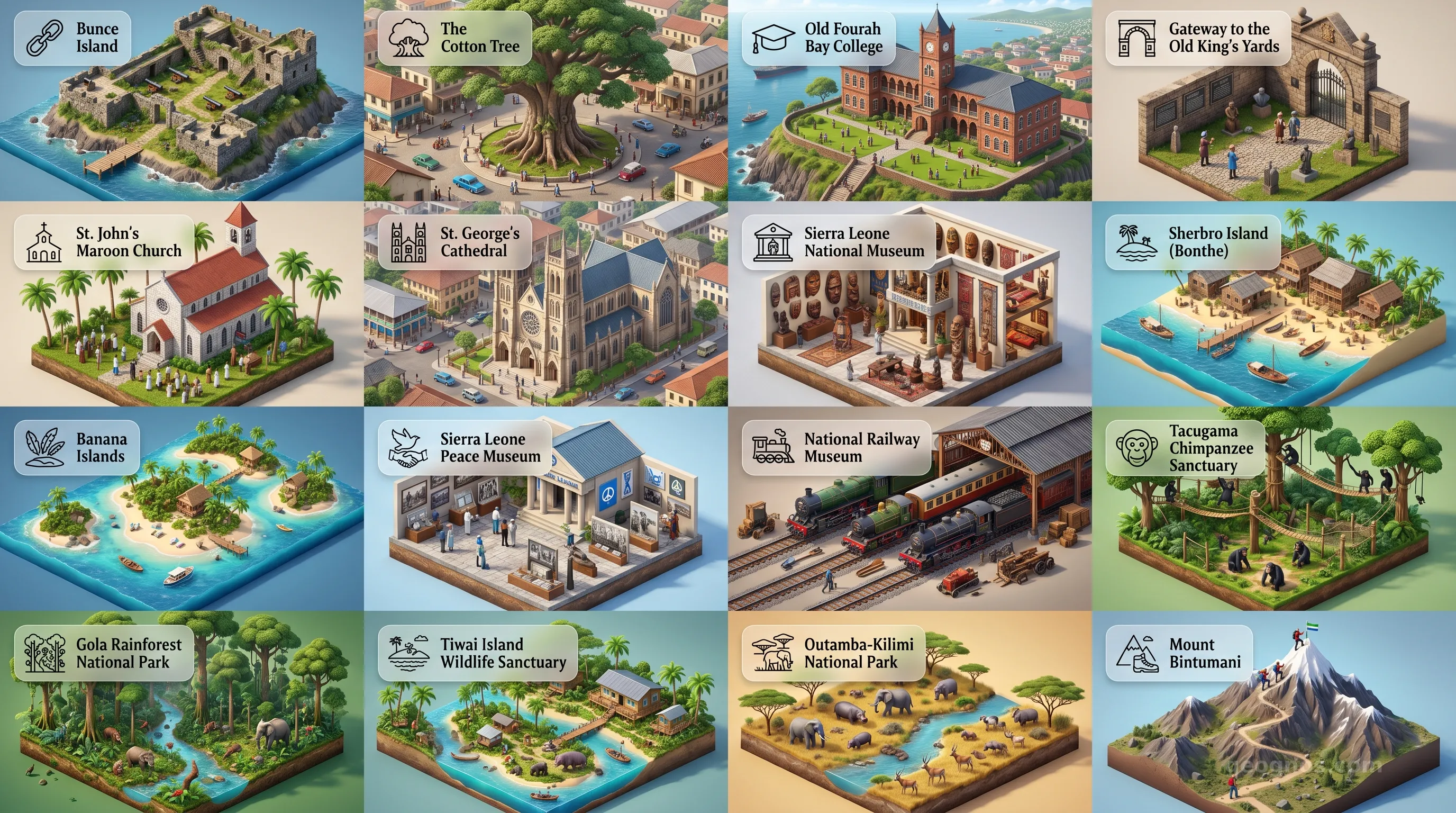
Sierra Leone - Panoramic Places of Interest Atlas including Bunce Island, The Cotton Tree, Old Fourah Bay College, Gateway to the Old King's Yards, St. John's Maroon Church, St. George's Cathedral, Sierra Leone National Museum, Sherbro Island (Bonthe), Banana Islands, Sierra Leone Peace Museum, National Railway Museum, Tacugama Chimpanzee Sanctuary, Gola Rainforest National Park, Tiwai Island Wildlife Sanctuary, Outamba-Kilimi National Park, Mount Bintumani

Top Sights & Landmarks

01

Bunce Island

Historic Slave Trade Fort

02

The Cotton Tree

Symbol of Emancipation

03

Old Fourah Bay College

The Athens of West Africa

04

Gateway to the Old King's Yards

Monument of Liberated Africans

05

St. John's Maroon Church

Historic Maroon Sanctuary

06

St. George's Cathedral

Grand Colonial Cathedral

07

Sierra Leone National Museum

Indigenous Culture and History

08

Sherbro Island (Bonthe)

Decaying Colonial Hub

09

Banana Islands

Historical Archipelago

10

Sierra Leone Peace Museum

Monument to Reconciliation

11

National Railway Museum

Colonial Engineering Heritage

12

Tacugama Chimpanzee Sanctuary

Primate Conservation Haven

13

Gola Rainforest National Park

Ancient Upper Guinean Forest

14

Tiwai Island Wildlife Sanctuary

Primate Biodiversity Hotspot

15

Outamba-Kilimi National Park

Savanna Wildlife Reserve

16

Mount Bintumani

Highest Peak in West Africa

Background

Continuously populated for at least 2,500 years, the area now known as Sierra Leone is covered with dense jungle that allowed the region to remain relatively protected from invading West African empires. Traders introduced Sierra Leone to Islam, which occupies a central role in Sierra Leonean culture and history. In the 17th century, the British set up a trading post near present-day Freetown. The trade originally involved timber and ivory but later expanded to enslaved people. In 1787, after the American Revolution, Sierra Leone became a destination for Black British loyalists from the new United States. When Britain abolished the slave trade in 1807, British ships delivered thousands of liberated Africans to Sierra Leone. During the 19th century, the colony gradually expanded inland. In 1961, Sierra Leone became independent of the UK. Sierra Leone held free and fair elections in 1962 and 1967, but Siaka STEVENS -- Sierra Leone’s second prime minister -- quickly reverted to authoritarian tendencies, outlawing most political parties and ruling from 1967 to 1985. In 1991, Sierra Leonean soldiers launched a civil war against STEVENS’ ruling party. The war caused tens of thousands of deaths and displaced more than 2 million people (about one third of the population). In 1998, a Nigerian-led West African coalition military force intervened, installing Tejan KABBAH -- who was originally elected in 1996 -- as prime minister. In 2002, KABBAH officially announced the end of the war. Since 1998, Sierra Leone has conducted democratic elections dominated by the two main political parties, the Sierra Leone People’s Party (SLPP) and the All People’s Congress (APC) party. In 2018, Julius Maada BIO of the Sierra Leone People’s Party won the presidential election that saw a high voter turnout despite some allegations of voter intimidation. BIO won again in June 2023, although irregularities were noted that called into question the integrity of the results. In October 2023, the Government of Sierra Leone and the main opposition party, the All People’s Congress, signed the Agreement for National Unity to boost cooperation between political parties and begin the process of reforming the country’s electoral system.

Location

Latitude
8.5° N
Longitude
-11.5° E
N S W E
World Map Location
Geographic Location

Western Africa, bordering the North Atlantic Ocean, between Guinea and Liberia

Map Reference
Africa

Area

Total Area
71,740 sq km
Land (100%)
Land: 71,620 sq km
Water: 120 sq km

Elevation

Highest Point
Loma Mansa (Bintimani)
Loma Mansa (Bintimani) 1,948 m
Lowest Point
Atlantic Ocean
Atlantic Ocean 0 m
Mean Elevation
279 m

Detailed Geography Information

Coastline

402 km

Geography - note

rainfall along the coast can reach 495 cm (195 in) a year, making it one of the wettest places along coastal western Africa

Irrigated land

300 sq km (2012)

Land boundaries

Total boundary: 1,093 km
Guinea 794 km
Liberia 299 km

Major watersheds (area sq km)

Atlantic Ocean drainage: Niger (2,261,741 sq km)

Maritime claims

territorial sea: 12 nm contiguous zone: 24 nm exclusive economic zone: 200 nm continental shelf: 200 nm

Natural hazards

dry, sand-laden harmattan winds blow from the Sahara (December to February); sandstorms, dust storms

Natural resources

diamondstitanium orebauxiteiron oregoldchromite

Terrain

coastal belt of mangrove swamps, wooded hill country, upland plateau, mountains in east

Population & Growth

+2.20% Growth
9,331,203
Total inhabitants (2025 est.)
Male: 49.5% (4,620,638) Female: 50.5% (4,710,565)

Age Distribution

0-14 years
40.1%
~3,741,812
15-64 years
57.4%
~5,356,111
65 years
2.5%
~233,280
Note: 2024 est.

Demographic Longevity

Median Age
19.7 years
Male
19 yrs
Female
19.9 yrs
Life Expectancy
59.4 years
Male
57.8 yrs
Female
61 yrs

Vital Dynamics

Birth Rate
30.04
births per 1,000 people
Death Rate
8.8
deaths per 1,000 people
Net Migration
+1.13
migrants per 1,000 people
Fertility Rate
3.52
children born per woman

Detailed People & Society Information

Alcohol consumption per capita

3.22 liters of pure alcohol (2019 est.)

Children under the age of 5 years underweight

12% (2021 est.)

Currently married women (ages 15-49)

61.5% (2019 est.)

Dependency ratios

total dependency ratio: 72.7 (2025 est.) youth dependency ratio: 68.4 (2025 est.) elderly dependency ratio: 4.4 (2025 est.) potential support ratio: 22.9 (2025 est.)

Education expenditure

2.6%

2.6% of GDP (2023 est.) 20.5% national budget (2025 est.)

Ethnic groups

Temne
35.4%
Mende
30.8%
Limba
8.8%
Kono
4.3%
Korankoh
4%
Fullah
3.8%
Mandingo
2.8%
Loko
2%
Sherbro
1.9%
Creole
1.2%
other
5%

Gross reproduction rate

1.73 (2025 est.)

Health expenditure

8.6%

8.6% of GDP (2021) 5.2% of national budget (2022 est.)

Infant mortality rate

total: 70.1 deaths/1,000 live births (2025 est.) male: 76 deaths/1,000 live births female: 66.2 deaths/1,000 live births

Languages

spoken by the descendants of freed Jamaican slaves; a first language for of the population but understood by
10%

Literacy

total population: 43.6% (2019 est.) male: 54.6% (2019 est.) female: 33.9% (2019 est.)

Major urban areas - population

1.309 million FREETOWN (capital) (2023)

Maternal mortality ratio

354 deaths/100,000 live births (2023 est.)

Mother's mean age at first birth

19.6 years (2019 est.) note: data represents median age at first birth among women 20-49

Nationality

noun: Sierra Leonean(s) adjective: Sierra Leonean

Obesity - adult prevalence rate

8.7% (2016)

Physician density

0.13 physicians/1,000 population (2022)

Population distribution

population clusters are found in the lower elevations of the south and west; the northern third of the country is less populated, as shown on this population distribution map

Religions

Muslim
77.1%
Christian
22.9%

Sex ratio

at birth: 1.03 male(s)/female 0-14 years: 1.02 male(s)/female 15-64 years: 0.96 male(s)/female 65 years and over: 0.97 male(s)/female total population: 0.98 male(s)/female (2024 est.)

Tobacco use

total: 9.8% (2025 est.) male: 14.8% (2025 est.) female: 4.9% (2025 est.)

Climate & Issues

Climate Profile

tropical; hot, humid; summer rainy season (May to December); winter dry season (December to April)

Key Environmental Issues
overharvesting of timber, expansion of cattle grazing, and slash-and-burn agriculture resulting in deforestation, soil exhaustion, and flooding loss of biodiversity air pollution water pollution overfishing

Land Cover

Coverage Distribution
Agri (55%)
Forest (34%)
Arable: 21.9%
Crops: 2.3%
Pasture: 30.5%
Forest: 34.3%

Air & Carbon Emissions

Annual CO2 Output 2023 est.
1.342 million
Coal (0%) Oil (100%) Gas (0%)
PM2.5 Exposure 45.4 µg/m³
0 5 (WHO Limit) 15 25 35+

Water Resources & Use

Renewable Water Resources 160 billion cubic meters (2022 est.)
Annual Water Withdrawal
municipal: 111 million cubic meters (2022 est.)
Municipal (52%) Ind (26%) Agri (22%)

Detailed Environmental Information

International environmental agreements

BiodiversityClimate ChangeClimate Change-Kyoto ProtocolClimate Change-Paris AgreementComprehensive Nuclear Test BanDesertificationEndangered SpeciesHazardous WastesLaw of the SeaMarine Dumping-London ConventionMarine Dumping-London ProtocolMarine Life ConservationNuclear Test BanOzone Layer ProtectionShip PollutionWetlands

Urbanization

urban population: 44.3% of total population (2023) rate of urbanization: 3.02% annual rate of change (2020-25 est.)

Waste and recycling

municipal solid waste generated annually: 610,200 tons (2024 est.) percent of municipal solid waste recycled: 9.7% (2022 est.)

Capital & State Profile

Capital City
Freetown
8.4833° N, -13.2333° E
Timezone UTC 0
Government Type
presidential republic
Independence 1961-04-27
National Holiday 04-27

Executive Branch

Chief of State
President Julius Maada BIO (since 27 June 2023)
Head of Government
President Julius Maada BIO (since 27 June 2023)
Last Election 24 June 2023
Next Election June 2028
Cabinet Ministers of State appointed by the president, approved by Parliament; the cabinet is responsible to the president

Legislative Branch

unicameral
Legislature Name Parliament
Seats & Term
149 (135 directly elected; 14 indirectly elected) seats / 5 years
Women in Chamber
29.5% Representation
Electoral System proportional representation
Parties Composition
Sierra Leone People's Party (SLPP) 81All People's Congress (APC) 54

National Identity & Symbols

National Flag Description

three equal horizontal bands of light green (top), white, and light blue

Symbolic Meaning green stands for agriculture, mountains, and natural resources; white for unity and justice; and blue for the sea and the natural harbor in Freetown
National Symbol lion
National Colors green, white, blue
National Anthem High We Exalt Thee, Realm of the Free

Detailed Government Information

Administrative divisions

4 provinces and 1 area*; Eastern, Northern, North Western, Southern, Western*

Citizenship

citizenship by birth: no citizenship by descent only: at least one parent or grandparent must be a citizen of Sierra Leone dual citizenship recognized: yes residency requirement for naturalization: 5 years

Constitution

history: several previous; latest effective 1 October 1991 amendment process: proposed by Parliament; passage of amendments requires at least two-thirds majority vote of Parliament in two successive readings and assent of the president of the republic; passage of amendments affecting fundamental rights and freedoms and many other constitutional sections also requires approval in a referendum with participation of at least one half of qualified voters and at least two thirds of votes cast

Country name

conventional long form: Republic of Sierra Leone conventional short form: Sierra Leone local long form: Republic of Sierra Leone local short form: Sierra Leone etymology: Portuguese explorer Pedro de SINTRA is usually credited with naming the country "Serra da Leao" (Lion Mountains) in 1462, but Venetian explorer Alvise CA' DA MOSTO recorded the name as "Serre-Lionne" in 1457, referring to the rumbling of thunder over the mountains

International law organization participation

has not submitted an ICJ jurisdiction declaration; accepts ICCt jurisdiction

International organization participation

Judicial branch

highest court(s): Superior Court of Judicature (consists of the Supreme Court at the top, with the chief justice and 4 other judges, the Court of Appeal with the chief justice and 7 other judges, and the High Court of Justice with the chief justice and 9 other judges) judge selection and term of office: Supreme Court chief justice and other judges of the Judicature appointed by the president on the advice of the Judicial and Legal Service Commission, a 7-member independent body of judges, presidential appointees, and the Commission chairman, and are subject to approval by Parliament; all Judicature judges serve until retirement at age 65 subordinate courts: magistrates' courts; District Appeals Court; local courts

Legal system

mixed system of English common law and customary law

National heritage

total World Heritage Sites: 1 (natural) selected World Heritage Site locales: Gola-Tiwai Complex (n)

Political parties

All People's Congress or APC Sierra Leone People's Party or SLPP

Suffrage

18 years of age; universal

Economic Overview

low-income West African economy; primarily subsistent agriculture; key iron and diamond mining activities suspended; slow recovery from 1990s civil war; systemic corruption; high-risk debt; high youth unemployment; natural resource rich

Size & Performance

Real GDP (PPP)
$26.728 billion
Latest available estimate (2024)
2023: $25.7 billion2022: $24.312 billion
Real GDP Growth
4% (2024 est.)
+4%
GDP Per Capita (PPP)
$3,100
2023: $3,0002022: $2,900

GDP Sector Breakdown

Agriculture: 25.4%Industry: 27.3%Services: 44.8%
Origin GDP %
Agriculture 25.4%
Industry 27.3%
Services 44.8%

Trade Balance

Trade Position
Trade Deficit
$882.00 million
Total Exports
$1.382 billion (2023 est.)
Total Imports
$2.264 billion (2023 est.)
Exports (38%) Imports (62%)

Budget Balance

Budget Position
Budget Deficit
-$127.00 million
Revenues
$740 million (2019 est.)
Expenditures
$867 million (2019 est.)
Revenues (46%) Expenditures (54%)

Export Profile

Top Export Partners

Note: 2023; top five export partners based on percentage share of exports

Major Export Commodities

iron oretitanium orediamondsaluminum orecocoa beans

Import Profile

Top Import Partners

32.0%
15.0%
5.0%
5.0%
Note: 2023; top five import partners based on percentage share of imports

Major Import Commodities

riceplastic productspackaged medicinecementcars

Labor & Employment

Total Labor Force 2.863 million (2024 est.)
General Unemployment Rate 3.2%
Youth Unemployment (Ages 15-24) 3.6%
Population Below Poverty Line 56.8% (2018 est.)

Income Inequality

Gini Coefficient (Family Income) 35.7
0 (Perfect Equality) Moderate Inequality 100 (Perfect Inequality)

Family Income / Consumption Share

Lowest 10%: 3.4% (2018 est.) Highest 10%: 29.4% (2018 est.)
Inequality Gap: Top 10% holds 8.6x the share of the bottom 10%.

Detailed Economic Data

Agricultural products

cassavariceoil palm fruitvegetablessweet potatoesmilkcitrus fruitsfruitsgroundnutssugarcane

Current account balance

-$606.358 million (2023 est.) -$452.094 million (2022 est.) -$522.815 million (2021 est.) note: balance of payments - net trade and primary/secondary income in current dollars

Debt - external

$1.451 billion (2023 est.) note: present value of external debt in current US dollars

Exchange rates

leones (SLL) per US dollar - Exchange rates: 21.305 (2023 est.) 14.048 (2022 est.) 10.439 (2021 est.) 9.83 (2020 est.) 9.01 (2019 est.)

GDP - composition, by end use

Industrial production growth rate

4.7% (2024 est.) note: annual % change in industrial value added based on constant local currency

Industries

diamond miningiron orerutile and bauxite miningsmall-scale manufacturing (beveragestextilesfootwear)

Inflation rate (consumer prices)

28.6% (2024 est.) 47.6% (2023 est.) 27.2% (2022 est.) note: annual % change based on consumer prices

Remittances

4.6% of GDP (2023 est.) 4.1% of GDP (2022 est.) 2.6% of GDP (2021 est.) note: personal transfers and compensation between resident and non-resident individuals/households/entities

Reserves of foreign exchange and gold

$495.699 million (2023 est.) $624.496 million (2022 est.) $945.908 million (2021 est.) note: holdings of gold (year-end prices)/foreign exchange/special drawing rights in current dollars

Grid Infrastructure

Electricity Access 29.4%
Urban: 55.3% Rural: 5%
Capacity 149,000 kW (2023 est.)
Consumption 131.321 million kWh (2023 est.)
Grid Losses: 81.921 million kWh (2023 est.)

Generation Mix

Percentage Share of Production
hydroelectricity 84.4%
solar 9.8%
fossil fuels 3.4%
biomass and waste 2.3%

Fossil Fuels Production

Petroleum
Consumption 9,000 bbl/day (2023 est.)

Intensity & Nuclear

Energy Consumption Per Capita 2.301 million Btu/person (2023 est.)
No nuclear energy infrastructure or reactor operations reported in this country dossier.

Digital Access

.sl
Internet Usage 21%

Active internet users as a percentage of the total population.

Fixed Broadband

Penetration Rate 0 / 100
Total Subscriptions 0 (2021 est.)

Mobile Cellular

Penetration Rate 108 / 100
Total Subscriptions 8.93 million (2022 est.)

Broadcast Media

1 state-owned TV station; 3 private TV stations; 1 pay-TV service; 1 state-owned national radio station; about 24 private radio stations; transmissions of several international broadcasters available (2019)

Aviation

9L
Airports
8
As of 2025
Heliports
3
As of 2025

Ports & Harbors

Ports Count 3
Hover for breakdown & key ports As of 2024

Merchant Marine

Commercial Fleet
584 ships
Hover for vessel types breakdown As of 2023

Military Expenditures

GDP Allocation 0.5%
0.5% of GDP (2024 est.) 0.6% of GDP (2023 est.) 0.6% of GDP (2022 est.) 0.3% of GDP (2021 est.) 0.3% of GDP (2020 est.)

Active Duty Strengths

estimated 10,000 active Armed Forces (2025)

Refers to active military personnel.

Service & Defense Details

Military and security forces

Republic of Sierra Leone Armed Forces (RSLAF): organized as a Joint Force Command with land, air, and maritime components Ministry of Internal Affairs: Sierra Leone Police (2025)

Military equipment inventories and acquisitions

the RSLAF has a small inventory comprised of obsolescent or secondhand imported armaments (2025)

Military - note

the RSLAF’s primary responsibilities are securing the country's borders and territorial waters, supporting civil authorities during internal emergencies, and participating in peacekeeping missions; since the end of the civil war in 2002, it has received assistance from several foreign militaries, including those of Canada, China, France, the UK, and the US the RSLAF’s origins lie in the Sierra Leone Battalion of the Royal West African Frontier Force (RWAFF), a multi-regiment force formed by the British colonial office in 1900 to garrison the West African colonies of Gold Coast (Ghana), Nigeria (Lagos and the protectorates of Northern and Southern Nigeria), Sierra Leone, and The Gambia; the RWAFF fought in both World Wars (2025)

Military service age and obligation

18-25 for voluntary military service for men and women; no conscription (2025)