Malta
Top Sights & Landmarks
Ancient Subterranean Necropolis
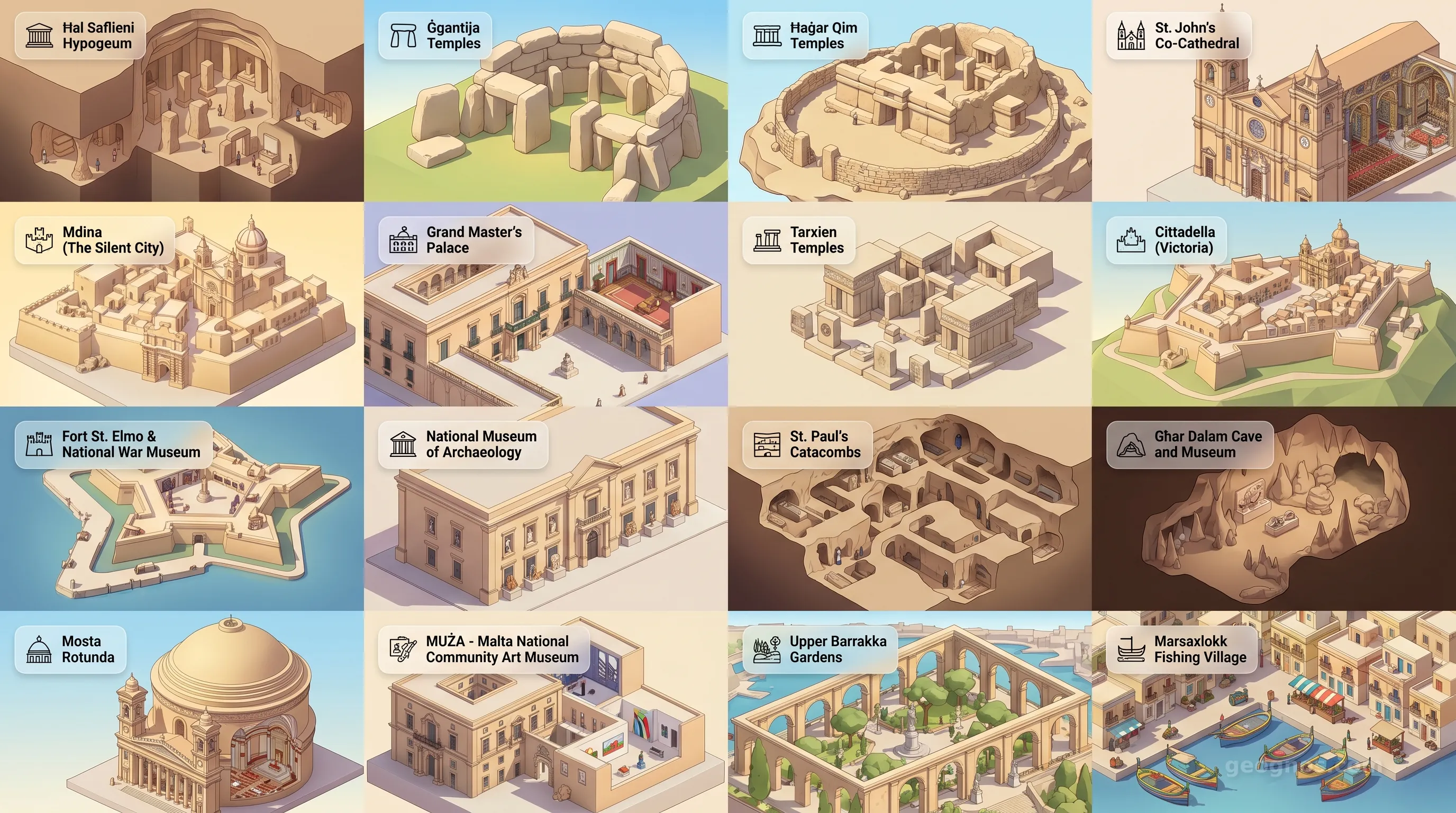
The Ħal Saflieni Hypogeum is an extraordinary subterranean necropolis dating back to 4000 BC. Carved entirely out of limestone rock using primitive tools, this UNESCO World Heritage site offers archaeology students and tourists alike a profound glimpse into Malta's prehistoric culture and early burial rituals. Its historical significance is unmatched, representing the only known prehistoric underground temple in the world. The acoustic properties of the 'Oracle Room' continue to fascinate scientists today. The best time to visit is during the shoulder seasons of spring or autumn. Tourist tip: Due to strict microclimate conservation efforts, only 10 visitors are allowed per hour. You must book your tickets several months in advance to secure entry.
Oldest Free-Standing Structures
Predating Stonehenge and the Egyptian Pyramids, the Ġgantija Temples on the island of Gozo were built around 3600 BC, making them some of the oldest free-standing monuments in the world. According to local folklore, these massive limestone blocks were erected by giants, giving the site its name. For history and architecture students, studying the corbelling techniques used here provides crucial insight into Neolithic engineering. The site is best visited in spring (April-May) when the surrounding Gozitan countryside is lush and covered in wildflowers. Tourist tip: Start your visit at the excellent Interpretation Centre to understand the archaeological context before walking among the megaliths.
Majestic Megalithic Complex
Perched atop a coastal cliff overlooking the Mediterranean Sea and the islet of Filfla, Ħaġar Qim is an awe-inspiring megalithic temple complex dating to 3600-3200 BC. The temple's layout reveals a complex understanding of solar alignments, with sunlight passing directly through the main portals during the summer solstice. This makes it an incredible study site for archaeoastronomy. The best season to visit is early autumn (September-October) for pleasant weather and clear coastal views. Tourist tip: Your ticket also grants access to the nearby Mnajdra Temples, located just a 500-meter walk down the hill. Visit in the early morning or late afternoon for the most dramatic lighting.
Masterpiece of High Baroque Art
Commissioned in 1572 by the Knights of St. John, St. John's Co-Cathedral in Valletta is a crown jewel of High Baroque architecture. Behind its austere, fortress-like exterior lies an incredibly ornate interior covered in gold leaf, intricately carved stone, and a mesmerizing marble floor composed of nearly 400 knightly tombstones. Art students flock here to view Caravaggio's 'The Beheading of Saint John the Baptist', the only painting the artist ever signed, housed in the Oratory. It is a stunning year-round destination, though winter visits allow you to escape the summer tourist crowds. Tourist tip: Wear comfortable, flat shoes, as stiletto heels are strictly forbidden to protect the historic marble floor. Shoulders and knees must be covered.
Malta's Ancient Capital
Mdina is a fortified medieval town that served as Malta's capital from antiquity until the medieval period. Known as the 'Silent City' due to its strict vehicle restrictions, stepping through its imposing gates feels like traveling back in time. The city features an extraordinary mix of Norman and Baroque architecture, providing an immersive textbook for architecture and urban planning students. Wandering its narrow, labyrinthine streets reveals stunning palazzos and sweeping views from the bastions. The best time to visit is during the mild spring or late autumn. Tourist tip: Visit at dusk when the day-trippers have left, and the city is beautifully illuminated by warm lanterns, truly living up to its silent moniker.
Center of the Knights' Power
Dominating Palace Square in Valletta, the Grand Master's Palace has been the administrative heart of Malta since 1571. It originally housed the Grand Masters of the Order of St. John and today serves as the Office of the President of Malta. Students of military history and political science will find the opulent State Rooms and the world-class Palace Armoury, featuring over 5,000 pieces of armor and weaponry, completely captivating. Visiting between October and April ensures cooler weather for exploring the capital. Tourist tip: Don't miss the tapestry chamber, which houses a priceless set of 18th-century Gobelins tapestries depicting the 'Indies'.
Intricate Prehistoric Artwork
Discovered by local farmers in 1913, the Tarxien Temples complex dates from 3150 BC to 2500 BC. What sets Tarxien apart from other Maltese megaliths is the complexity of its stonework, featuring highly decorated stone blocks with relief patterns of spirals, domestic animals, and the famous 'fat lady' statue representing a fertility goddess. It is an essential site for studying the progression of prehistoric art and religious practices. Spring and autumn are the most comfortable seasons to explore the open-air site. Tourist tip: The site is equipped with an elevated walkway, making it fully accessible and providing great overhead views of the temple apses.
The Crown of Gozo
Rising majestically above Victoria, the capital of Gozo, the Cittadella is a historic fortified city that has been inhabited since the Bronze Age. Extensively rebuilt by the Knights of St. John after a devastating Ottoman raid in 1551, its high walls served as a refuge for the entire Gozitan population. Today, it offers students of medieval history an excellent example of strategic defensive architecture. The site offers 360-degree panoramic views of Gozo's rolling hills. Visit during spring to see the island at its greenest. Tourist tip: Walk the full circuit of the bastions for the best photographs, and visit the historic grain silos and World War II shelters hidden beneath the walls.
Heroic Fortress of the Great Siege
Situated at the very tip of the Valletta peninsula, Fort St. Elmo is a star fort best known for its heroic role in the Great Siege of Malta in 1565, where it withstood a massive Ottoman bombardment. Today, it houses the National War Museum. History students will find an unparalleled collection detailing Malta's military history, from the Knights Hospitaller to the island's critical role and heavy bombardment during World War II. The museum displays the George Cross, awarded to the entire island for bravery. Winter and spring are ideal for visiting, as exploring the vast fortress requires extensive walking. Tourist tip: Dedicate at least half a day here to fully explore both the fortifications and the detailed museum exhibits.
Prehistoric Masterpieces Preserved
Housed in the Auberge de Provence in Valletta, a beautiful Baroque building constructed for the Knights in 1571, the National Museum of Archaeology is a crucial companion visit to Malta's temple sites. It protects and displays the most delicate artifacts excavated from the megaliths, including the 'Sleeping Lady' from the Hypogeum and the 'Venus of Malta' from Ħaġar Qim. It is an indispensable resource for archaeology and art history students. Being indoors, it is a perfect year-round destination and a great refuge during hot summer afternoons. Tourist tip: Visit the museum *before* heading to the temple sites to gain a deeper context of what you will see in the field.
Early Christian Underground City
Located on the outskirts of Mdina in Rabat, St. Paul's Catacombs are a typical complex of interconnected, underground Roman cemeteries that were in use up to the 4th century AD. They represent the earliest archaeological evidence of Christianity in Malta. Students of theology and classical history will be fascinated by the mix of Christian, Jewish, and Pagan burial rituals evident in the rock-hewn tombs and agape tables. The subterranean environment is consistently cool, making it a great summer visit. Tourist tip: The complex is vast. Follow the mapped routes carefully, and don't miss the small but excellent visitor center detailing Roman burial customs.
Malta's Ice Age Time Capsule
Għar Dalam (the 'Cave of Darkness') is Malta's oldest prehistoric site. Here, paleontologists have unearthed the fossilized bones of Pleistocene animals—such as dwarf elephants, hippopotamuses, and giant swans—that became stranded on the island when sea levels rose. Above these layers, the earliest evidence of human settlement in Malta (around 5200 BC) was discovered. It is an exceptional site for geology and evolutionary biology students. Spring is the best time to visit, as the cave is surrounded by a beautiful botanical garden. Tourist tip: Keep an eye out for the endemic woodlouse species that lives only deep within the dark recesses of this specific cave.
The Miracle Dome
The Sanctuary Basilica of the Assumption of Our Lady, commonly known as the Mosta Rotunda, boasts one of the largest unsupported domes in the world, inspired by the Pantheon in Rome. Completed in 1860, it holds a profound place in Maltese modern history. During a WWII air raid in 1942, a 500kg bomb pierced the dome and landed among a congregation of 300 people—and miraculously failed to detonate. Architecture students can marvel at the neoclassical design, while history buffs can see a replica of the bomb in the sacristy. It is open year-round. Tourist tip: Climb the stairs to the portico roof for an up-close view of the dome's massive scale and a great vantage point over the town.
Modern Gateway to Maltese Fine Art
MUŻA is Malta's premier fine arts museum, housed in the historic Auberge d'Italie in Valletta. This innovative institution was a flagship project of Valletta's tenure as the 2018 European Capital of Culture. It holds a vast collection of Maltese and international art from the early Renaissance to contemporary works, making it a vibrant hub for art students and cultural tourists. The museum's layout encourages visitors to interact with the narratives of the Mediterranean. Since it is entirely indoors and air-conditioned, it's perfect for a mid-summer cultural immersion. Tourist tip: Enjoy a coffee or light lunch in the museum's beautiful courtyard café, an oasis of calm in the bustling capital.
Panoramic Grand Harbour Views
Originally created in 1560 as a private garden and exercise ground for the Knights of the 'Langue of Italy', the Upper Barrakka Gardens offer arguably the most spectacular viewpoint in the Mediterranean. Looking out over the Grand Harbour and the historic 'Three Cities', the terraced gardens are a masterclass in Renaissance landscape placement. Below the viewing balcony lies the Saluting Battery, where cannons are still fired daily. Any season is suitable, though a clear winter's day provides crisp photography. Tourist tip: Arrive just before 12:00 PM or 4:00 PM to witness the historical re-enactors firing the cannon from the Saluting Battery.
Traditional Mediterranean Port
Marsaxlokk is Malta's largest traditional fishing village, famous for its picturesque harbor filled with brightly colored 'Luzzu' fishing boats, which still bear the ancient Phoenician 'Eye of Osiris' on their bows to ward off evil spirits. For cultural studies, it offers a living example of Mediterranean maritime traditions. The village is steeped in history; it was the landing site of the Ottoman fleet during the Great Siege of 1565. Visit on a Sunday morning during the autumn or spring to experience the massive, bustling open-air fish market. Tourist tip: Skip the busiest tourist restaurants right on the square and walk further down the promenade for the freshest, most authentic seafood catches of the day.