🇲🇻

Maldives

South Asia • Countries •
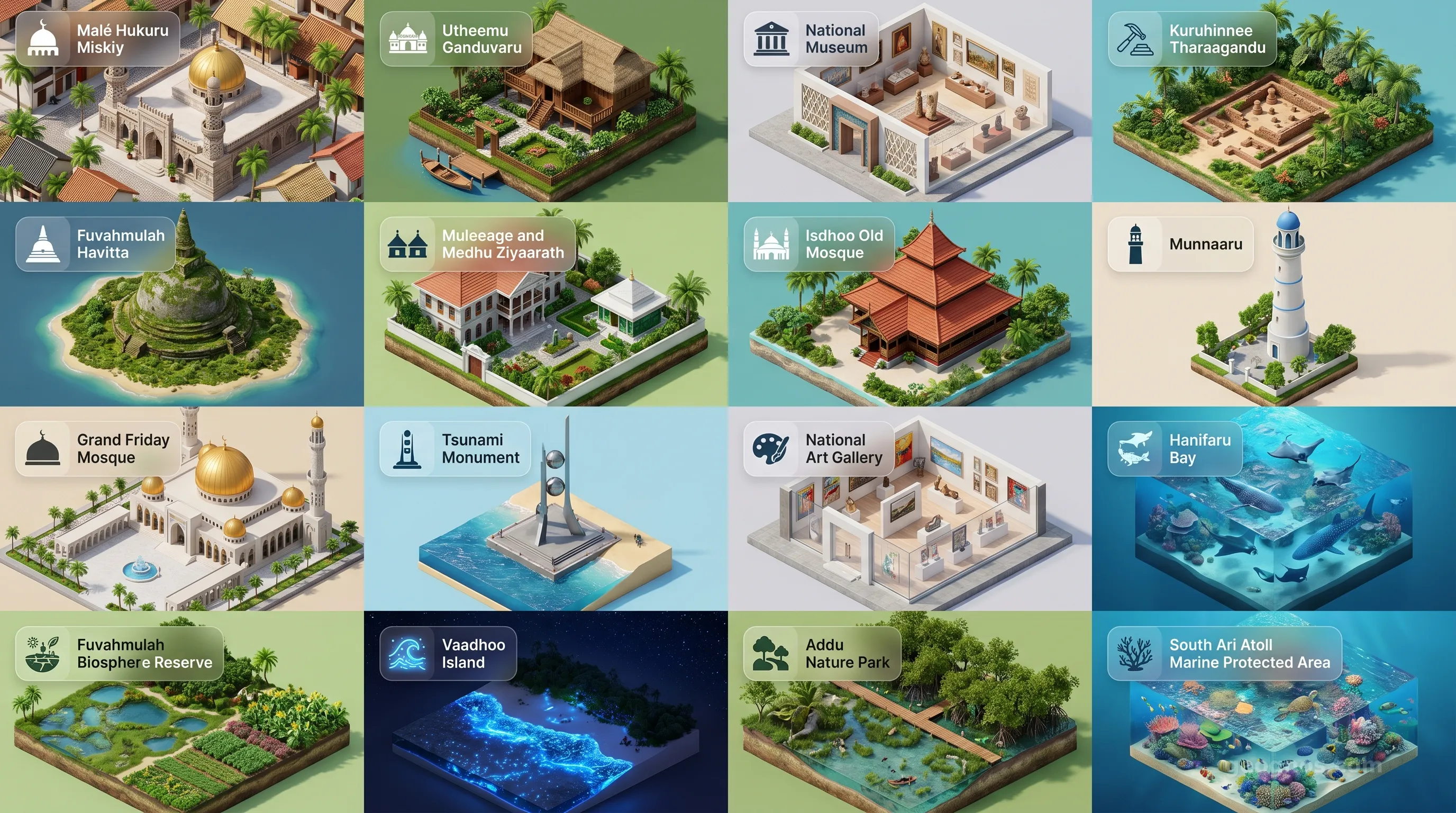
Maldives - Panoramic Places of Interest Atlas including Malé Hukuru Miskiy (Old Friday Mosque), Utheemu Ganduvaru, National Museum, Kuruhinnee Tharaagandu, Fuvahmulah Havitta, Muleeaage and Medhu Ziyaarath, Isdhoo Old Mosque, Munnaaru, Grand Friday Mosque (Islamic Centre), Tsunami Monument, National Art Gallery, Hanifaru Bay (Baa Atoll Biosphere Reserve), Fuvahmulah Biosphere Reserve, Vaadhoo Island, Addu Nature Park, South Ari Atoll Marine Protected Area

Top Sights & Landmarks

01

Malé Hukuru Miskiy (Old Friday Mosque)

Ancient Coral Stone Mosque

02

Utheemu Ganduvaru

Palace of the National Hero

03

National Museum

Repository of Maldivian Heritage

04

Kuruhinnee Tharaagandu

Ancient Buddhist Monastery Ruins

05

Fuvahmulah Havitta

Ruined Pre-Islamic Stupa

06

Muleeaage and Medhu Ziyaarath

Presidential Palace and Sacred Tomb

07

Isdhoo Old Mosque

Home of the Ancient Loamaafaanu

08

Munnaaru

The Grand Minaret of Malé

09

Grand Friday Mosque (Islamic Centre)

Modern Icon of Maldivian Islam

10

Tsunami Monument

Memorial to the 2004 Tragedy

11

National Art Gallery

Center for Contemporary Maldivian Art

12

Hanifaru Bay (Baa Atoll Biosphere Reserve)

Manta Ray Feeding Sanctuary

13

Fuvahmulah Biosphere Reserve

The Single-Island Equatorial Atoll

14

Vaadhoo Island

The Sea of Stars

15

Addu Nature Park

Largest Wetlands in the Maldives

16

South Ari Atoll Marine Protected Area

Year-Round Whale Shark Habitat

Background

A sultanate since the 12th century, the Maldives became a British protectorate in 1887 and a republic in 1968, three years after independence. President Maumoon Abdul GAYOOM dominated Maldives' political scene for 30 years, elected to six successive terms by single-party referendums. After political demonstrations in the capital Male in 2003, GAYOOM and his government pledged to embark upon a process of liberalization and democratic reforms, including a more representative political system and expanded political freedoms. Political parties were legalized in 2005. In 2008, a constituent assembly -- termed the "Special Majlis" -- finalized a new constitution ratified by GAYOOM. The first-ever presidential elections under a multi-candidate, multi-party system were held later that year. GAYOOM was defeated in a runoff by Mohamed NASHEED, a political activist whom the regime had jailed several years earlier. In 2012, after several weeks of street protests in response to a top judge's arrest, NASHEED resigned the presidency and handed over power to Vice President Mohammed WAHEED Hassan Maniku. A government-appointed Commission of National Inquiry concluded that there was no evidence of a coup, but NASHEED contended that police and military personnel forced him to resign. NASHEED, WAHEED, and Abdulla YAMEEN Abdul Gayoom ran in the 2013 elections with YAMEEN ultimately winning the presidency after three rounds of voting. In 2018, YAMEEN lost his reelection bid to parliamentarian Ibrahim Mohamed SOLIH. YAMEEN was arrested and jailed in 2022 on corruption charges. Maldives' fourth democratic election was held in September 2023. The winner, Male City Mayor Dr. Mohamed MUIZZU, campaigned on a platform of Maldivian sovereignty, vowing to remove Indian military personnel from the country. MUIZZU represents a joint Progressive Pary of Maldives and People's National Congress (PPM/PNC) coalition.

Location

Latitude
3.25° N
Longitude
73° E
N S W E
World Map Location
Geographic Location

Southern Asia, group of atolls in the Indian Ocean, south-southwest of India

Map Reference
Asia

Area

Total Area
298 sq km
Land (100%)
Land: 298 sq km
Water: 0 sq km

Elevation

Highest Point
8th tee, golf course, Villingi Island
8th tee, golf course, Villingi Island 5 m
Lowest Point
Indian Ocean
Indian Ocean 0 m
Mean Elevation
2 m

Detailed Geography Information

Coastline

644 km

Geography - note

smallest Asian country; archipelago of 1,190 coral islands grouped into 26 atolls (200 inhabited islands, plus 80 islands with tourist resorts); strategic location along major sea lanes in Indian Ocean

Irrigated land

0 sq km (2012)

Land boundaries

total: 0 km

Maritime claims

territorial sea: 12 nm contiguous zone: 24 nm exclusive economic zone: 200 nm note: measured from claimed archipelagic straight baselines

Natural hazards

tsunamis; low elevation of islands makes them sensitive to sea level rise

Natural resources

fish

Terrain

flat coral atolls, with white sandy beaches; sits atop the submarine volcanic Chagos-Laccadive Ridge

Population & Growth

-0.20% Growth
388,010
Total inhabitants (2025 est.)
Male: 50.3% (195,208) Female: 49.7% (192,802)

Age Distribution

0-14 years
22.4%
~86,914
15-64 years
71.5%
~277,427
65 years
6.1%
~23,669
Note: 2024 est.

Demographic Longevity

Median Age
32.4 years
Male
31.3 yrs
Female
32.4 yrs
Life Expectancy
77.4 years
Male
75.1 yrs
Female
79.9 yrs

Vital Dynamics

Birth Rate
14.77
births per 1,000 people
Death Rate
4.3
deaths per 1,000 people
Net Migration
-12.85
migrants per 1,000 people
Fertility Rate
1.7
children born per woman

Detailed People & Society Information

Alcohol consumption per capita

1.38 liters of pure alcohol (2019 est.)

Children under the age of 5 years underweight

14.8% (2017 est.)

Currently married women (ages 15-49)

68.4% (2022 est.)

Dependency ratios

total dependency ratio: 40.8 (2025 est.) youth dependency ratio: 31.6 (2025 est.) elderly dependency ratio: 9.2 (2025 est.) potential support ratio: 10.9 (2025 est.)

Education expenditure

5.2%

5.2% of GDP (2023 est.) 9.6% national budget (2025 est.)

Ethnic groups

Gross reproduction rate

0.83 (2025 est.)

Health expenditure

10%

10% of GDP (2021) 18.2% of national budget (2022 est.)

Hospital bed density

5 beds/1,000 population (2020 est.)

Infant mortality rate

total: 23.7 deaths/1,000 live births (2025 est.) male: 27.3 deaths/1,000 live births female: 21.3 deaths/1,000 live births

Languages

Literacy

total population: 98.2% (2019 est.) male: 98.2% (2019 est.) female: 98.3% (2019 est.)

Major urban areas - population

177,000 MALE (capital) (2018)

Maternal mortality ratio

32 deaths/100,000 live births (2023 est.)

Mother's mean age at first birth

23.2 years (2016/17 est.) note: data represents median age at first birth among women 25-49

Nationality

noun: Maldivian(s) adjective: Maldivian

Obesity - adult prevalence rate

8.6% (2016)

Physician density

2.24 physicians/1,000 population (2019)

Population distribution

about a third of the population lives in the centrally located capital city of Male and almost a tenth in southern Addu City; the remainder of the populace is spread over the 200 or so populated islands of the archipelago

Refugees and internally displaced persons

Total Displaced & Vulnerable Persons
54 individuals
Internally Displaced Persons (IDPs)
100.0%
54
54 (2023 est.)

Religions

School life expectancy (primary to tertiary education)

total: 13 years (2022 est.) male: 11 years (2022 est.) female: 15 years (2022 est.)

Sex ratio

at birth: 1.05 male(s)/female 0-14 years: 1.04 male(s)/female 15-64 years: 1.06 male(s)/female 65 years and over: 0.77 male(s)/female total population: 1.04 male(s)/female (2024 est.)

Tobacco use

total: 28% (2025 est.) male: 41.5% (2025 est.) female: 9.2% (2025 est.)

Climate & Issues

Climate Profile

tropical; hot, humid; dry, northeast monsoon (November to March); rainy, southwest monsoon (June to August)

Key Environmental Issues
rising sea levels depletion of freshwater aquifers inadequate sewage treatment coral reef bleaching

Land Cover

Coverage Distribution
Agri (20%)
Other (68%)
Arable: 13.4%
Crops: 3.0%
Pasture: 3.4%
Forest: 12.5%

Air & Carbon Emissions

Annual CO2 Output 2023 est.
1.908 million
Coal (0%) Oil (100%) Gas (0%)
PM2.5 Exposure 12.3 µg/m³
0 5 (WHO Limit) 15 25 35+

Water Resources & Use

Renewable Water Resources 30 million cubic meters (2022 est.)
Annual Water Withdrawal
municipal: 5.6 million cubic meters (2022 est.)
Municipal (91%) Ind (5%) Agri (4%)

Detailed Environmental Information

International environmental agreements

BiodiversityClimate ChangeClimate Change-Kyoto ProtocolClimate Change-Paris AgreementComprehensive Nuclear Test BanDesertificationEndangered SpeciesHazardous WastesLaw of the SeaOzone Layer ProtectionShip Pollution

Urbanization

urban population: 42% of total population (2023) rate of urbanization: 2.34% annual rate of change (2020-25 est.)

Waste and recycling

municipal solid waste generated annually: 211,500 tons (2024 est.) percent of municipal solid waste recycled: 20.9% (2022 est.)

Capital & State Profile

Capital City
Mal&eacute
4.1667° N, 73.5° E
Timezone UTC+5
Government Type
presidential republic
Independence 1965-07-26
National Holiday 07-26

Executive Branch

Chief of State
President Mohamed MUIZZU (since 17 November 2023)
Head of Government
President Mohamed MUIZZU (since 17 November 2023)
Last Election 9 September 2023, with runoff on 30 September 2023
Next Election 2028
Cabinet Cabinet of Ministers appointed by the president, approved by People's Majlis

Legislative Branch

unicameral
Legislature Name People's Majlis (Majlis)
Seats & Term
93 (all directly elected) seats / 5 years
Women in Chamber
3.2% Representation
Electoral System plurality/majority
Parties Composition
People's National Congress (PNC) 66Maldivian Democratic Party (MDP) 12Independents 11Other 4

National Identity & Symbols

National Flag Description

red with a large green rectangle in the center and a vertical white crescent moon centered on the rectangle

Symbolic Meaning red stands for those who have sacrificed their lives to defend the country, green for peace and prosperity, and the white crescent is a symbol of Islam
National Symbol coconut palm, yellowfin tuna
National Colors red, green, white
National Anthem Gaumee Salaam (National Salute)

Detailed Government Information

Administrative divisions

21 administrative atolls (atholhuthah, singular - atholhu); Addu (Addu City), Ariatholhu Dhekunuburi (South Ari Atoll), Ariatholhu Uthuruburi (North Ari Atoll), Faadhippolhu, Felidhuatholhu (Felidhu Atoll), Fuvammulah, Hahdhunmathi, Huvadhuatholhu Dhekunuburi (South Huvadhu Atoll), Huvadhuatholhu Uthuruburi (North Huvadhu Atoll), Kolhumadulu, Maale (Male), Maaleatholhu (Male Atoll), Maalhosmadulu Dhekunuburi (South Maalhosmadulu), Maalhosmadulu Uthuruburi (North Maalhosmadulu), Miladhunmadulu Dhekunuburi (South Miladhunmadulu), Miladhunmadulu Uthuruburi (North Miladhunmadulu), Mulakatholhu (Mulaku Atoll), Nilandheatholhu Dhekunuburi (South Nilandhe Atoll), Nilandheatholhu Uthuruburi (North Nilandhe Atoll), Thiladhunmathee Dhekunuburi (South Thiladhunmathi), Thiladhunmathee Uthuruburi (North Thiladhunmathi)

Citizenship

citizenship by birth: no citizenship by descent only: at least one parent must be a citizen of Maldives dual citizenship recognized: yes residency requirement for naturalization: unknown

Constitution

history: many previous; latest ratified 7 August 2008 amendment process: proposed by Parliament; passage requires at least three-quarters majority vote by its membership and the signature of the president of the republic; passage of amendments to constitutional articles on rights and freedoms and the terms of office of Parliament and of the president also requires a majority vote in a referendum

Country name

conventional long form: Republic of Maldives conventional short form: Maldives local long form: Dhivehi Raajjeyge Jumhooriyyaa local short form: Dhivehi Raajje etymology: the origin of the name is obscure but may derive from the Sanskrit word maladvipa, meaning "garland of islands;" the local name, Dhivehi Raajje, means "land of the Dhivehi people" in the local language

International law organization participation

has not submitted an ICJ jurisdiction declaration; accepts ICCt jurisdiction

International organization participation

Judicial branch

highest court(s): Supreme Court (consists of the chief justice and 6 justices) judge selection and term of office: Supreme Court judges appointed by the president in consultation with the Judicial Service Commission -- a 10-member body of selected senior government officials and the public -- and on confirmation by voting members of the People's Majlis; judges serve until mandatory retirement at age 70 subordinate courts: High Court; Criminal, Civil, Family, Juvenile, and Drug Courts; Magistrate Courts (on each of the inhabited islands)

Legal system

Islamic (sharia) legal system with English common law influences, primarily in commercial matters

Political parties

Adhaalath (Justice) Party or AP Dhivehi Rayyithunge Party or DRP Maldives Development Alliance or MDA Maldivian Democratic Party or MDP Maldives Third Way Democrats or MTD People's National Congress or PNC People's National Front Republican (Jumhooree) Party or JP

Suffrage

18 years of age; universal

Economic Overview

upper middle-income Indian Ocean island economy; major tourism, fishing, and shipping industries; high public debt; systemic corruption; crippled by COVID-19; ongoing deflation; poverty has tripled since pandemic began

Size & Performance

Real GDP (PPP)
$12.325 billion
Latest available estimate (2024)
2023: $11.723 billion2022: $11.194 billion
Real GDP Growth
5.1% (2024 est.)
+5.1%
GDP Per Capita (PPP)
$23,400
2023: $22,3002022: $21,400

GDP Sector Breakdown

Agriculture: 3.0%Industry: 9.0%Services: 73.8%
Origin GDP %
Agriculture 3.0%
Industry 9.0%
Services 73.8%

Trade Balance

Trade Position
Trade Surplus
$69.00 million
Total Exports
$5.413 billion (2024 est.)
Total Imports
$5.344 billion (2024 est.)
Exports (50%) Imports (50%)

Budget Balance

Budget Position
Budget Deficit
-$532.00 million
Revenues
$1.407 billion (2021 est.)
Expenditures
$1.939 billion (2021 est.)
Revenues (42%) Expenditures (58%)

Export Profile

Top Export Partners

Note: 2023; top five export partners based on percentage share of exports

Major Export Commodities

fishaircraftrefined petroleumscrap ironnatural gas

Import Profile

Top Import Partners

15.0%
15.0%
14.0%
12.0%
Note: 2023; top five import partners based on percentage share of imports

Major Import Commodities

refined petroleumplastic productsaircraftgraniteships

Labor & Employment

Total Labor Force 270,300 (2024 est.)
General Unemployment Rate 4.7%
Youth Unemployment (Ages 15-24) 16.1%
Population Below Poverty Line 5.4% (2019 est.)

Income Inequality

Gini Coefficient (Family Income) 29.3
0 (Perfect Equality) Low Inequality 100 (Perfect Inequality)

Family Income / Consumption Share

Lowest 10%: 3.8% (2019 est.) Highest 10%: 23.3% (2019 est.)
Inequality Gap: Top 10% holds 6.1x the share of the bottom 10%.

Detailed Economic Data

Agricultural products

fruitsvegetablesnutsother meatspapayasbananastomatoesmaizepulsespeppers

Current account balance

-$1.257 billion (2024 est.) -$1.4 billion (2023 est.) -$1.042 billion (2022 est.) note: balance of payments - net trade and primary/secondary income in current dollars

Debt - external

$3.113 billion (2023 est.) note: present value of external debt in current US dollars

Exchange rates

rufiyaa (MVR) per US dollar - Exchange rates: 15.389 (2024 est.) 15.387 (2023 est.) 15.387 (2022 est.) 15.373 (2021 est.) 15.381 (2020 est.)

GDP - composition, by end use

Industrial production growth rate

-2.7% (2024 est.) note: annual % change in industrial value added based on constant local currency

Industries

tourismfish processingshippingboat buildingcoconut processingwoven matsropehandicraftscoral and sand mining

Inflation rate (consumer prices)

1.4% (2024 est.) 2.9% (2023 est.) 2.3% (2022 est.) note: annual % change based on consumer prices

Remittances

0.1% of GDP (2024 est.) 0.1% of GDP (2023 est.) 0.1% of GDP (2022 est.) note: personal transfers and compensation between resident and non-resident individuals/households/entities

Reserves of foreign exchange and gold

$673.886 million (2024 est.) $590.523 million (2023 est.) $832.094 million (2022 est.) note: holdings of gold (year-end prices)/foreign exchange/special drawing rights in current dollars

Taxes and other revenues

19.5% (of GDP) (2021 est.) note: central government tax revenue as a % of GDP

Grid Infrastructure

Electricity Access 100%
Capacity 432,000 kW (2023 est.)
Consumption 821.397 million kWh (2023 est.)
Grid Losses: 25.867 million kWh (2023 est.)

Generation Mix

Percentage Share of Production
fossil fuels 93.2%
solar 6.6%
wind 0.2%

Fossil Fuels Production

Petroleum
Consumption 13,000 bbl/day (2023 est.)
Coal
Imports 8 metric tons (2023 est.)

Intensity & Nuclear

Energy Consumption Per Capita 50.886 million Btu/person (2023 est.)
No nuclear energy infrastructure or reactor operations reported in this country dossier.

Digital Access

.mv
Internet Usage 85%

Active internet users as a percentage of the total population.

Fixed Broadband

Penetration Rate 19 / 100
Total Subscriptions 98,000 (2023 est.)

Mobile Cellular

Penetration Rate 148 / 100
Total Subscriptions 782,000 (2024 est.)

Broadcast Media

formerly a state-owned radio and TV monopoly; now 4 state-operated and 7 privately owned TV stations; 4 state-operated and 7 privately owned radio stations (2019)

Aviation

8Q
Airports
20
As of 2025

Ports & Harbors

Ports Count 1
Hover for breakdown & key ports As of 2024

Merchant Marine

Commercial Fleet
82 ships
Hover for vessel types breakdown As of 2023

Military Expenditures

GDP Allocation N/A
not available

Active Duty Strengths

approximately 3-4,000 active Defense Forces (2025)

Refers to active military personnel.

Service & Defense Details

Military and security forces

Maldives National Defense Force (MNDF): Coast Guard, Marine Corps, Air Corps, Fire and Rescue Service Ministry of Homeland Security and Technology (MOHST): Maldives Police Service (2025) note: in addition to the MNDF, the Maldives Ministry of Defense controls the Aviation Security Command, which provides security for the civil aviation industry, and the National Counter Terrorism Center

Military equipment inventories and acquisitions

the Defense Force has a limited inventory consisting of mostly secondhand or donated equipment from suppliers such as Germany, India, Japan, Türkiye, and the UK (2025)

Military - note

the Maldives National Defense Force (MNDF) is responsible for defending and safeguarding the Maldives' territorial integrity, economic exclusion zone, and people; it is also responsible for disaster relief, and if requested, assisting the Maldives Police Service in maintaining internal security and law and order; maritime security is its largest focus; the Indian Armed Forces have long been the MNDF's most important partner (2025)

Military service age and obligation

18-25 years of age for voluntary service; no conscription (2025) note: in 2025, the Maldives began allowing Maldivians 16-28 (under 18 with parental consent) who lacked access to further education after completing their secondary education or employment could join the Maldives National Service Program and be recruited to the Army or Police