Suriname
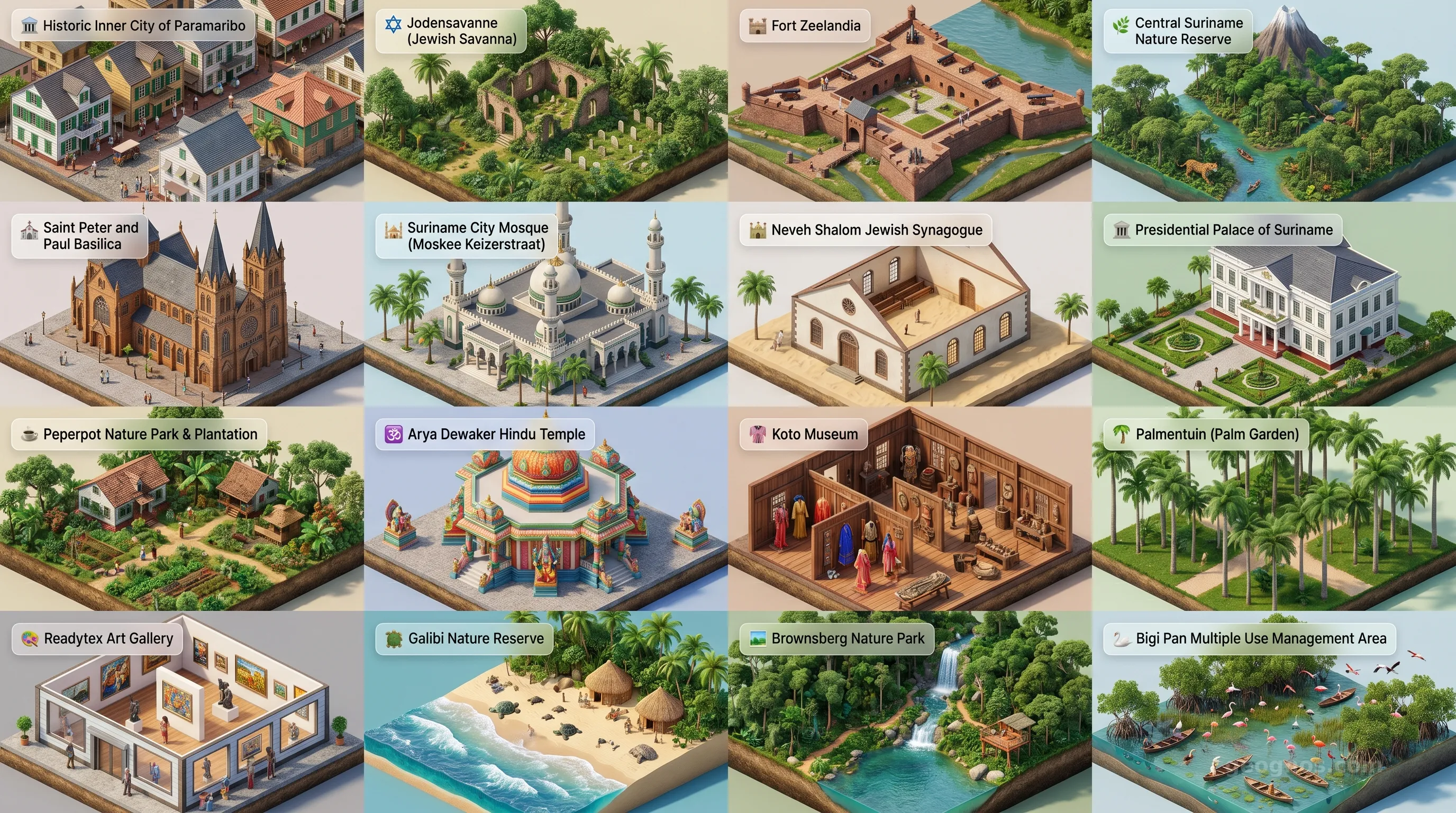
Top Sights & Landmarks
A Dutch-Creole Architectural Marvel
The Historic Inner City of Paramaribo is a remarkable fusion of European architectural techniques and indigenous South American materials, creating a unique Dutch-Creole streetscape. Designated a UNESCO World Heritage site, its impeccably preserved 17th and 18th-century timber buildings reflect Suriname's complex colonial past, offering a vital study area for urban historians and sociologists. The intricate, grid-like layout speaks volumes about Dutch colonial planning adapted to a tropical environment. The best time to visit is during the dry seasons (February to April or August to November) to comfortably walk the streets. Tourist tip: Start your walking tour early in the morning to avoid the midday equatorial heat, and don't miss the striking black-and-white facades of the Waterkant.
Ruins of a 17th-Century Jewish Settlement
Recently recognized as a UNESCO World Heritage site, Jodensavanne is a profoundly significant archaeological area. Established in the 17th century by Sephardic Jews fleeing persecution, it was one of the first places in the Americas where Jewish people were granted territorial and religious autonomy. The site contains the evocative ruins of the Beracha Ve Shalom synagogue and sprawling historic cemeteries hidden amidst the encroaching jungle. It is an essential site for studying early colonial religious sanctuaries and the dark history of the plantation economy. Visit during the long dry season (August to November) when the dirt roads leading south of Paramaribo are most accessible. Tourist tip: Hire a knowledgeable local guide who can contextualize the surviving gravestones and the broader historical narrative of the area.
Suriname's Colonial Stronghold
Originally built by the French, expanded by the British, and ultimately completed by the Dutch, Fort Zeelandia is a pentagonal fortress that has witnessed centuries of Surinamese history. Today, it houses the Stichting Surinaams Museum, making it an indispensable stop for anyone studying the country's pre-Columbian artifacts, colonial heritage, and modern political struggles, including the tragic 'December Murders' of 1982. The fort's riverside location provides stunning views of the Suriname River. The museum is excellent year-round, offering an air-conditioned reprieve from the tropical weather. Tourist tip: Visit on a Sunday morning for a quieter, more reflective experience, and stop by the historic Baka Bana cafe on the museum grounds.
A Pristine Amazonian Wilderness
Covering over 1.6 million hectares of primary tropical forest, this UNESCO World Heritage site is a globally crucial area for biodiversity and climate regulation. For environmental scientists, biologists, and ecotourists, it represents one of the most untouched and pristine ecosystems in the Neotropics, home to jaguars, giant armadillos, and tapirs. The reserve protects the upper watershed of the Coppename River and offers unmatched opportunities to study virgin rainforest ecology. The best time to visit is from August to November when the trails are less muddy. Tourist tip: Access is largely via small aircraft or long boat journeys; book an all-inclusive eco-lodge tour to ensure permits and logistics are handled.
The Wooden Cathedral of Paramaribo
The Saint Peter and Paul Basilica is the largest wooden structure in the Western Hemisphere, an awe-inspiring testament to Suriname's unique architectural heritage. Constructed in the late 19th century, the interior is entirely unpainted, showcasing beautifully carved Surinamese cedar. Historically and culturally, it serves as the spiritual center for the Catholic community in an incredibly religiously diverse nation. Architecture and theology students will marvel at its Gothic Revival design adapted to Caribbean constraints. The basilica is open year-round. Tourist tip: Visitors must adhere to a strict dress code (shoulders and knees must be covered). Guided tours are highly recommended to understand the structural challenges of maintaining such a massive wooden building.
A Symbol of Religious Harmony
The Moskee Keizerstraat serves as the headquarters of the Lahore Ahmadiyya Movement in Suriname. What makes this mosque culturally and historically vital is its location—it stands directly adjacent to the Neveh Shalom Jewish Synagogue, famously symbolizing the peaceful religious coexistence that characterizes Suriname. Featuring beautiful minarets and elegant Islamic architecture, it offers a window into the demographic shifts resulting from indentured labor from South Asia. Students of sociology and theology will find the site a powerful case study in multiculturalism. Open year-round, respectful attire is required. Tourist tip: Visit both the mosque and the synagogue in a single trip to truly appreciate the juxtaposed harmony.
Historic Sand-Floored Synagogue
Constructed in 1832 to replace an earlier 18th-century structure, the Neveh Shalom Synagogue is a breathtaking architectural gem. Its most distinctive feature is its floor covered entirely in white sand—a tradition symbolic of the Israelites' 40 years in the desert and a functional acoustic dampener used by conversos during the Spanish Inquisition. It provides immense value to historians studying the Jewish diaspora in the Caribbean. Located next to the central mosque, it completes the picture of Surinamese religious tolerance. The synagogue is accessible year-round. Tourist tip: Check in advance for visiting hours, as they can be irregular, and be prepared to take your shoes off to walk softly on the sand.
The Seat of the Republic
Overlooking Independence Square (Onafhankelijkheidsplein), the Presidential Palace is an exquisite example of Dutch colonial architecture and the political heart of Suriname. Originally built in 1730 and expanded over the centuries, the brilliant white building with its iconic portico serves as the official reception venue for the government. It is a critical landmark for understanding Suriname's transition from a Dutch colony to an independent republic in 1975. The exterior is best photographed in the golden hour just before sunset. Tourist tip: While the interior is generally closed to the public except on National Independence Day (November 25), the surrounding square offers a beautiful walk alongside historic statues and monuments.
Reclaimed Coffee and Cocoa Plantation
Peperpot is one of the oldest coffee and cocoa plantations along the Commewijne River, functioning from the early 19th century until the late 20th century. Now overgrown and reclaimed by the jungle, it has been transformed into a nature park. For historians, it provides a sobering look into the plantation economy, slavery, and subsequent indentured labor from Java and India. For biologists, the dense secondary forest is a hotspot for spotting squirrel monkeys, toucans, and sloths. It is a fantastic year-round destination, especially early mornings for wildlife. Tourist tip: Rent a bicycle in Paramaribo, take the small wooden ferry across the Suriname River, and cycle through the scenic trail of Peperpot.
Suriname's Largest Hindu Temple
The Arya Dewaker temple is an octagonal, two-story marvel that stands out as the most prominent Hindu temple in Suriname. Built by the Arya Samaj community, the architecture avoids traditional depictions of deities, instead using Vedic symbolism, Hindi and Sanskrit inscriptions, and the sun's geometry. It is a vital cultural landmark representing the Indo-Surinamese population, who make up a significant portion of the country's demographic. It is highly educational for those studying religious architecture and Indian diaspora history. Tourist tip: Visit during Diwali (usually October or November) when the temple is beautifully illuminated, though respectful visits are welcome year-round.
Celebrating Afro-Surinamese Heritage
The Koto Museum is a charming, intimate institution dedicated to the history and preservation of the 'Koto'—the traditional dress of Afro-Surinamese women, and the 'Angisa'—the intricately folded headscarves used to communicate hidden messages during and after the era of slavery. This museum provides essential sociological and anthropological context regarding Creole culture, resilience, and female empowerment in Suriname. The traditional wooden house setting adds to the immersive historical experience. Open year-round in Paramaribo. Tourist tip: The museum is small and privately run; call ahead to ensure it is open and to request a guided explanation of the secretive language of the Angisa folds.
A Historic Royal Oasis
Located directly behind the Presidential Palace, the Palmentuin is a historic garden boasting hundreds of towering royal palm trees, some planted under the orders of Dutch Governor van Aerssen van Sommelsdijck in the late 17th century. As part of the UNESCO-designated inner city, it has long served as a recreational hub and an urban refuge. The garden is a living monument to colonial landscaping and is culturally significant as the site of numerous national festivals. The best time to visit is in the late afternoon. Tourist tip: Keep an eye out for tropical birds and the occasional capuchin monkey, and enjoy a traditional Surinamese shaved ice (schaafijs) from a local vendor near the entrance.
The Pulse of Surinamese Contemporary Art
To truly understand a country's evolving identity, one must look at its art. Readytex Art Gallery is the premier visual arts institution in Suriname, spread across multiple floors and featuring contemporary works by Indigenous, Maroon, Creole, Javanese, and Hindustani artists. It provides immense educational value for those studying post-colonial Caribbean and South American art movements. The gallery showcases paintings, sculptures, and mixed-media installations that explore themes of identity, nature, and history. It's a perfect indoor activity during heavy tropical downpours. Tourist tip: Check their schedule for exhibition openings or artist talks, which offer a great opportunity to mingle with the local creative community.
Sea Turtle Sanctuary and Indigenous Culture
Located at the mouth of the Marowijne River on the border with French Guiana, Galibi is world-renowned as a major nesting ground for the giant Leatherback, Green, and Olive Ridley sea turtles. Beyond its immense ecological value for marine biologists and conservationists, the area is home to traditional Kali'na (Carib) indigenous communities, offering a unique opportunity to study indigenous culture, crafts, and survival in the modern era. The absolute best season to visit is between March and July, during the turtle nesting season. Tourist tip: Turtle watching is strictly regulated; always go with certified local guides at night, and refrain from using flash photography, which disorients the majestic creatures.
A Mountaintop Jungle Retreat
A relatively accessible slice of the Amazonian rainforest, Brownsberg Nature Park sits on a 500-meter-high laterite plateau overlooking the Brokopondo Reservoir. For geology and ecology students, it represents an incredible transition zone of biodiversity, boasting beautiful waterfalls (like Ireneval and Leoval) and abundant wildlife including howler monkeys and blue morpho butterflies. Historically, it reflects the nation's eco-tourism evolution alongside a legacy of gold mining in surrounding areas. The dry season (August to November) makes the steep, unpaved ascent much easier. Tourist tip: Wake up before sunrise to hear the deafening and otherworldly roar of the howler monkeys echoing through the misty canopy.
A Birdwatcher's Wetland Paradise
Bigi Pan, located in the northwestern district of Nickerie, is a vast, open wetland ecosystem composed of mangrove forests, mudflats, and a huge shallow lagoon. It is an internationally recognized habitat for over 120 species of birds, most notably the brilliant Scarlet Ibis and massive flocks of flamingos. It is an essential study site for ornithologists and wetland ecologists. The interaction of the local fishing communities with the ecosystem provides a great model of sustainable resource management. September to March is ideal for seeing migratory bird flocks. Tourist tip: Book a stay in one of the wooden lodges built on stilts directly over the water for an incredibly tranquil overnight experience.