🇵🇾

Paraguay

South America Countries
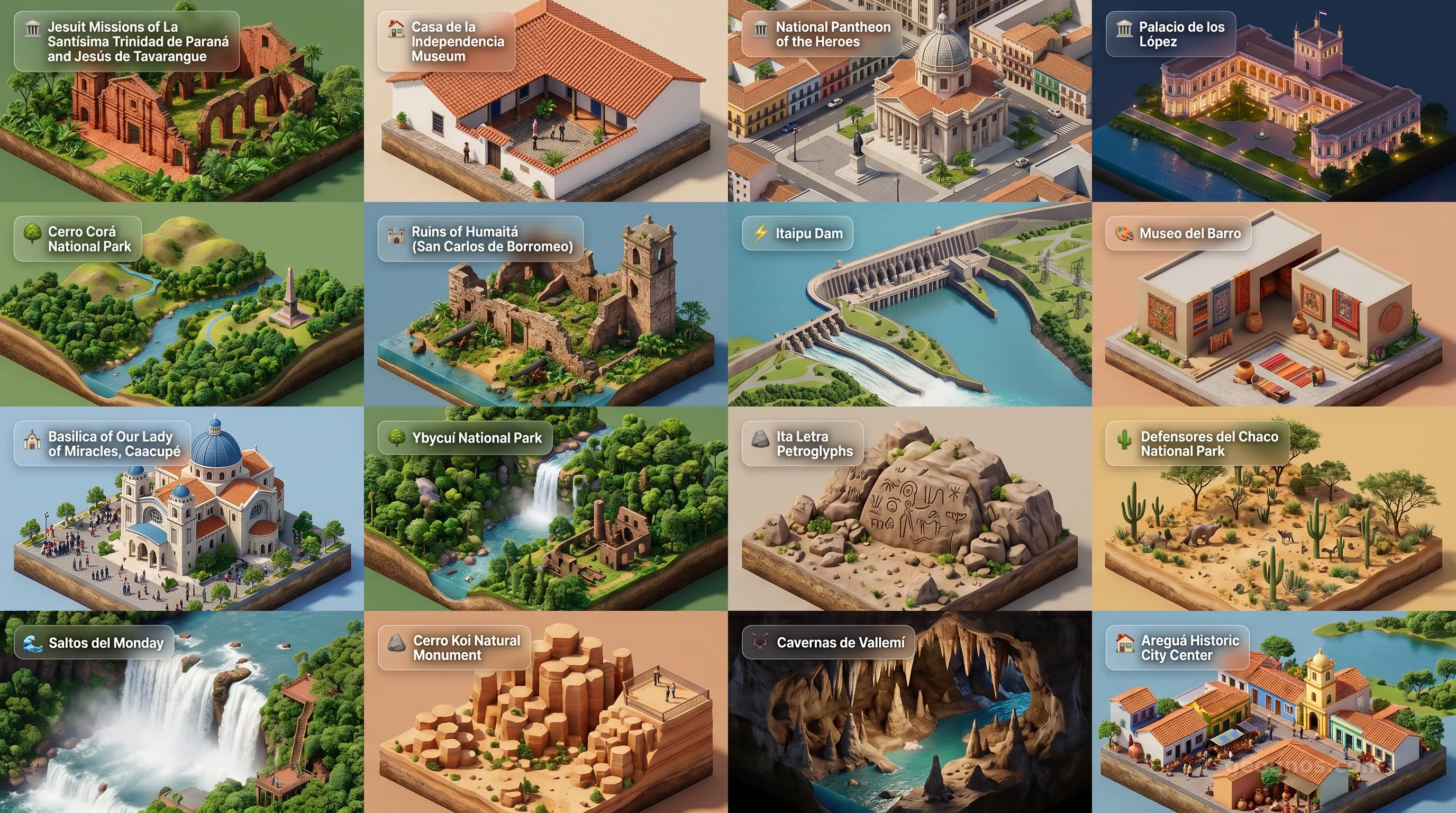
Paraguay - Panoramic Places of Interest Atlas including Jesuit Missions of La Santísima Trinidad de Paraná and Jesús de Tavarangue, Casa de la Independencia Museum, National Pantheon of the Heroes, Palacio de los López, Cerro Corá National Park, Ruins of Humaitá (San Carlos de Borromeo), Itaipu Dam, Museo del Barro, Basilica of Our Lady of Miracles, Caacupé, Ybycuí National Park, Ita Letra Petroglyphs, Defensores del Chaco National Park, Saltos del Monday, Cerro Koi Natural Monument, Cavernas de Vallemí, Areguá Historic City Center

Top Sights & Landmarks

01

Jesuit Missions of La Santísima Trinidad de Paraná and Jesús de Tavarangue

Ruins of the Jesuit Reductions

02

Casa de la Independencia Museum

Birthplace of Paraguayan Liberty

03

National Pantheon of the Heroes

Resting Place of Paraguay's Heroes

04

Palacio de los López

The Seat of the Paraguayan Government

05

Cerro Corá National Park

Site of the Final Battle

06

Ruins of Humaitá (San Carlos de Borromeo)

The Fortress of Humaitá

07

Itaipu Dam

A Modern Engineering Marvel

08

Museo del Barro

Showcase of Paraguayan Art

09

Basilica of Our Lady of Miracles, Caacupé

The Spiritual Heart of Paraguay

10

Ybycuí National Park

Nature and Iron History

11

Ita Letra Petroglyphs

Ancient Rock Inscriptions

12

Defensores del Chaco National Park

The Untamed Gran Chaco

13

Saltos del Monday

The Roaring Monday Falls

14

Cerro Koi Natural Monument

Octagonal Sandstone Formations

15

Cavernas de Vallemí

Limestone Labyrinths of the North

16

Areguá Historic City Center

The City of Strawberries and Pottery

Background

Several Indigenous groups, principally belonging to the Guarani language family, inhabited the area of modern Paraguay before the arrival of the Spanish in the early 16th century, when the territory was incorporated into the Viceroyalty of Peru. Paraguay achieved its independence from Spain in 1811 with the help of neighboring states. In the aftermath of independence, a series of military dictators ruled the country until 1870. During the disastrous War of the Triple Alliance (1864-70) -- fought against Argentina, Brazil, and Uruguay -- Paraguay lost two thirds of its adult males and much of its territory. The country stagnated economically for the next half-century and experienced a tumultuous series of political regimes. Following the Chaco War of 1932-35 with Bolivia, Paraguay gained a large part of the Chaco lowland region. The 35-year military dictatorship of Alfredo STROESSNER ended in 1989, and Paraguay has held relatively free and regular presidential elections since the country's return to democracy.

Location

Latitude
-23° N
Longitude
-58° E
N S W E
World Map Location
Geographic Location

Central South America, northeast of Argentina, southwest of Brazil

Map Reference
South America

Area

Total Area
406,752 sq km
Land (98%)
Land: 397,302 sq km
Water: 9,450 sq km

Elevation

Highest Point
Cerro Pero
Cerro Pero 842 m
Lowest Point
junction of Río Paraguay and Río Paraná
junction of Río Paraguay and Río Paraná 46 m
Mean Elevation
178 m

Detailed Geography Information

Coastline

0 km (landlocked)

Geography - note

landlocked; lies between Argentina, Bolivia, and Brazil; population concentrated in eastern and southern part of country

Irrigated land

1,362 sq km (2012)

Land boundaries

Total boundary: 4,655 km
Argentina 2531 km
Bolivia 753 km
Brazil 1371 km

Major aquifers

Guarani Aquifer System

Major rivers (by length in km)

Río de la Plata/Paraná (shared with Brazil [s], Argentina, and Uruguay [m]) - 4,880 km; Paraguay river mouth (shared with Brazil [s] and Argentina) - 2,549 km note: [s] after country name indicates river source; [m] after country name indicates river mouth

Major watersheds (area sq km)

Atlantic Ocean drainage: Paraná (2,582,704 sq km)

Maritime claims

none (landlocked)

Natural hazards

local flooding in southeast (early September to June); poorly drained plains may become boggy (early October to June)

Natural resources

hydropowertimberiron oremanganeselimestone

Terrain

grassy plains and wooded hills east of Rio Paraguay; Gran Chaco region west of Rio Paraguay mostly low, marshy plain near the river, and dry forest and thorny scrub elsewhere

Population & Growth

+1.10% Growth
7,604,044
Total inhabitants (2025 est.)
Male: 50.1% (3,809,407) Female: 49.9% (3,794,637)

Age Distribution

0-14 years
22.2%
~1,688,098
15-64 years
68.4%
~5,201,166
65 years
9.4%
~714,780
Note: 2024 est.

Demographic Longevity

Median Age
32.3 years
Male
31.6 yrs
Female
32 yrs
Life Expectancy
78.8 years
Male
76.2 yrs
Female
81.6 yrs

Vital Dynamics

Birth Rate
15.66
births per 1,000 people
Death Rate
4.97
deaths per 1,000 people
Net Migration
-0.07
migrants per 1,000 people
Fertility Rate
1.88
children born per woman

Detailed People & Society Information

Alcohol consumption per capita

5.47 liters of pure alcohol (2019 est.)

Children under the age of 5 years underweight

1.3% (2016 est.)

Currently married women (ages 15-49)

54.8% (2022 est.)

Dependency ratios

total dependency ratio: 46.7 (2025 est.) youth dependency ratio: 32.4 (2025 est.) elderly dependency ratio: 14.3 (2025 est.) potential support ratio: 7 (2025 est.)

Education expenditure

3.4%

3.4% of GDP (2023 est.) 11.7% national budget (2025 est.)

Ethnic groups

Mestizo
95%
other
5%

Gross reproduction rate

0.92 (2025 est.)

Health expenditure

8%

8% of GDP (2021) 17.4% of national budget (2022 est.)

Hospital bed density

1 beds/1,000 population (2020 est.)

Infant mortality rate

total: 21.4 deaths/1,000 live births (2025 est.) male: 26.1 deaths/1,000 live births female: 17.7 deaths/1,000 live births

Languages

Spanish and Guarani
46.3%
only Guarani
34%
only Spanish
15.2%
other Indigenous languages
4.1%
no response
0.4%

Literacy

total population: 94.9% (2024 est.) male: 95.4% (2024 est.) female: 94.3% (2024 est.)

Major urban areas - population

3.511 million ASUNCION (capital) (2023)

Maternal mortality ratio

58 deaths/100,000 live births (2023 est.)

Mother's mean age at first birth

22.9 years (2008 est.) note: data represents median age at first birth among women 25-29

Nationality

noun: Paraguayan(s) adjective: Paraguayan

Obesity - adult prevalence rate

20.3% (2016)

Physician density

3.89 physicians/1,000 population (2022)

Population distribution

most of the population resides in the eastern half of the country; to the west lies the Gran Chaco (a semi-arid lowland plain), which accounts for 60% of the land territory, but only 2% of the overall population

Refugees and internally displaced persons

Total Displaced & Vulnerable Persons
7,795 individuals
Refugees
98.1%
7,649
7,649 (2024 est.)
Internally Displaced Persons (IDPs)
1.8%
141
141 (2024 est.)
Stateless Persons
0.1%
5
5 (2024 est.)

Religions

Roman Catholic
80.4%
Protestant
7%
Evangelical Pentecostal <
0.1%
Adventist <
0.1%
Protestant <
0.1%
Believer
5.7%
other
0.6%
agnostic <
0.1%
none
0.2%
unspecified
6.2%

Sex ratio

at birth: 1.05 male(s)/female 0-14 years: 1.04 male(s)/female 15-64 years: 1.01 male(s)/female 65 years and over: 0.91 male(s)/female total population: 1 male(s)/female (2024 est.)

Tobacco use

total: 9.3% (2025 est.) male: 15.5% (2025 est.) female: 3.3% (2025 est.)

Climate & Issues

Climate Profile

subtropical to temperate; substantial rainfall in the eastern portions, becoming semiarid in the far west

Key Environmental Issues
deforestation water pollution toxic dumping in rivers and streams loss of wetlands inadequate means for waste disposal in urban areas

Land Cover

Coverage Distribution
Agri (54%)
Forest (37%)
Arable: 11.5%
Crops: 0.2%
Pasture: 42.4%
Forest: 36.9%

Air & Carbon Emissions

Annual CO2 Output 2023 est.
7.509 million
Coal (100%) Oil (0%) Gas (0%)
PM2.5 Exposure 12.5 µg/m³
0 5 (WHO Limit) 15 25 35+
Methane Emissions
energy: 37.3 kt (2022-2024 est.)

Water Resources & Use

Renewable Water Resources 387.77 billion cubic meters (2022 est.)
Annual Water Withdrawal
municipal: 362 million cubic meters (2022 est.)
Municipal (15%) Ind (6%) Agri (79%)

Detailed Environmental Information

International environmental agreements

BiodiversityClimate ChangeClimate Change-Kyoto ProtocolClimate Change-Paris AgreementComprehensive Nuclear Test BanDesertificationEndangered SpeciesHazardous WastesLaw of the SeaOzone Layer ProtectionWetlands

Urbanization

urban population: 63.1% of total population (2023) rate of urbanization: 1.64% annual rate of change (2020-25 est.)

Waste and recycling

municipal solid waste generated annually: 1.819 million tons (2024 est.) percent of municipal solid waste recycled: 18.1% (2022 est.)

Capital & State Profile

Capital City
Asunci&oacute
-25.2667° N, -57.6667° E
Timezone UTC-3
Government Type
presidential republic
Independence 1811-05-15
National Holiday 05-15

Executive Branch

Chief of State
President Santiago PE&Ntilde;A Palacios (since 15 August 2023)
Head of Government
President Santiago PE&Ntilde;A Palacios (since 15 August 2023)
Last Election 30 April 2023
Next Election April 2028
Cabinet Council of Ministers appointed by the president

Legislative Branch

bicameral
Legislature Name Congress (Congreso)
Lower Chamber Chamber of Deputies (Cámara de Diputados)
Seats 80 (all directly elected)
Term 5 years
% Women 23.8%
Parties Composition
National Republican Association/Colorado Party (ANR) 48Authentic Radical Liberal Party (PLRA) - Alliances 23National Crusade Party (CN) 4Other 5
Upper Chamber Senate (Cámara de Senadores)
Seats 45 (all directly elected)
Term 5 years
% Women 22.2%
Parties Composition
National Republican Association/Colorado Party (ANR) 23Authentic Radical Liberal Party (PLRA) - Alliances 12National Crusade Party (CN) 5Other 5

National Identity & Symbols

National Flag Description

three equal horizontal bands of red (top), white, and blue, with an emblem centered on the white band; the emblem on one side of the flag is the national coat of arms, which has a five-pointed yellow star in a green wreath with the words REPUBLICA DEL PARAGUAY around it, all inside two circles; the other side of the flag has a circular treasury seal (a yellow lion below a red Cap of Liberty and the words PAZ Y JUSTICIA)

Symbolic Meaning red stands for bravery and patriotism, white for integrity and peace, and blue for liberty and generosity
National Symbol lion
National Colors red, white, blue
National Anthem Paraguayos, Republica o muerte! (Paraguayans, the Republic or Death!)

Detailed Government Information

Administrative divisions

17 departments (departamentos, singular - departamento) and 1 capital city*; Alto Paraguay, Alto Parana, Amambay, Asuncion*, Boquer&oacute;n, Caaguaz&uacute;, Caazap&aacute;, Canindey&uacute;, Central, Concepcion, Cordillera, Guair&aacute;, Itap&uacute;a, Misiones, &Ntilde;eembuc&uacute;, Paraguar&iacute;, Presidente Hayes, San Pedro

Citizenship

citizenship by birth: yes citizenship by descent only: at least one parent must be a native-born citizen of Paraguay dual citizenship recognized: yes residency requirement for naturalization: 3 years

Constitution

history: several previous; latest approved and promulgated 20 June 1992 amendment process: proposed at the initiative of at least one quarter of either chamber of the National Congress, by the president of the republic, or by petition of at least 30,000 voters; passage requires a two-thirds majority vote by both chambers and approval in a referendum

Country name

conventional long form: Republic of Paraguay conventional short form: Paraguay local long form: Rep&uacute;blica del Paraguay local short form: Paraguay etymology: derives from the river of the same name; the river's name may come from the Guarani words para (water or river) and guay (born)

International law organization participation

accepts compulsory ICJ jurisdiction; accepts ICCt jurisdiction

International organization participation

Judicial branch

highest court(s): Supreme Court of Justice or Corte Suprema de Justicia (consists of 9 justices divided 3 each into the Constitutional Court, Civil and Commercial Chamber, and Criminal Division) judge selection and term of office: justices proposed by the Council of Magistrates or Consejo de la Magistratura, a 6-member independent body, and appointed by the Chamber of Senators with presidential concurrence; judges can serve until mandatory retirement at age 75 subordinate courts: appellate courts; first instance courts; minor courts, including justices of the peace

Legal system

civil law system with influences from Argentine, Spanish, Roman, and French civil law models; Supreme Court of Justice reviews legislative acts

National heritage

total World Heritage Sites: 1 (cultural) selected World Heritage Site locales: Jesuit Missions of La Sant&iacute;sima Trinidad de Paran&aacute; and Jes&uacute;s de Tavarangue

Political parties

Asociacion Nacional Republicana (National Republican Association) - Colorado Party or ANR Avanza Pais coalition or AP Frente Guasu (Broad Front coalition) or FG GANAR Alliance (Great Renewed National Alliance) (alliance between PLRA and Guas&uacute; Front) Movimiento Hagamos or MH Movimiento Union Nacional de Ciudadanos Eticos (National Union of Ethical Citizens) or UNACE Partido Cruzada Nacional (National Crusade Party) or PCN; note - formerly Movimiento Cruzada Nacional Partido del Movimiento al Socialismo or P-MAS Partido Democratica Progresista (Progressive Democratic Party) or PDP Partido Encuentro Nacional or PEN Partido Liberal Radical Autentico (Authentic Radical Liberal Party) or PLRA Partido Pais Solidario or PPS Partido Popular Tekojoja or PPT Patria Querida (Beloved Fatherland Party) or PPQ

Suffrage

18 years of age; universal and compulsory until the age of 75

Economic Overview

upper middle-income South American economy; COVID-19 hit while still recovering from 2019 Argentina-driven recession; global hydroelectricity leader; major corruption and money-laundering locale; highly agrarian economy; significant income inequality

Size & Performance

Real GDP (PPP)
$112.919 billion
Latest available estimate (2024)
2023: $108.316 billion2022: $103.159 billion
Real GDP Growth
4.2% (2024 est.)
+4.2%
GDP Per Capita (PPP)
$16,300
2023: $15,8002022: $15,300

GDP Sector Breakdown

Agriculture: 10.7%Industry: 32.5%Services: 48.7%
Origin GDP %
Agriculture 10.7%
Industry 32.5%
Services 48.7%

Trade Balance

Trade Position
Trade Deficit
$982.00 million
Total Exports
$17.395 billion (2024 est.)
Total Imports
$18.377 billion (2024 est.)
Exports (49%) Imports (51%)

Budget Balance

Budget Position
Budget Deficit
-$1.65 billion
Revenues
$7.751 billion (2023 est.)
Expenditures
$9.397 billion (2023 est.)
Revenues (45%) Expenditures (55%)

Export Profile

Top Export Partners

Note: 2023; top five export partners based on percentage share of exports

Major Export Commodities

soybeansbeefelectricitycornsoybean meal

Import Profile

Top Import Partners

Note: 2023; top five import partners based on percentage share of imports

Major Import Commodities

broadcasting equipmentrefined petroleumfertilizerscarspesticides

Labor & Employment

Total Labor Force 3.502 million (2024 est.)
General Unemployment Rate 6.1%
Youth Unemployment (Ages 15-24) 14.1%
Population Below Poverty Line 24.7% (2022 est.)

Income Inequality

Gini Coefficient (Family Income) 44.4
0 (Perfect Equality) High Inequality 100 (Perfect Inequality)

Family Income / Consumption Share

Lowest 10%: 1.8% (2023 est.) Highest 10%: 34.4% (2023 est.)
Inequality Gap: Top 10% holds 19.1x the share of the bottom 10%.

Detailed Economic Data

Agricultural products

soybeanssugarcanemaizecassavawheatricemilkbeeforangesbananas

Current account balance

-$1.666 billion (2024 est.) -$176.597 million (2023 est.) -$2.948 billion (2022 est.) note: balance of payments - net trade and primary/secondary income in current dollars

Debt - external

$13.783 billion (2023 est.) note: present value of external debt in current US dollars

Exchange rates

guarani (PYG) per US dollar - Exchange rates: 7,560.248 (2024 est.) 7,288.872 (2023 est.) 6,982.752 (2022 est.) 6,774.163 (2021 est.) 6,771.097 (2020 est.)

GDP - composition, by end use

Industrial production growth rate

2.2% (2024 est.) note: annual % change in industrial value added based on constant local currency

Industries

sugar processingcementtextilesbeverageswood productssteelbase metalselectric power

Inflation rate (consumer prices)

3.8% (2024 est.) 4.6% (2023 est.) 9.8% (2022 est.) note: annual % change based on consumer prices

Remittances

2% of GDP (2024 est.) 1.7% of GDP (2023 est.) 1.4% of GDP (2022 est.) note: personal transfers and compensation between resident and non-resident individuals/households/entities

Reserves of foreign exchange and gold

$9.886 billion (2023 est.) $9.519 billion (2022 est.) $9.661 billion (2021 est.) note: holdings of gold (year-end prices)/foreign exchange/special drawing rights in current dollars

Taxes and other revenues

10.1% (of GDP) (2023 est.) note: central government tax revenue as a % of GDP

Grid Infrastructure

Electricity Access 100%
Capacity 8.928 million kW (2023 est.)
Consumption 14.835 billion kWh (2023 est.)
Exports 24.202 billion kWh (2023 est.)
Grid Losses: 5.209 billion kWh (2023 est.)

Generation Mix

Percentage Share of Production
hydroelectricity 99.4%
biomass and waste 0.5%

Fossil Fuels Production

Petroleum
Production 2,000 bbl/day (2023 est.)
Consumption 52,000 bbl/day (2023 est.)
Coal
Consumption 700 metric tons (2023 est.)
Exports 10 metric tons (2023 est.)
Imports 100 metric tons (2023 est.)

Intensity & Nuclear

Energy Consumption Per Capita 25.733 million Btu/person (2023 est.)
No nuclear energy infrastructure or reactor operations reported in this country dossier.

Digital Access

.py
Internet Usage 78%

Active internet users as a percentage of the total population.

Fixed Broadband

Penetration Rate 13 / 100
Total Subscriptions 878,000 (2023 est.)

Mobile Cellular

Penetration Rate 127 / 100
Total Subscriptions 8.67 million (2023 est.)

Broadcast Media

6 privately owned TV stations; about 75 commercial and community radio stations; 1 state-owned radio network (2019)

Aviation

ZP
Airports
83
As of 2025
Heliports
29
As of 2025

Railways

Total Track Length
30 km
National Network Data from 2014

Ports & Harbors

Ports Count 1
Hover for breakdown & key ports As of 2024

Merchant Marine

Commercial Fleet
108 ships
Hover for vessel types breakdown As of 2023

Military Expenditures

GDP Allocation 0.8%
0.8% of GDP (2024 est.) 0.8% of GDP (2023 est.) 0.8% of GDP (2022 est.) 1% of GDP (2021 est.) 1% of GDP (2020 est.)

Active Duty Strengths

approximately 15,000 active duty Armed Forces (2025)

Refers to active military personnel.

Service & Defense Details

Military and security forces

Armed Forces of Paraguay (Fuerzas Armadas de Paraguay; aka Armed Forces of the Nation or Fuerzas Armadas de la Naci&oacute;n): Paraguayan Army (Ej&eacute;rcito Paraguayo), Paraguayan Navy (Armada Paraguaya; includes marines), Paraguayan Air Force (Fuerza A&eacute;rea Paraguaya) Ministry of Internal Affairs: National Police of Paraguay (Polic&iacute;a Nacional del Paraguay, PNP) (2025)

Military equipment inventories and acquisitions

the military's inventory is comprised of mostly older or obsolescent equipment from a variety of foreign suppliers, particularly Brazil and the US; in recent years, the military has received small quantities of more modern equipment, such as light attack aircraft from Brazil and secondhand helicopters from Taiwan (2025)

Military - note

the Paraguayan military is responsible for external defense and has a role in domestic security duties; it provides support for natural disasters and cooperates with the National Police and other internal security organizations in combating the Paraguayan People’s Army (Ej&eacute;rcito del Pueblo Paraguayo or EPP) and transnational criminal organizations, largely narcotics traffickers; the EPP is a small, domestic criminal/guerrilla group operating in the rural northern part of the country along the border with Brazil; the activities of the EPP and its offshoots—Marsical L&oacute;pez’s Army (EML) and the Armed Peasant Association (ACA)—have consisted largely of isolated attacks on remote police and army posts, or against ranchers and peasants accused of aiding Paraguayan security forces the Paraguayan military has deployed small numbers of troops on UN peacekeeping missions and cooperates with neighboring countries, such as Argentina and Brazil, on security issues, particularly organized crime and narco-trafficking in what is known as the Tri-Border Area; Paraguay has not fought a war against a neighboring country since the Chaco War with Bolivia in the 1930s (2025)

Military service age and obligation

18-25 years of age for voluntary service for men and women; all men 18-25 are required to perform military service for at least 12 months (2025)

Space Agency

Space Agency of Paraguay (Agencia Especial del Paraguay, AEP; established 2014) (2025)

Program Overview

has a small, recently established space program focused on the acquisition of satellites, satellite data, and the technologies and capabilities to manufacture satellites, as well as promoting domestic expertise and industry; a priority is acquiring remote sensing capabilities to support socio-economic development, including resource mapping, weather, and crop monitoring; has built a cube satellite with foreign assistance; operates satellites; cooperates with foreign space agencies and industries, including those of India, Japan, Taiwan, the US, and member states of the Latin American and Caribbean Space Agency (2025)

Program Milestones

2017 organized country’s first international conference on space issues
2021 first research/technology-demonstrator cube satellite (Guaranisat-1) built jointly with Japan, launched by US, and deployed from International Space Station; signed protocols for the establishment of the Latin American and Caribbean Space Agency
2025 developing Guarani-Sat-2, which will be Paraguay's second satellite and the first designed and built domestically