Argentina
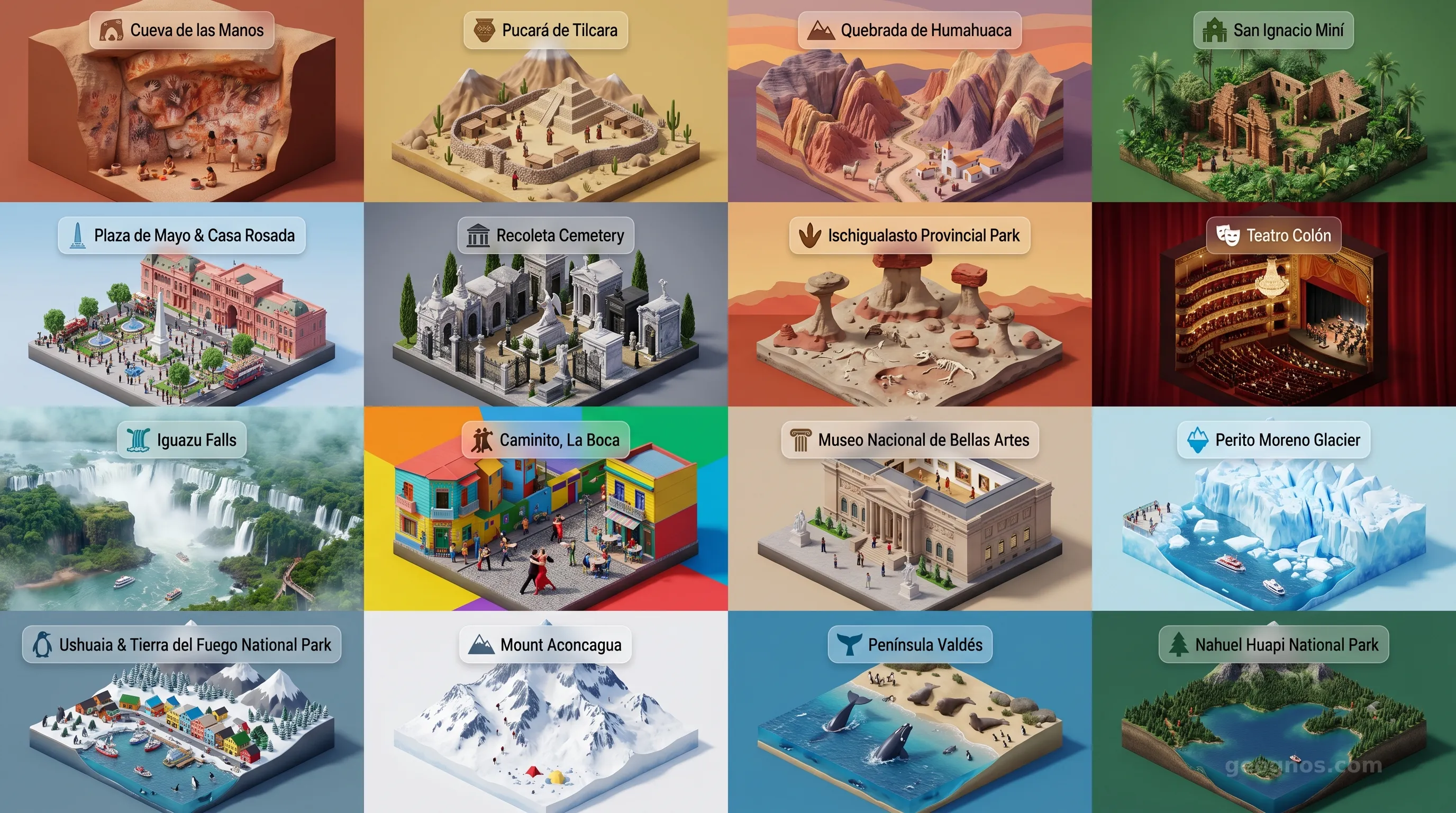
Top Sights & Landmarks
Ancient Cave Art of Patagonia
Nestled in the deep canyon of the Pinturas River, Cueva de las Manos ('Cave of the Hands') is one of the most important archaeological sites in South America. It features exceptionally preserved rock art dating back between 9,300 and 1,300 years, offering profound insights into the hunter-gatherer societies of early Patagonia. The iconic stenciled hands, guanaco hunting scenes, and abstract patterns make it an essential study site for anthropologists and historians. The best time to visit is during the Patagonian summer (November to February) to avoid harsh winter weather. Tourist tip: Base yourself in the town of Perito Moreno and prepare for a bumpy dirt road journey, or book a guided 4x4 tour for the best experience.
Pre-Inca Fortification
Strategically located on a hill in the Quebrada de Humahuaca, the Pucará de Tilcara is a reconstructed pre-Inca fortress built by the Omaguaca tribe around the 12th century. It serves as a vital educational site for understanding pre-Columbian military architecture, social organization, and later Inca assimilation. Exploring its stone dwellings, ceremonial centers, and ancient necropolis offers a tangible connection to Argentina's indigenous past. The site is best visited during the dry season (April to November). Tourist tip: Don't miss the high-altitude botanical garden at the site, which features regional cacti, and allow time to visit the nearby archaeological museum in Tilcara's town center.
Vibrant Andean Valley Route
This spectacular narrow mountain valley has served as a major cultural and trade corridor for over 10,000 years, linking the high Andean plateau with the plains. Used by prehistoric hunter-gatherers, the Inca Empire, and Spanish conquistadors, the valley is a living museum of syncretic cultural traditions. Its geological centerpiece is the Cerro de los Siete Colores (Hill of Seven Colors), making it a haven for geologists and photographers alike. The ideal visiting season is late spring (October/November) or early autumn (March/April). Tourist tip: Rent a car to drive at your own pace between the traditional villages of Purmamarca, Tilcara, and Humahuaca, and acclimatize slowly to the high altitude.
17th-Century Jesuit Ruins
Founded in 1632, San Ignacio Miní is the most remarkably preserved of the Jesuit missions in Argentina. It offers a crucial historical lens into the 'Guarani Jesuit Missions', an extraordinary colonial experiment where indigenous peoples and European Jesuits coexisted, ultimately destroyed during the Guaraní War. The site's striking red sandstone ruins, intricately carved with a blend of baroque and indigenous motifs, are an architectural marvel. Spring (September to November) is the best time to visit to avoid the extreme summer humidity of the Misiones province. Tourist tip: Stay for the spectacular evening light and sound show that brings the tragic and fascinating history of the mission to life.
The Political Heart of Argentina
Plaza de Mayo has been the epicenter of Argentine political life since the founding of Buenos Aires in 1580. Flanked by the iconic Casa Rosada (the Pink House, seat of the executive branch), the Metropolitan Cathedral, and the Cabildo, it is where the 1810 revolution began. It is deeply moving to learn about the 'Mothers of the Plaza de Mayo' who marched here during the 1970s military dictatorship. The area is highly educational for political science and modern history students. Spring and autumn offer the best walking weather. Tourist tip: Free guided tours of the Casa Rosada are available on weekends, but must be booked at least two weeks in advance online.
City of the Dead
Frequently ranked among the world's most beautiful cemeteries, Recoleta is a stunning labyrinth of elaborate marble mausoleums and statues spanning Art Deco, Neo-Gothic, and Baroque styles. It is a monumental open-air museum detailing Argentine high society, politics, and military history. The cemetery is the final resting place of Eva Perón (Evita), alongside past presidents and Nobel laureates. It is fascinating for architecture and history students. Open year-round, though crisp winter days (June-August) lend it an eerie, atmospheric charm. Tourist tip: Download a digital map or hire a local guide at the entrance to ensure you don't miss the most historically significant tombs hidden in the narrow walkways.
Valley of the Moon
Often called the Valle de la Luna, Ischigualasto is an absolute must for geology and paleontology enthusiasts. It contains a complete sequence of fossiliferous continental sediments from the Triassic Period (around 245 to 208 million years ago), offering unprecedented insight into the dawn of the dinosaurs and mammalian ancestors. The stark, otherworldly landscape features bizarrely eroded rock formations. The best time to visit is during the cooler months (April to October) as summer temperatures can be dangerously high. Tourist tip: You must explore the park via a guided convoy in your own vehicle; sunset tours are highly recommended to see the rocks glow with vivid reds and purples.
World-Renowned Opera House
Opened in 1908, the Teatro Colón is considered one of the top five opera houses in the world due to its flawless acoustics and breathtaking European-influenced architecture. A monument to Argentina's 'Golden Age' of wealth and European immigration, the theater boasts an opulent interior layered with Italian marble, French stained glass, and Venetian mosaics. It is a premier study location for architectural acoustics, performing arts, and urban history. Can be visited year-round. Tourist tip: While the daily guided tours are exceptional, attending an actual symphony or ballet performance provides the ultimate acoustic experience. Book tickets well in advance.
The Devil's Throat and Beyond
Straddling the border of Argentina and Brazil, the Iguazu Falls comprise 275 individual cascades dropping over a vast crescent. Historically revered by the native Guarani people, the falls and surrounding subtropical rainforest are now a UNESCO site protecting jaguars, toucans, and rare flora. It is an unparalleled site for environmental and ecological studies, as well as eco-tourism. The shoulder seasons (March-May and September-November) offer great weather and fewer crowds. Tourist tip: Spend at least two days on the Argentine side to hike the upper and lower circuits, and don't miss the thrilling Gran Aventura boat ride that takes you right under the cascades.
Birthplace of the Tango
Caminito is a colorful street museum in the working-class neighborhood of La Boca, Buenos Aires. In the late 19th and early 20th centuries, this port area absorbed massive waves of European immigrants, mainly from Genoa. It is historically vital as the crucible of the Tango dance and music, reflecting a melancholic blend of immigrant cultures. The vibrantly painted conventillos (shared boarding houses) clad in corrugated iron define its aesthetic. It can be visited any time of year. Tourist tip: Stick to the well-patrolled tourist areas around Caminito and the Boca Juniors stadium during daylight hours, as surrounding streets can be unsafe for tourists.
Argentina's Premier Art Museum
The MNBA is Latin America's most significant public art museum, housing the largest collection of Argentine art alongside European masters such as Goya, Rembrandt, Van Gogh, and Rodin. It is central to the study of Argentine cultural evolution, showcasing the shift from 19th-century post-colonial portraiture to the explosive avant-garde movements of the 20th century. Open year-round. Tourist tip: Admission is free for everyone, making it an excellent budget-friendly cultural immersion. Pair your visit with a walk over the nearby futuristic Floralis Genérica sculpture.
The Advancing Ice Giant
Located in Los Glaciares National Park, the Perito Moreno Glacier is one of the few glaciers in the world that is currently in a state of equilibrium rather than retreating. This massive 250-square-kilometer ice formation is crucial for glaciology and climate change studies. The history of indigenous Tehuelche peoples and early European explorers is woven into this harsh landscape. The best time to visit is the Patagonian summer (November to March). Tourist tip: Splurge on the 'Minitrekking' tour to actually hike on the glacier with crampons, culminating in a sip of whiskey chilled by ancient glacial ice.
The End of the World
Ushuaia, the southernmost city in the world, is the gateway to Antarctica and a place of profound historical and geographical significance. Originally inhabited by the Yamana people, it later became a harsh penal colony established by the Argentine government to assert sovereignty. The adjacent Tierra del Fuego National Park offers a dramatic meeting of subantarctic forests, glacial lakes, and the Beagle Channel. Summer (December to February) provides the longest daylight hours and warmest weather. Tourist tip: Get your passport stamped at the 'End of the World' post office in the national park, and take a boat tour on the Beagle Channel to see penguins and sea lions.
Highest Peak in the Americas
Towering at 6,960 meters (22,837 feet), Aconcagua is the highest mountain outside of Asia. Revered as a sacred site by the Incas—archaeologists have found mummified remains at extreme altitudes—it now attracts mountaineers and researchers from around the globe. It is an excellent destination for high-altitude physiological studies and physical geography. The climbing and trekking season strictly runs from November to March. Tourist tip: You don't need to summit to appreciate its grandeur. A day hike to the Confluencia base camp gives trekkers breathtaking views and a taste of the thin Andean air.
Marine Wildlife Sanctuary
This Patagonian peninsula is an internationally critical site for the conservation of marine mammals. Its sheltered gulfs are the primary breeding grounds for the endangered southern right whale, alongside significant populations of southern elephant seals, South American sea lions, and orcas that exhibit a unique beaching hunting technique. It is an absolute dream for marine biologists and zoologists. The best time to visit is from September to November when whale activity is at its peak. Tourist tip: Base yourself in Puerto Madryn and book boat tours early; keep an eye out for guanacos, rheas, and armadillos on the long, dusty roads of the peninsula itself.
The Argentine Lake District
As Argentina's oldest national park, Nahuel Huapi was established in 1934 around the massive, crystal-clear Nahuel Huapi Lake. The region is steeped in Mapuche indigenous mythology and the history of early 20th-century European settlement, reflected in the alpine architecture of San Carlos de Bariloche. It provides an exceptional environment to study biodiversity, vulcanology, and sustainable ecotourism. Summer (December to February) is ideal for hiking and kayaking, while winter (July to September) offers world-class skiing at Cerro Catedral. Tourist tip: Drive the 'Route of the Seven Lakes' for one of the most scenic road trips in South America.