Estonia
Top Sights & Landmarks
Medieval Hanseatic Gem
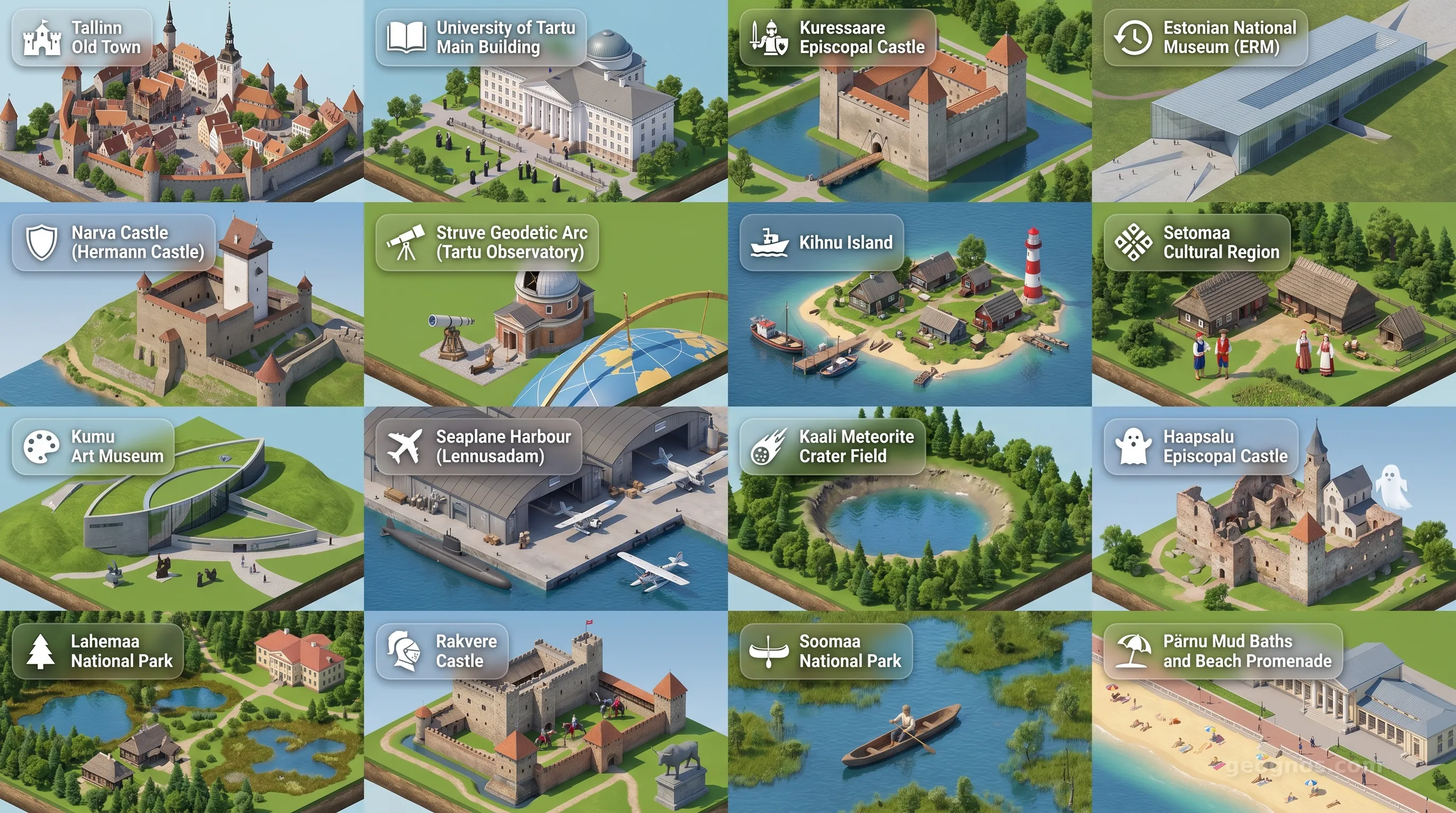
Tallinn Old Town is one of the best-preserved medieval cities in Europe, boasting original cobblestone streets, defensive walls, and stunning Gothic architecture. Studying here offers an unparalleled look into the Hanseatic League's economic and cultural network. Historically, it served as a vital trading hub connecting Western Europe with Russia. The best season to visit is summer for warm, vibrant cafe culture, or December for its world-renowned Christmas Market. Tourist tip: Wear flat, comfortable shoes to navigate the historic cobblestones and hike up to the Kohtuotsa viewing platform for panoramic sunset views.
The Cradle of Estonian Awakening
Founded in 1632 by Swedish King Gustavus Adolphus, the University of Tartu is the intellectual heart of Estonia. The Main Building is a masterpiece of classical architecture with its striking six-column portico. For students and historians, it is the epicenter of the Estonian national awakening in the 19th century. The university’s lock-up room (karser), where misbehaving students were once held, provides a fascinating glimpse into historical student life. Autumn is the best time to visit when the student town comes alive. Tourist tip: Don't miss the university's art museum located inside the main building, and stroll through the adjacent Toomemägi park.
Baltics' Best-Preserved Fortress
Located on the island of Saaremaa, this spectacular 14th-century fortress is the most well-preserved medieval castle in the Baltic region. Built by the Teutonic Order, it served as the stronghold of the Ösel-Wiek bishopric. Today, it houses the Saaremaa Museum, making it a prime destination for studying medieval defense architecture and the region's complex socio-political history under Danish, Swedish, and Russian rule. Summer is ideal for visiting due to the lively courtyard festivals. Tourist tip: Explore the surrounding moat and park, and be sure to dine in the castle's authentic medieval-style tavern.
Modern Shrine of Finno-Ugric Heritage
Situated in Tartu on a former Soviet military airfield, the ERM is a visually arresting, award-winning architectural triumph whose sloping roof seems to launch into the sky. It is the premier academic and tourist hub for understanding Estonian and wider Finno-Ugric cultural history, showcasing everyday life from the Ice Age to the digital era. The interactive exhibits are revolutionary for museology students. It is an excellent year-round destination, as it is entirely indoors. Tourist tip: Dedicate at least a half-day here, as the 'Echo of the Urals' exhibition is incredibly vast and immersive.
Fortress on the Eastern Frontier
Standing proudly on the banks of the Narva River, staring directly across at Russia's Ivangorod Fortress, Narva Castle represents centuries of geopolitical tension and border history. Initially established by the Danes in the 13th century and later expanded by the Livonian Order, it is essential for studying Baltic military history and East-West relations. The newly renovated interactive museum inside the Tall Hermann tower is engaging for all ages. Late spring to early autumn is best for exploring the extensive grounds. Tourist tip: Take a walk along the river promenade to witness the striking contrast of the two rival castles facing each other.
A Milestone in Earth Sciences
The Old Observatory of Tartu is a key point on the Struve Geodetic Arc, a 19th-century scientific marvel used to accurately measure the exact size and shape of the Earth. As a UNESCO World Heritage site, it holds massive importance for students of astronomy, geodesy, and history of science. Under F.G.W. Struve, the observatory housed the world's largest refracting telescope at the time. Visit during the milder months of May through September for pleasant walks on Toome Hill. Tourist tip: The museum offers great hands-on astronomy exhibits—check their schedule for occasional evening stargazing sessions.
Europe's Last Matriarchy
Kihnu Island is a living museum of rural Estonian culture, historically sustained by women while the men went to sea for months at a time. Its unique cultural space—characterized by vibrant striped skirts, traditional singing, and folklore—is recognized as a UNESCO Intangible Cultural Heritage. Anthropologists, sociologists, and tourists alike visit to observe a society where ancient traditions dictate daily life. Summer is the only practical time to visit for full accessibility and to witness traditional festivals. Tourist tip: Rent a bicycle to explore the island, and always ask for permission before photographing the locals in traditional dress.
Land of the Singing Setos
Located in southeastern Estonia on the Russian border, Setomaa is home to the Seto people, an indigenous ethnic and linguistic minority. Their polyphonic singing tradition, 'Seto Leelo', is on UNESCO’s Intangible Cultural Heritage list. The region offers deep insights into borderland identities, Eastern Orthodox traditions mixed with pagan roots, and ethnomusicology. Late summer is the best time to visit, specifically during the Seto Kingdom Day in August. Tourist tip: Visit the Obinitsa Seto Museum to try traditional foods like 'sõir' (curd cheese) and buy intricate local silver jewelry.
The Pinnacle of Estonian Art
Nestled into the limestone cliff of Kadriorg Park in Tallinn, Kumu is the largest exhibition venue in Estonia and a spectacular feat of contemporary architecture. It presents a comprehensive timeline of Estonian art, spanning from the 18th century through the Soviet period to modern contemporary works. For cultural and art history students, its exhibits on non-conformist Soviet-era art are profound. It's a fantastic indoor attraction suitable for year-round visits. Tourist tip: After viewing the art, explore the surrounding Kadriorg Park and the nearby baroque Kadriorg Palace built by Peter the Great.
Maritime History in Concrete Domes
This incredible museum is housed in enormous concrete seaplane hangars built in 1916. The hangars are recognized as the world's first large-scale reinforced concrete shell structures, a landmark in engineering history. Inside, visitors can explore the 1930s submarine Lembit, a full-scale replica of a WWI seaplane, and countless interactive maritime exhibits. It is an educational goldmine for naval history and engineering students. Highly recommended year-round. Tourist tip: Try the submarine simulator and walk the museum's outdoor harbor to see historical icebreakers and military ships.
Europe's Most Accessible Meteorite Craters
Located on Saaremaa island, the Kaali craters were formed approximately 3,500 years ago by a meteorite impact, one of the most recent significant impacts in a populated area. The main crater features a small, picturesque lake. The event deeply influenced regional mythology and even ancient Scandinavian epics. It is a vital site for geology and archaeology students studying catastrophic environmental events and their impact on ancient societies. Late spring to early autumn provides the best lighting and access. Tourist tip: Visit the small adjacent museum to see actual meteorite fragments and understand the science behind the impact.
The Realm of the White Lady
Founded in the 13th century, Haapsalu Castle was a center of the Bishopric of Ösel-Wiek. The ruins, including a magnificent Cathedral, blend Romanesque and Gothic styles. It is legendary for the 'White Lady', a ghost said to appear in the chapel window in August, reflecting its rich folklore. Students of architecture and medieval ecclesiastical history will find the newly renovated museum and rampart walkways fascinating. Summer is the best season, particularly during the August full moon. Tourist tip: Climb the 38-meter bell tower for a commanding view of the charming coastal town of Haapsalu.
Bogs, Boulders, and Baltic Manors
As the first national park established in the former Soviet Union (1971), Lahemaa is critical for ecological study and conservation history. It features diverse ecosystems, from the iconic boardwalks of the Viru Bog to coastal pine forests dotted with massive glacial erratic boulders. The park also contains stunning restored Baltic German manor houses (like Palmse and Sagadi), bridging the gap between natural and aristocratic history. Autumn is breathtaking for the foliage, while summer is ideal for hiking. Tourist tip: Walk the Viru Bog trail at sunrise for a magical, misty, and crowd-free experience.
Interactive Medieval Immersion
Perched on a hill overlooking the town, Rakvere Castle is an expansive 16th-century ruin that has been transformed into a highly interactive historical theme park. Visitors can experience a medieval torture chamber, an alchemist's workshop, and ancient weaponry, making history incredibly engaging for younger students and tourists alike. The site saw heavy fighting during the Livonian War, providing essential context to regional conflicts. Summer is the ideal time to catch live knights' tournaments and workshops. Tourist tip: Take a photo with the massive bronze 'Tarvas' (Aurochs) statue near the castle entrance.
The Land of the Fifth Season
Soomaa (meaning 'Land of Bogs') is globally renowned for its 'fifth season'—a massive annual spring flood that submerges forests, roads, and meadows. During this time, locals and tourists navigate the flooded forests in canoes. The region's traditional dugout canoe building (haabjas) is recognized by UNESCO. It is a premier location for studying hydrology, peatland ecology, and traditional survival skills. The absolute best time to visit is during the spring melt (March/April) to experience the floods. Tourist tip: Book a guided canoe tour well in advance during the fifth season, as availability is limited.
Estonia's Summer Capital
Pärnu has been a famous spa destination since the 1830s, originally drawing the Russian imperial elite. The neoclassical Pärnu Mud Baths building, built in 1926, is a stunning architectural symbol of the town's resort heritage. Studying Pärnu reveals the socio-cultural evolution of European health resorts and Baltic summer leisure over two centuries. Summer is undeniably the best season, characterized by endless white-sand beach days and lively festivals. Tourist tip: Beyond the beach, explore the historic wooden villas dotted around the quiet, leafy streets of the resort district.