Finland
Top Sights & Landmarks
The Gibraltar of the North
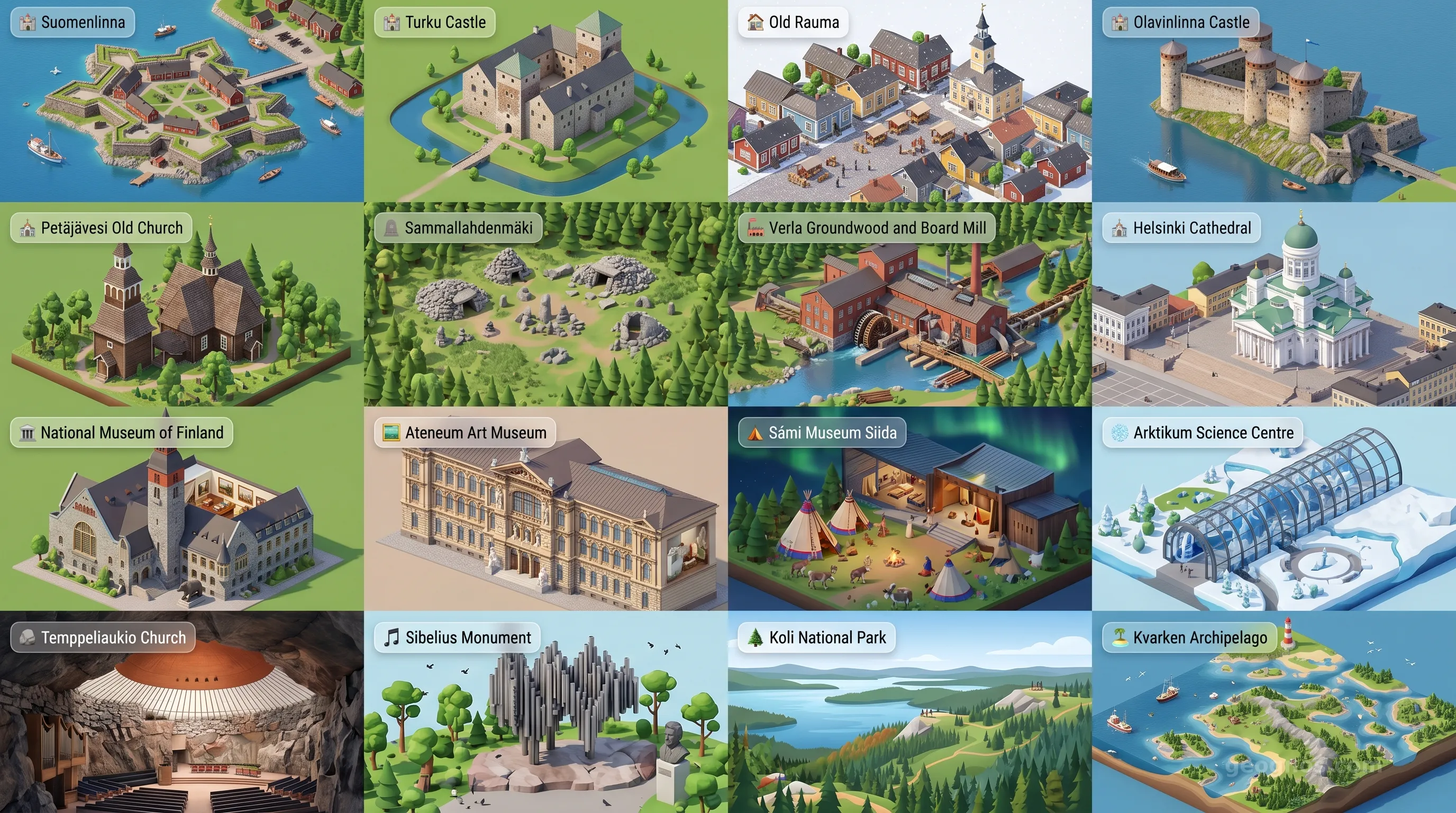
Spread across six linked islands off the coast of Helsinki, Suomenlinna is an 18th-century sea fortress with a deeply layered past. Built by the Swedish Crown in 1748 as protection against the Russian Empire, it later served as a Russian garrison before being claimed by an independent Finland. For students of military history and architecture, its star-shaped bastions and submarine dry docks offer a masterclass in 18th-century defense strategies. Tourists will find it a picturesque escape just a 15-minute ferry ride from Helsinki's Market Square. The best time to visit is summer for picnics and exploring the tunnels, though winter offers a haunting, icy beauty. Tip: Wear comfortable walking shoes and allocate at least half a day to fully explore its museums, cafes, and historic artillery.
Finland's Grandest Medieval Fortress
Dating back to the 1280s, Turku Castle is the largest surviving medieval building in Finland and a cornerstone of the nation's history. Originally a military fort, it evolved into a magnificent Renaissance palace during the 16th century under Duke John of Finland. Today, it serves as a massive historical museum where students can trace the development of Nordic geopolitics, court life, and medieval architecture. The intricate maze of rooms, dungeons, and banquet halls is endlessly fascinating. Summer is the most vibrant season, featuring medieval tournaments and guided tours in multiple languages. Tourist tip: Do not miss the beautifully restored Renaissance floors, and allow plenty of time as the castle is much larger on the inside than it appears.
Nordic Wooden Town Masterpiece
Old Rauma is the largest unified wooden town in the Nordic countries, encompassing around 600 historic buildings that date back to the 18th and 19th centuries. Its organic medieval street layout and intricately decorated facades offer a living museum of traditional Finnish urban planning and craftsmanship. Students of architecture and urban history will be captivated by how the community preserves these active, lived-in homes while maintaining strict heritage guidelines. The town is also famous for its centuries-old bobbin lace-making tradition. The ideal time to visit is during the annual Lace Week in late July. Tourist tip: Wander off the main streets into the narrowest alleys to truly appreciate the intricate details of the colorful wooden houses.
The Northernmost Medieval Stone Fortress
Situated dramatically on a rocky island amidst the swirling currents of Lake Saimaa, Olavinlinna Castle was constructed in 1475 by the Swedes to defend their eastern border against the Grand Duchy of Moscow. It represents a spectacular feat of medieval military engineering, designed specifically to withstand the newly introduced threat of artillery fire. Culturally, it is renowned worldwide as the spectacular stage for the annual Savonlinna Opera Festival. Visiting during July to experience world-class opera within the castle walls is unforgettable. For history enthusiasts, guided tours reveal tales of fierce sieges, changing empires, and tragic local legends. Tip: Even in summer, the stone interior can be remarkably chilly, so bring a light jacket.
Pinnacle of Nordic Wooden Architecture
Built between 1763 and 1765 by a local master builder, the Petäjävesi Old Church is a quintessential example of architectural adaptation, merging Central European architectural styles with traditional Nordic log-building techniques. This Lutheran church's symmetrical cross-plan, intricate vaulting, and hand-carved wooden pews offer profound insights for students studying vernacular architecture and the spread of religious aesthetics into rural environments. Located on a scenic peninsula surrounded by lakes, the site is exceptionally peaceful. The church is open to the public primarily in the summer, which is the best time to appreciate the pine-scented interior and surrounding nature. Tip: Notice the incredible craftsmanship of the wooden joints that have allowed the structure to survive centuries without nails.
Bronze Age Burial Cairns
Sammallahdenmäki is the most extensive and significant Bronze Age burial site in Scandinavia, featuring over 30 granite burial cairns dating from 1500 to 500 BC. For archaeology and anthropology students, this site is a crucial link to understanding the religious beliefs, sun-worship practices, and societal structures of early Nordic farming communities. The most famous structures are the 'Church Floor', a unique rectangular cairn, and the 'Flute' wall formation. Nestled within a serene, rugged pine forest, the site offers a highly atmospheric hike. The warmer months between May and September provide the best conditions for exploring the trails. Tip: Hire a local guide or download an audio guide beforehand, as the raw stone structures are best appreciated with historical context.
19th-Century Industrial Time Capsule
An exceptionally well-preserved example of the small-scale rural industrial settlements that flourished in Northern Europe during the 19th and early 20th centuries. The Verla Mill offers an intact look at the early days of the Finnish forestry and paper industry, which became the backbone of the nation's economy. Students of industrial history will marvel at the original German-made machinery still standing in place, alongside the workers' cottages and the mill owner's residence. The surrounding Kymi River provides a beautiful backdrop. The museum is open from May to September. Tourist tip: Keep an eye out for the ancient rock paintings on the cliffs above the rapids, tying prehistoric history directly to the industrial age.
The Neoclassical Heart of Helsinki
Dominating the Senate Square, Helsinki Cathedral is the iconic, brilliant white symbol of the Finnish capital. Designed by Carl Ludvig Engel and completed in 1852, it was originally created as a tribute to the Grand Duke of Finland, Tsar Nicholas I of Russia. The structure is a masterpiece of Neoclassical architecture, featuring striking green domes and statues of the twelve apostles guarding the roof. For students of urban planning, the surrounding Senate Square is a perfect example of a cohesive Empire-style administrative center. It is beautiful to visit year-round, but descending its massive steps during the Christmas market season is truly magical. Tip: The interior is famously austere, typical of Finnish Lutheranism, contrasting sharply with its grandiose exterior.
Chronicles of the Finnish Nation
Housed in a spectacular building that embodies the Finnish National Romantic style, the National Museum of Finland is the premier institution for understanding the country's trajectory from prehistoric times to the modern era. The architecture itself, resembling a medieval Finnish church or castle, is a crucial study subject for art history students. Inside, the exhibits cover the Stone Age, Swedish rule, the Russian Empire era, and the path to independence. The museum is a year-round destination. Tourist tip: Look up at the entrance hall's vaulted ceiling to see the magnificent frescoes painted by Akseli Gallen-Kallela, which depict scenes from the Kalevala, Finland's national epic.
Home of Finnish Fine Arts
The Ateneum is the definitive gallery for Finnish classical art, housing the country's most extensive collections from the 19th century to the modern age. It is the perfect place for cultural students to track the development of Finnish national identity through the 'Golden Age of Finnish Art', featuring monumental works by artists like Albert Edelfelt, Helene Schjerfbeck, and Hugo Simberg. The building's ornate Neo-Renaissance facade is itself a cultural landmark in central Helsinki. Open throughout the year, it offers an excellent indoor activity during Finland's colder months. Tip: Don't miss Simberg's 'The Wounded Angel', consistently voted Finland's national painting, which offers deep insight into the Finnish soul.
Gateway to Indigenous Sámi Culture
Located in Inari, far above the Arctic Circle, Siida is the national museum of the Finnish Sámi. It offers unparalleled insights into the vibrant culture, history, and survival strategies of Europe's only recognized indigenous people. For anthropology and environmental studies students, the exhibitions brilliantly intertwine the cultural heritage of the Sámi with the intense ecological realities of the distinct eight seasons of Lapland. The open-air museum component, accessible in summer, showcases traditional dwellings and trapping methods. Winter visits offer the chance to see the Northern Lights over Lake Inari. Tip: Pair your visit with a traditional Sámi meal at the museum's excellent restaurant.
Science and Culture of the Arctic
Situated in Rovaniemi, Arktikum is both a museum and a science center, serving as an educational hub for understanding the delicate ecosystems, indigenous cultures, and climate change realities of the Arctic region. Architecturally striking, it features a stunning 172-meter-long glass corridor pointing north toward the Ounasjoki River. Students of environmental science and geology will find the interactive exhibits on glaciology and Arctic flora/fauna invaluable. The center is a fantastic year-round destination, but visiting in winter allows the glass tube to act as a warm viewing gallery for the Northern Lights. Tip: Allocate plenty of time for the Provincial Museum of Lapland section, which offers deep historical context on the region's World War II history.
The Subterranean Rock Church
Excavated directly into solid granite in the late 1960s, Temppeliaukio Church is one of Helsinki's most spectacular modern architectural achievements. Designed by brothers Timo and Tuomo Suomalainen, the interior is bathed in natural light filtering through a spectacular copper dome supported by concrete beams. For architecture and geology students, the raw, unworked rock walls offer brilliant acoustics and a unique harmony between nature and human design. It remains an active Lutheran church and a highly popular tourist destination. The best time to visit is on a sunny morning when beams of light sweep across the rock walls. Tip: Check the schedule in advance to catch a live organ or classical music rehearsal, as the acoustics are world-renowned.
Tribute to a Musical Genius
Located in Helsinki's Sibelius Park, this abstract monument by Eila Hiltunen is dedicated to Jean Sibelius, Finland's most celebrated composer whose music was pivotal to the Finnish national awakening. Constructed from over 600 hollow steel pipes welded together in a wave-like pattern, it resembles an organ but is designed to capture the essence of Sibelius's nature-inspired symphonies. Art students will appreciate the controversy and ultimate triumph of this pioneering piece of Finnish modernism. It is visually striking year-round, though a snowy winter day adds a dramatic, melancholic contrast to the steel pipes. Tip: Stand directly underneath the pipes and speak; the metallic echoes create a haunting auditory experience.
Finland's Ultimate National Landscape
Rising steeply above Lake Pielinen, the peaks of Koli offer what is officially recognized as the definitive Finnish 'national landscape'. This breathtaking view has inspired countless Finnish artists, composers, and authors, particularly during the National Romantic period at the turn of the 20th century. For geology students, Koli's white quartzite cliffs are remnants of an ancient mountain range dating back two billion years. It is an extraordinary destination for hiking in autumn when the 'ruska' (fall foliage) turns the forests into a sea of red and gold. Winter offers excellent snowshoeing and skiing. Tip: Take the short hike to the Ukko-Koli peak at sunrise for a truly spiritual viewing experience of the lakeland.
The Land that Rises from the Sea
Shared with the High Coast in Sweden, the Kvarken Archipelago is Finland's only natural UNESCO World Heritage site. It represents one of the best places in the world to witness 'isostatic uplift'—the phenomenon where land rapidly rises from the ocean after being compressed by Ice Age glaciers. The land here rises nearly a centimeter a year, constantly changing the coastal geography. Geology and environmental studies students can directly observe glacial moraines and shifting shallow waters. Summer is the prime season for kayaking, cycling, and birdwatching in this rapidly changing ecosystem. Tip: Climb the striking red wooden Saltkaret observation tower for a panoramic view of the De Geer moraine fields.