Lithuania
Top Sights & Landmarks
Heart of the Grand Duchy
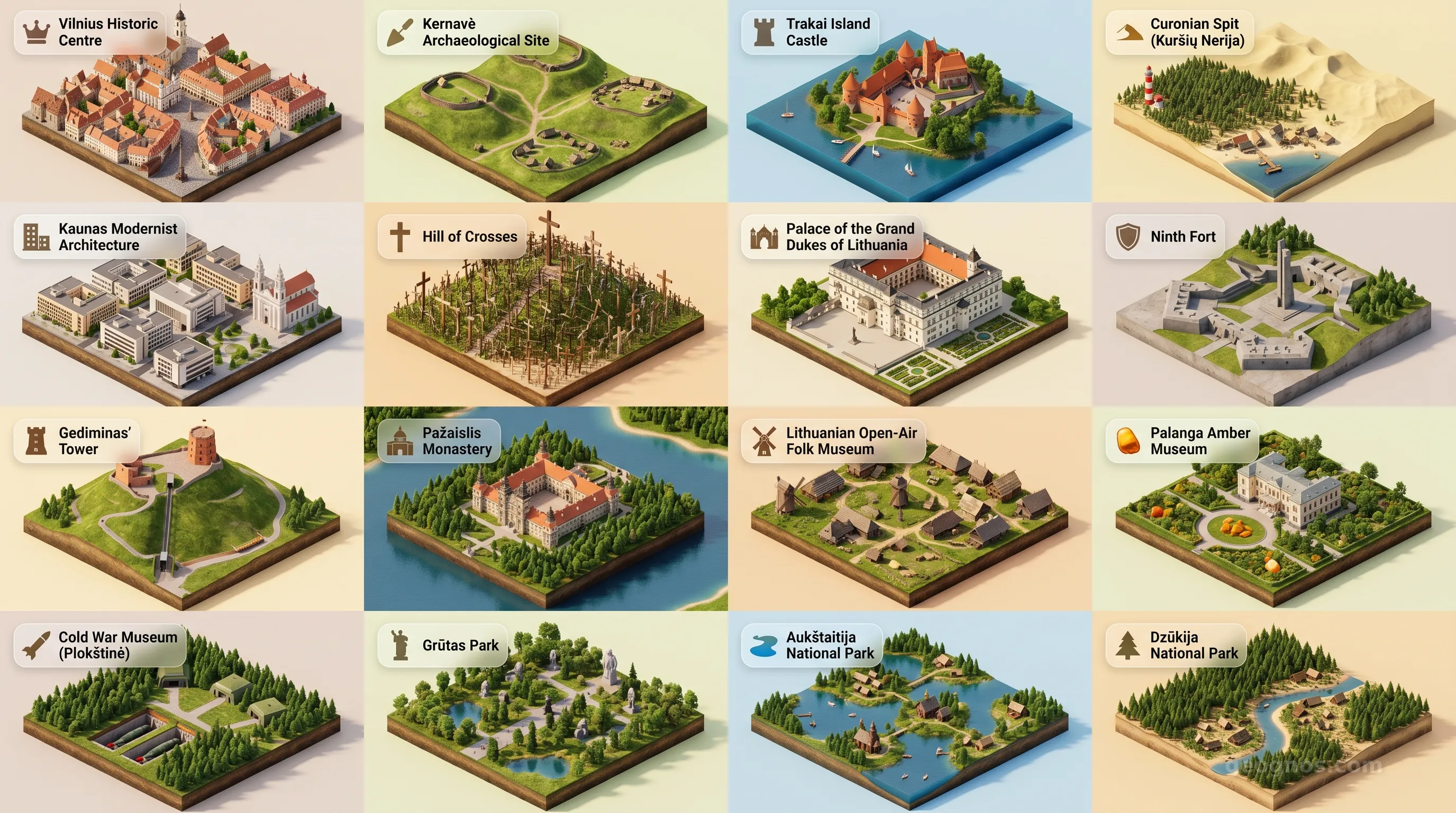
An essential visit for architecture and history students, the Vilnius Historic Centre is a living tapestry of Gothic, Renaissance, Baroque, and Neoclassical styles. Historically serving as the political hub of the Grand Duchy of Lithuania from the 13th century, it was one of Eastern Europe's most prominent cultural epicenters. The layout retains its medieval street pattern, offering incredible insights into historical urban planning. The best season to visit is late spring or early autumn, when the weather is ideal for long strolls. Tourist tip: Wear comfortable, flat shoes to easily navigate the extensive network of uneven, centuries-old cobblestone alleys, and don't miss the panoramic views from the nearby Hill of Three Crosses.
The Troy of Lithuania
Kernavė represents an exceptional testimony to some 10,000 years of human settlement in the Baltic region. It is historically monumental as the first known capital of pagan Lithuania, boasting a complex ensemble of five impressive hill forts, unfortified settlements, and burial sites. It provides unparalleled study material for archaeologists examining the transition from paganism to Christianity. The optimal time to visit is during July, specifically during the 'Live Archaeology Days' festival where history is vividly reenacted. Tourist tip: Bring water, sun protection, and robust footwear, as scaling the steep wooden stairs connecting the hill forts can be physically demanding.
Gothic Fortress on the Lake
Situated on an island in Lake Galvė, this 14th-century red-brick Gothic fortress is a masterpiece of medieval defensive architecture. Historically, it was the strategic center of the Grand Duchy of Lithuania and holds deep cultural importance due to the Karaim community, brought here from Crimea by Grand Duke Vytautas. Students of medieval history will find the castle's construction and strategic placement fascinating. Summer is the most popular season to visit, offering boating and vibrant festivals, though winter provides a magical, frozen-lake aesthetic. Tourist tip: Arrive early to beat the crowds, and be sure to taste 'Kibinai', the traditional Karaim pastry sold in the surrounding village.
The Baltic Sahara
A striking 98-kilometer-long, curved sand-dune spit separating the Curonian Lagoon from the Baltic Sea. Historically inhabited since prehistoric times, it is a testament to the ongoing human struggle to survive in a highly dynamic natural environment. It is a vital study area for environmental scientists and geographers observing coastal erosion and deforestation management. The best season to visit is summer for swimming and cycling, or early autumn for bird migrations. Tourist tip: Rent a bicycle to explore the well-maintained trails between the picturesque fishermen villages of Nida and Juodkrantė, and respect the strictly protected dune zones by staying on marked paths.
Interwar Art Deco Capital
When Vilnius was occupied by Poland between 1919 and 1939, Kaunas served as Lithuania's temporary capital. This fueled a massive, rapid urbanization boom resulting in a unique concentration of Modernist and Art Deco architecture infused with Lithuanian national motifs. It is a premier destination for architecture students studying early 20th-century urban design. Spring and summer are the best seasons to visit, allowing for pleasant walking tours along Laisvės Alėja. Tourist tip: Book a specialized architectural walking tour to fully appreciate the interior details, curved staircases, and hidden courtyards of these historic buildings.
Monument of Defiance and Faith
A powerful site of pilgrimage and peaceful resistance featuring over 100,000 crosses of varying sizes. Historically, the tradition began after the 1831 uprising against the Russian Empire and became a profound symbol of Lithuanian Catholic faith and national identity during the Soviet occupation, when the regime repeatedly bulldozed the hill. It offers a profound sociological study into faith-based resistance. Autumn or spring offers a moody, atmospheric experience, while winter under the snow is solemn and haunting. Tourist tip: You can bring your own cross to leave on the hill; small wooden crosses are also sold by local vendors near the entrance.
Resurrected Royal Residence
Reconstructed in the 21st century over its original ruins, this palace reflects the political, administrative, and cultural might of the Grand Duchy. The original palace was demolished in the early 19th century by the Russian Empire. Today, it stands as an immense museum detailing Lithuanian statehood, making it critical for European history scholars. The museum is indoors, making it an excellent visit year-round, though winter visits provide a warm retreat from the snowy streets of Vilnius. Tourist tip: Dedicate at least three hours to explore all four tour routes, and take the elevator to the observation tower for a spectacular view of the Cathedral Square.
Memorial of Tragic History
Originally built in the late 19th century as a Russian fortress to protect Kaunas, the Ninth Fort took on a dark historical significance during WWII. It was used by Soviet authorities as a prison and later by Nazi Germany as an extermination camp. It is a sobering, essential site for studying Holocaust history and 20th-century totalitarianism. The massive, brutalist memorial monument is visually arresting. The site can be visited year-round, though the grim history feels particularly poignant on a grey autumn day. Tourist tip: Prepare for an emotionally heavy experience. The underground bunker tours can be chilly, so bring a light jacket even in summer.
The Symbol of Vilnius
The remaining brick tower of the Upper Castle, built by Grand Duke Gediminas. It holds immense symbolic value; the raising of the Lithuanian flag here in 1988 was a pivotal moment in the country's independence movement from the Soviet Union. It provides a fascinating case study in medieval fortification. Summer and spring provide lush, green backdrops, making it the perfect time for photography. Tourist tip: You can either hike up the steep cobblestone path or take the funicular. Aim for a visit during the golden hour just before sunset for the best views over the red roofs of the Old Town.
Masterpiece of Baroque
One of the most magnificent examples of Italian Baroque architecture in Eastern Europe, founded in 1662 for the Camaldolese monks. Historically significant for its survival through various wars and occupations, it has served as an archive, psychiatric hospital, and art gallery before returning to a religious order. Art and architecture students will be captivated by its frescoes and stuccowork. Summer is ideal, particularly when the renowned Pažaislis Music Festival takes place, filling the courtyard with classical music. Tourist tip: Combine your visit with a walk along the shores of the nearby Kaunas Reservoir, and enjoy a meal at the exceptional on-site restaurant, Monte Pacis.
Rural Lithuania Preserved
Located in Rumšiškės, this is one of the largest open-air ethnographic museums in Europe, spanning 195 hectares. It preserves the traditional rural lifestyle, architecture, and tools of Lithuania's four main ethnographic regions from the 18th to the early 20th century. It is a goldmine for anthropology and sociology students. Summer is the absolute best time to visit, as craftsmen perform traditional trades and festivals (like Midsummer/Joninės) bring the village to life. Tourist tip: The park is massive; consider renting a bike or a horse-drawn carriage to get around if you are short on time.
Palace of Baltic Gold
Housed in the magnificent 19th-century Neo-Renaissance Tiškevičiai Palace, this museum holds one of the world's most abundant collections of amber inclusions. Historically, amber was the region's main trade commodity, shaping the Baltic economy since Roman times. Geologists and biologists visit to study prehistoric insects perfectly preserved in fossilized resin. Summer is perfect, as you can also enjoy the expansive botanical park surrounding the palace. Tourist tip: Don't miss the 'Sun Stone', one of the largest pieces of amber in Europe, and take time to stroll through the beautifully manicured rose gardens outside.
Underground Nuclear Base
Hidden deep in the forests of Žemaitija National Park, this former secret Soviet underground ballistic missile base is now a chilling museum. Built in the 1960s during the height of the Cold War, it targeted European cities with nuclear warheads. It offers a unique, tense educational experience for historians studying the geopolitical dynamics of the 20th century. The indoor, underground nature of the museum makes it a suitable visit in any season. Tourist tip: It is damp and cold inside the missile silos, so bring a warm sweater. Booking tickets in advance is recommended during the peak summer months.
Relics of Soviet Propaganda
A unique, somewhat surreal sculpture garden containing dozens of Soviet-era statues (Lenin, Stalin, Marx) that were dismantled across Lithuania after independence in 1990. Rather than destroying history, the park preserves these artifacts as a stark educational tool regarding the absurdity and terror of the Soviet occupation. Sociologists and historians find it a fascinating study in post-totalitarian memory management. Open year-round, though a summer visit allows for a more comfortable walk through the forest trails. Tourist tip: The site features a cafe serving meals in typical Soviet-era metal bowls—a quirky (if slightly eerie) culinary experience.
Land of Ancient Lakes
Lithuania's oldest national park is an ecological paradise boasting 126 interconnected lakes nestled amid ancient pine forests and traditional wooden villages. It preserves the ancient fishing and foraging traditions of the Aukštaitija region. Biology and ecology students will value its pristine biodiversity. Summer is the premier season for kayaking, wild swimming, and camping. Tourist tip: Rent a kayak for a multi-day trip. The lakes are connected by rivers, allowing you to paddle uninterrupted for days. Stop at Ladakalnis hill for a panoramic view of six different lakes.
Forests of Foragers
The largest protected area in Lithuania is deeply entrenched in the country's cultural psyche. It consists of vast, seemingly endless pine forests that hide traditional, isolated ethnographic villages like Marcinkonys and Zervynos. Historically, the harsh sandy soil meant locals relied heavily on the forest for survival, creating a unique culture of mushroom foraging and beekeeping. Late summer and early autumn are the best times to visit for the legendary mushroom-picking season. Tourist tip: Hire a local guide to teach you the safe and traditional ways of foraging, and sample local delicacies made from buckwheat and wild mushrooms.