Bahamas, The
Top Sights & Landmarks
Site of Christopher Columbus's 1492 Landfall
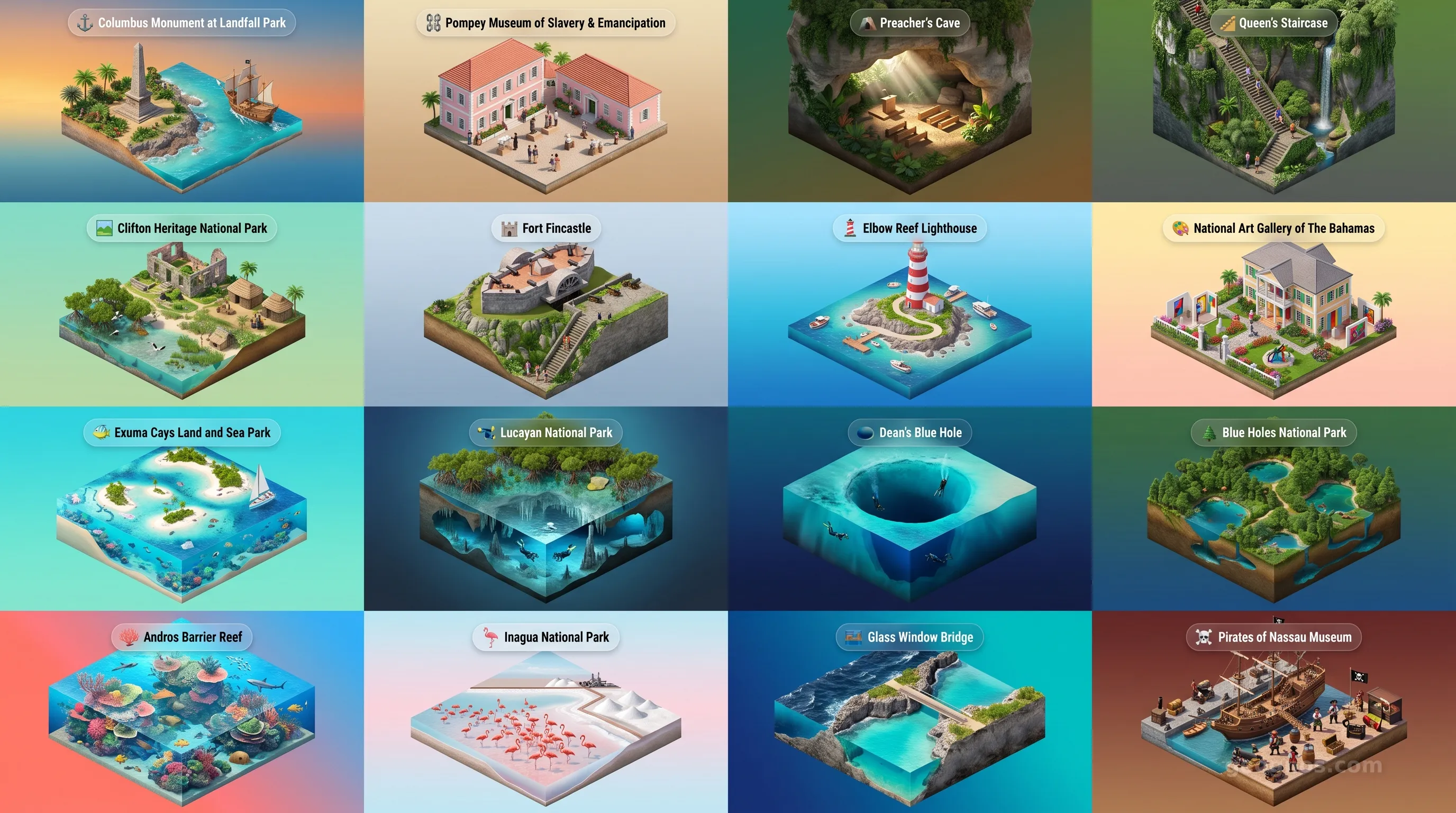
Marking the spot where Christopher Columbus first set foot in the New World on October 12, 1492, this site on San Salvador is deeply significant for the study of the Columbian Exchange and early European-Indigenous contact. The white stone cross stands against a stunning coastal backdrop, serving as a historical pivot point of the Americas. The best season to visit is between December and April to enjoy favorable weather. Tourist Tip: Rent a car to explore the remote and culturally rich island of San Salvador, and be sure to read the historical markers detailing the encounter with the native Lucayan people.
Bahamian Slavery & Emancipation History
Housed in the vibrant pink Vendue House—a building that functioned as a marketplace for enslaved Africans in the 18th century—this museum is crucial for understanding the transatlantic slave trade and Bahamian emancipation. It is named after Pompey, an enslaved man who led a revolt in Exuma in 1830. A visit here is an essential, somber educational experience for cultural and historical studies. Open year-round, it offers a deeply moving exhibition. Tourist Tip: Combine your visit with a heritage walking tour of downtown Nassau to fully contextualize the area's colonial past.
First English Settlement Site (1648)
This vast limestone cave on the northern shore of Eleuthera served as a refuge for the Eleutheran Adventurers, a group seeking religious freedom who shipwrecked here in 1648. It essentially acted as the birthplace of the modern Bahamian nation. Archaeological excavations have also uncovered the remains of early indigenous Lucayan inhabitants, making it highly valuable for both colonial and pre-Columbian studies. The best time to explore is from November to May. Tourist Tip: The cave is easily accessible by a short walk from the road, but bring bug spray and sturdy walking shoes.
The 66 Steps Carved from Solid Limestone
Known locally as the 66 Steps, this marvel of sheer manual labor was carved out of solid limestone by around 600 enslaved Africans between 1793 and 1794. Originally built to provide a direct route from Fort Fincastle to Nassau city, it was later named in honor of Queen Victoria for her role in abolishing slavery in the British Empire. It is a profound site for studying colonial infrastructure and enslaved labor. Visit year-round, ideally in the early morning to avoid the heat. Tourist Tip: Entry is free, but local guides offer excellent oral histories for a small tip.
Convergence of Lucayan, Loyalist, and African Heritage
Clifton Heritage National Park is unique because it preserves the historical remnants of three distinct cultures: the indigenous Lucayans, the British Loyalists, and the enslaved Africans. The park features ruins of a plantation, replica Lucayan villages, and breathtaking underwater sculptures, including the massive 'Ocean Atlas'. It is an unparalleled site for multi-disciplinary cultural studies. Spring and winter are the best times to visit. Tourist Tip: Book a snorkeling tour to fully experience the underwater statue garden and marine ecosystem.
18th-Century Fort Overlooking Nassau
Built in 1793 by Lord Dunmore, the Royal Governor of The Bahamas, this fort sits atop Bennet's Hill and is uniquely shaped like a paddle-wheel steamer. It was constructed to protect Nassau from pirates and rival empires, offering an incredible vantage point over the city and harbor. It is a prime location to study British colonial military architecture and strategy. The site is open year-round. Tourist Tip: The fort is located directly above the Queen's Staircase, making it easy to visit both significant historical sites in a single afternoon.
The Last Manual Kerosene Lighthouse
Standing proudly in Hope Town, Abaco, the Elbow Reef Lighthouse is a living museum. Built in 1864, it is the last remaining manually operated, kerosene-burning lighthouse in the world. It provides a fascinating look into 19th-century maritime navigation, engineering, and the resilience of local lighthouse keepers. The best time to visit is between December and June. Tourist Tip: Climb the 101 narrow steps to the top for an unrivaled panoramic view of the Abaco Sea and the candy-colored homes of Hope Town.
Premier Bahamian Fine Arts Hub
Housed in the fully restored 1860s Villa Doyle, a quintessential colonial mansion, the National Art Gallery of The Bahamas (NAGB) is the premier arts institution in the country. It is crucial for students and tourists looking to understand contemporary Bahamian identity, post-colonial narratives, and Caribbean visual arts. The gallery is an ideal, culturally enriching activity year-round, especially on rainy days. Tourist Tip: Check their calendar in advance for outdoor film screenings, community workshops, and rotating exhibitions.
World's First Marine Protected Area
Established in 1958, this 112-square-mile park was the first marine reserve of its kind in the world. It is a groundbreaking conservation success story and is essential for marine biology students studying coral reef ecology and protected fisheries. The pristine waters showcase some of the highest biodiversity in the Caribbean. The best season for boating and diving is from March to May when the seas are calmest. Tourist Tip: The park is accessible only by boat, and it operates under a strict 'no-take' policy to protect the vibrant wildlife.
Vast Underwater Cave System and Mangroves
Located on Grand Bahama, this 40-acre park encompasses all six of the Bahamas' vegetative zones and holds one of the longest mapped underwater cave systems in the world. Archaeologically, it is significant because ancient remains of the Lucayan people were discovered in the burial caves. It is a fantastic site for both geological and anthropological study. Visit during the cooler winter months for comfortable hiking. Tourist Tip: Follow the mangrove boardwalk across the road to discover Gold Rock Beach, spectacular at low tide.
Second Deepest Blue Hole in the World
Plunging to a staggering depth of 663 feet (202 meters) in a bay west of Clarence Town on Long Island, Dean's Blue Hole is a spectacular geological marvel. It offers an exceptional opportunity to study karst topography, limestone sinkhole formations, and unique deep-water marine ecosystems. The waters are remarkably clear year-round. Tourist Tip: While it is safe to swim around the sandy rim, only experienced freedivers and scuba divers should attempt significant depths. It is the site of the annual Vertical Blue international freediving competition.
Vast Network of Inland Fresh Water Blue Holes
Spanning over 40,000 acres on the island of Andros, this park protects the highest concentration of blue holes in the world. These deep, water-filled limestone sinkholes are surrounded by lush pine forests and contain unique, endemic species of cave fish. The hydrology and unique evolutionary biology found here make it a world-class destination for ecological and geological research. Visit during the dry season (December to April). Tourist Tip: Hire a local guide, as the terrain can be rugged and some of the best blue holes are hidden deep off the main trails.
Third Largest Barrier Reef in the World
Stretching for 190 miles along the east coast of Andros, this is the third-largest fringing barrier reef in the world. It plunges into the Tongue of the Ocean, a deep oceanic trench, providing a habitat for an incredible array of marine life including manta rays, sharks, and sea turtles. It is an indispensable site for studying marine biology, coral bleaching, and climate change impacts. Spring offers the best visibility for diving. Tourist Tip: Book a stay at a dive resort in Central or North Andros to get the most comprehensive and safe access to the reef.
Massive West Indian Flamingo Sanctuary
Covering almost half of Great Inagua Island, this park is a monumental conservation success. It rescued the West Indian Flamingo from near extinction and is now home to the world's largest breeding colony, with over 80,000 birds. The extreme saline environments also host unique brine shrimp, making it a stellar location for ornithology and specialized ecology studies. The best time to witness the flocks is during their nesting season from March to May. Tourist Tip: Access to the park requires coordination with an authorized Bahamas National Trust warden.
The Narrowest Point on Earth
Known as the 'narrowest place on Earth', this striking geological formation on Eleuthera separates the dark, churning, deep blue waters of the Atlantic Ocean from the calm, shallow, turquoise waters of the Bight of Eleuthera. It provides a highly visual lesson in coastal erosion, marine geology, and oceanic currents. Visit on clear days to truly appreciate the stark contrast in water colors. Tourist Tip: Use extreme caution and do not cross the bridge on foot or by vehicle during severe storms or high surf, as rogue waves frequently wash over the rocks.
Interactive Golden Age of Piracy Exhibits
Located in the heart of downtown Nassau, this interactive museum brings the Golden Age of Piracy (1690-1720) to life. It explores the socio-economic factors that led to the establishment of the 'Republic of Pirates' and details the real histories of infamous figures like Blackbeard and Anne Bonny. It provides a highly engaging, theatrical introduction to Caribbean maritime history. The indoor attraction is perfect year-round. Tourist Tip: This museum is incredibly family-friendly and serves as a great, immersive educational detour for younger students and children.