Iceland
Top Sights & Landmarks
Birthplace of Iceland's Parliament
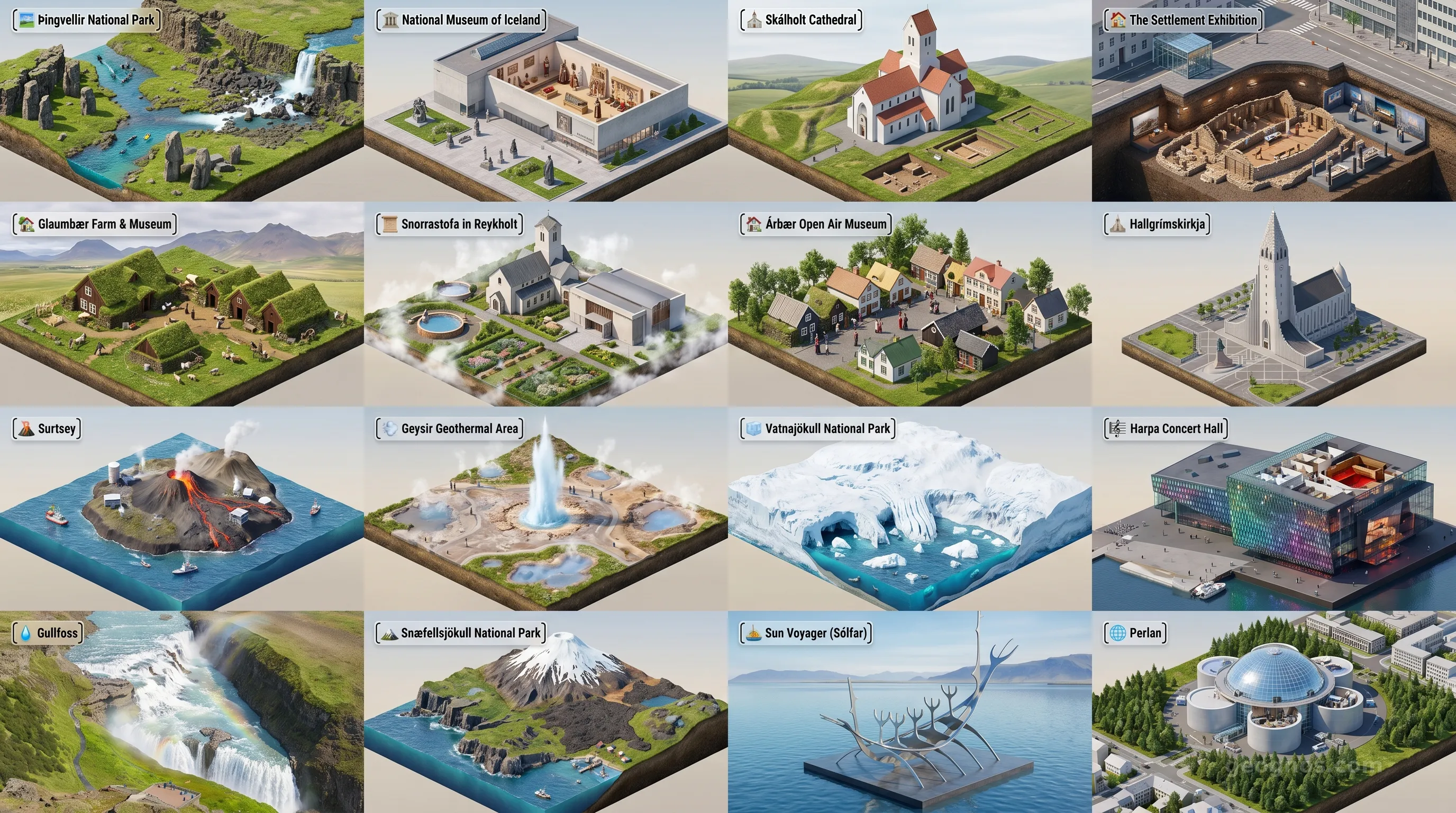
Þingvellir (Thingvellir) is the crown jewel of Icelandic history and geology. It is the site where the Alþingi, one of the oldest surviving parliaments in the world, was established in 930 AD, shaping Iceland's cultural identity. For geology students, it offers a rare opportunity to walk in the rift valley between the North American and Eurasian tectonic plates. The best season to visit is summer for accessible trails, or winter for spectacular snowy vistas and Northern Lights. Tip: Bring waterproof gear and snorkel in the Silfra fissure for crystal-clear underwater views between tectonic plates.
Chronicle of a Nation
The National Museum of Iceland in Reykjavík offers a comprehensive timeline of the country's history, from the Viking Age settlement to the contemporary era. It holds immense educational value, featuring the famous Valþjófsstaður door with its medieval carvings and countless artifacts detailing pagan rituals and the adoption of Christianity. It is a year-round destination, perfect for rainy days. Tip: Use the multimedia audio guides to gain deeper insights into the complex sagas and daily life of early Icelanders.
Ancient Seat of Power
For over 700 years, Skálholt was the political, spiritual, and cultural heart of Iceland. Founded in 1056 as the first bishopric, it functioned as the country's main center of learning. Studying this site provides critical context for Iceland's shift from paganism to Christianity and its medieval political struggles. The modern cathedral features exquisite stained glass and acoustics. Summer is the best time to visit, especially during the Skálholt Summer Concerts. Tip: Do not miss the subterranean tunnel leading to an underground exhibition of archaeological finds.
Viking Roots Unearthed
Built around the excavated ruins of a 10th-century Viking longhouse, this museum provides an authentic glimpse into the lives of Reykjavík's earliest inhabitants. The site is a masterclass in archaeological preservation and interactive museum design, making it vital for students of Norse history. It seamlessly blends actual ruins with holographic displays. Visit any time of year. Tip: The exhibition is located below ground level in downtown Reykjavík; pair it with a walking tour of the city's historic center.
Traditional Turf Houses
Glaumbær offers a perfectly preserved example of the traditional Icelandic turf farmhouses that sheltered the population for centuries. Studying this site reveals the ingenious architectural adaptations required to survive harsh sub-Arctic climates with limited timber. The farm was also once home to Snorri Þorfinnsson, reputed to be the first European born in the Americas. Best visited in summer when the surrounding landscape is vibrant green. Tip: Check the opening hours carefully, as they are limited during the winter months.
Home of Sagas and Mythology
Reykholt was the homestead of Snorri Sturluson, a 13th-century chieftain, historian, and author of the Prose Edda. This location is paramount for scholars of Norse mythology and medieval literature, as Snorri's works are the primary source of our knowledge regarding Thor, Odin, and Loki. Visitors can see Snorralaug, a reconstructed medieval hot spring bath. Visit during summer or early autumn for the best driving conditions. Tip: Read a summary of the Prose Edda before visiting to fully appreciate the site's immense cultural footprint.
Reykjavík Through the Ages
This living history museum features more than 20 distinct historical buildings relocated from central Reykjavík to form a charming village. It provides an immersive study of Iceland's transition from a rural, agricultural society to an urbanized nation in the 19th and 20th centuries. Costumed guides showcase traditional crafts and farming techniques. Summer is the ideal season for the full outdoor experience. Tip: Look out for traditional Icelandic horses on the premises and try the freshly baked pancakes at the museum café.
Towering Expressionist Masterpiece
Hallgrímskirkja is Iceland's tallest and most recognizable church. Designed by Guðjón Samúelsson, its expressionist architecture is deeply tied to Iceland's natural landscape, mimicking the cooling lava basalt columns found throughout the country. It serves as a modern cultural symbol and a working parish. The massive pipe organ inside is an engineering marvel. Visit year-round. Tip: Pay the small fee to take the elevator to the viewing tower for the best panoramic views of Reykjavík's colorful rooftops.
The World's Newest Island
Formed by volcanic eruptions between 1963 and 1967, Surtsey is a UNESCO World Heritage site and a pristine natural laboratory. It provides scientists with a unique opportunity to study biocolonization—how life establishes itself on a sterile landmass. While tourists are not allowed to step foot on the island to protect its delicate ecosystem, it is a crucial subject for ecological and geological study. Tip: View the island from a distance on boat tours around the Westman Islands (Vestmannaeyjar) during the summer.
The Original Geyser
This highly active geothermal field is home to The Great Geysir, the earliest geyser documented in European literature, which gave its name to the phenomenon globally. While the Great Geysir is mostly dormant today, the adjacent Strokkur erupts reliably every 5-10 minutes, shooting boiling water up to 30 meters into the air. It is a stunning display of the earth's geothermal power. It is accessible year-round. Tip: Stay on the marked paths, as the surrounding mud pools and runoff streams are dangerously hot.
The Realm of Fire and Ice
Covering nearly 14% of Iceland, this UNESCO site encompasses Europe's largest glacier, Vatnajökull, along with active volcanoes, ice caves, and glacial lagoons like Jökulsárlón. The park's dynamic interplay between fire (volcanic activity) and ice (glaciers) provides a living textbook for environmental science and glaciology. Winter is ideal for exploring blue ice caves, while summer is best for hiking and boat tours among icebergs. Tip: Always hire a certified glacier guide when venturing onto the ice to ensure safety.
Modern Prism of Sound and Light
Harpa is a spectacular contemporary cultural hub, renowned for its distinctive glass facade inspired by Iceland's basalt landscapes, designed in collaboration with artist Olafur Eliasson. Culturally significant as a symbol of Iceland's resilience (its construction continued through the 2008 financial crisis), it hosts the Iceland Symphony Orchestra and vibrant art exhibits. Visit anytime. Tip: Visit at night or during the low winter sun to see the glass facade beautifully illuminated by changing LED lights.
The Golden Waterfall
Gullfoss is one of Iceland's most iconic waterfalls, plunging into a deep, rugged canyon. It holds immense historical significance due to early 20th-century conservation efforts led by Sigríður Tómasdóttir, often considered Iceland's first environmentalist, who fought to save the falls from being converted into a hydroelectric plant. Summer provides roaring flows, while winter offers magical frozen edges. Tip: Prepare for intense spray; wear a waterproof jacket even if it is sunny.
Journey to the Center of the Earth
Dominated by a glacier-capped stratovolcano, this park is steeped in folklore and mysticism, famously serving as the starting point for Jules Verne's novel 'Journey to the Center of the Earth'. It encapsulates 'Iceland in miniature' with its black sand beaches, lava tubes, and bird cliffs, making it perfect for geography students. Late spring to early autumn is the best time to explore. Tip: Drive the Snæfellsnes Peninsula loop and explore the nearby Vatnshellir lava cave with a guide.
Ode to the Sun
Created by artist Jón Gunnar Árnason, the Sun Voyager is a massive steel sculpture situated on Reykjavík's waterfront. Often mistaken for a Viking ship, it is actually intended as a 'dreamboat' representing an ode to the sun, symbolizing the promise of undiscovered territory, hope, and freedom. It is a vital part of modern Icelandic artistry. It is stunning year-round. Tip: The absolute best time to visit is at sunset or during the Midnight Sun in summer, when the sky reflects dramatically off the steel.
Wonders of Iceland Museum
Built atop six massive geothermal water tanks, Perlan's iconic glass dome is a staple of the Reykjavík skyline. Inside, it houses a state-of-the-art interactive nature museum featuring an indoor ice cave, a real indoor geyser, and a planetarium focused on Northern Lights education. It is an excellent educational primer for anyone planning to explore the country's harsh environments. Visit year-round. Tip: Enjoy a meal at the rotating restaurant on the top floor for spectacular 360-degree views of the capital area.