Haiti
Top Sights & Landmarks
Icon of Haitian Independence
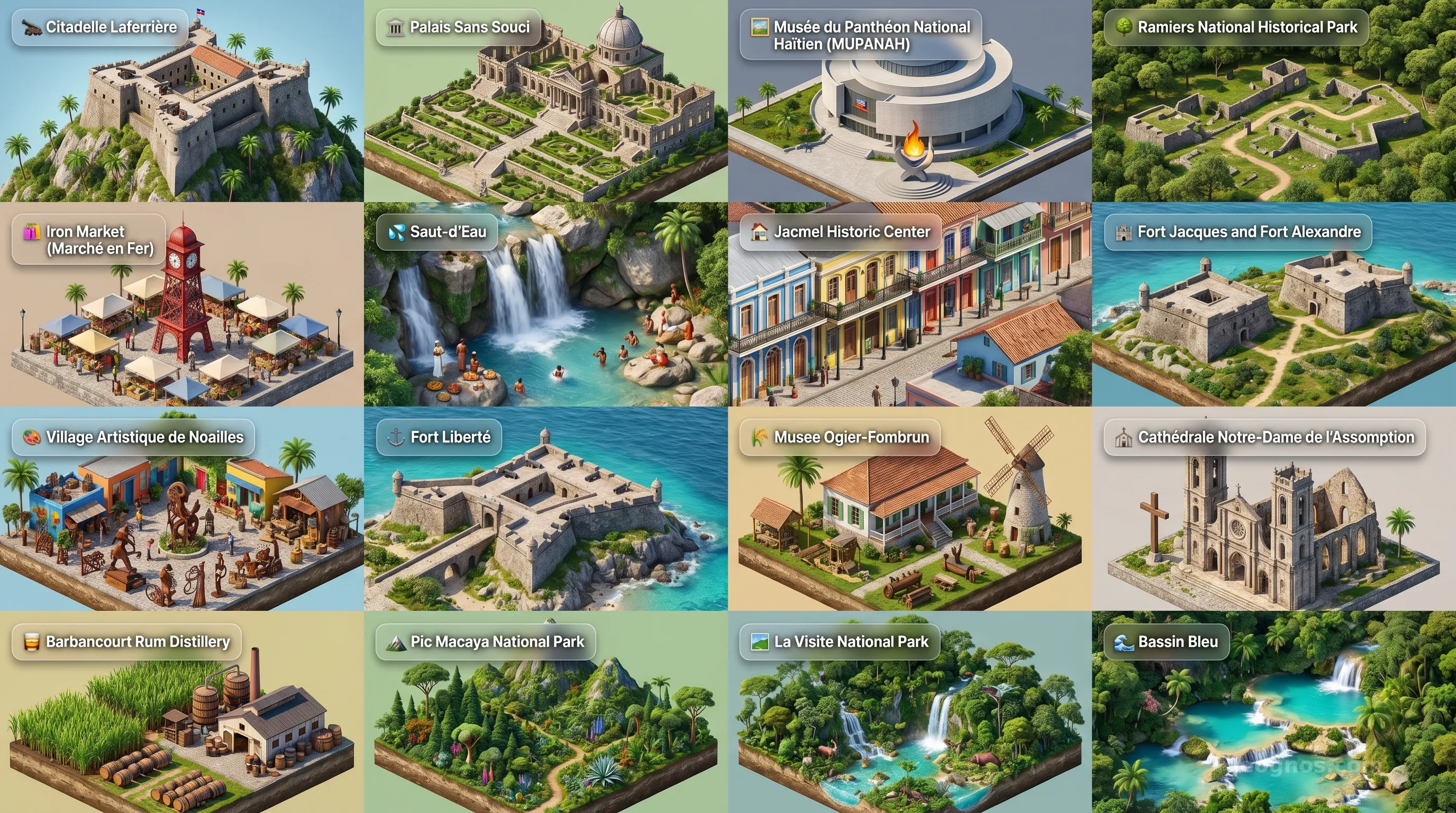
Perched atop the Bonnet à l'Evêque mountain, the Citadelle Laferrière is a monumental fortress and the ultimate symbol of Haitian independence. Built in the early 19th century by King Henri Christophe to defend against potential French incursions, it stands as the largest fortress in the Americas and is essential for students of post-colonial history and military architecture. The best time to visit is during the dry season from November to March. Tourist tip: Start your hike or horseback ride from the village of Milot early in the morning to avoid the midday heat, and ensure you hire a local guide for rich historical context.
The Versailles of the Caribbean
Once the opulent royal residence of King Henri Christophe, the Palais Sans Souci was built to rival the grandeur of European palaces and assert the dignity of the newly free Black republic. Though partially destroyed by an earthquake in 1842, the remaining grand staircases and historic facades offer a poignant study into early 19th-century Haitian wealth and sovereignty. It is best visited alongside the Citadelle between November and March. Tourist tip: Spend time exploring the lower terraces and the nearby royal chapel, and wear sturdy walking shoes.
Haiti's Historical Heart
Located in Port-au-Prince, MUPANAH is Haiti's premier museum, safeguarding the nation's profound history from the indigenous Taíno people through the brutality of slavery to the triumph of the Haitian Revolution. It houses remarkable artifacts, including the anchor of Christopher Columbus's Santa Maria, Toussaint Louverture's pocket watch, and King Henri Christophe's silver pistol. It is an invaluable resource for history and anthropology students. Open year-round. Tourist tip: Opt for a guided tour, as the expert narrations dramatically enhance the emotional and educational impact of the exhibits.
Symbol of Universal Liberty
Forming a broader UNESCO complex alongside the Citadelle and Sans Souci, the ruins of the Ramiers site are located on a plateau offering sweeping views of the northern landscape. This archaeological site features the foundations of smaller forts and residential areas built by Henri Christophe's forces. It serves as a vital study of post-independence strategic defense mechanisms. Visit in the cooler winter months. Tourist tip: This site requires extra hiking beyond the Citadelle, so it is best suited for physically fit travelers looking for a less crowded, introspective historical experience.
Port-au-Prince's Cultural Bazaar
With its iconic red minarets, the Iron Market was originally built in Paris in 1890 intended for a railway station in Cairo before being purchased by Haitian President Florvil Hyppolite. Destroyed in the 2010 earthquake and meticulously restored, it is a living study of Haitian commerce, resilience, and culture. The market is packed with vibrant art, spices, and Vodou artifacts. The best time to visit is on a bustling weekday morning. Tourist tip: It can be overwhelming for first-time visitors; hire a trusted local guide to help navigate the stalls and negotiate purchases.
Sacred Waterfalls of Faith
Saut-d'Eau is a majestic waterfall that holds profound spiritual significance in both Catholicism and Haitian Vodou. According to legend, the Virgin Mary (syncretized with the Vodou spirit Erzulie Dantor) appeared in a nearby palm tree in the 19th century. Today, it is an incredible ethnographic study site, especially during the annual July pilgrimage when thousands come to bathe in the sacred waters for purification and healing. The wet season makes the falls most powerful. Tourist tip: If visiting during the July festival, be highly respectful of religious practitioners and ask before taking photographs.
The Art and Coffee Capital
Jacmel is renowned for its well-preserved, early 20th-century French colonial architecture, characterized by cast-iron balconies and grand coffee merchant mansions. It is arguably Haiti's artistic capital, serving as the birthplace of the country's famous papier-mâché craft. Studying the city's architecture and art provides insight into Haiti's post-independence economic boom. The absolute best time to visit is February or early March to witness the surreal, creative brilliance of Jacmel's Carnival. Tourist tip: Explore the boardwalk (Ruelle des Artistes) to buy authentic local art directly from the creators.
Dessalines' Mountain Defenses
Constructed in 1804 by Jean-Jacques Dessalines and named after him (Jacques) and Alexandre Pétion, these twin forts were the first defense structures built after Haiti gained independence. Overlooking the Bay of Port-au-Prince, they offer students of military history a glimpse into the paranoia and preparedness of the new republic facing potential French retaliation. May 18th (Haitian Flag Day) features grand celebrations here. Tourist tip: Pack a picnic and enjoy the breathtaking panoramic views of the capital city, but travel with a guide due to the remote mountain roads.
Birthplace of Haitian Metal Art
Located in Croix-des-Bouquets, this bustling artisan village is the epicenter of 'fer découpé' (cut-metal art), an art form pioneered by Georges Liautaud in the 1950s. The entire neighborhood reverberates with the sound of hammers striking recycled oil drums to create intricate sculptures representing folklore, nature, and Vodou spirits. It is a phenomenal destination for art history students and culture enthusiasts. Open year-round. Tourist tip: You can observe the mesmerizing, labor-intensive process firsthand; bring cash, as purchasing art directly supports the artisan families.
Colonial Coastal Bastion
Founded in 1578, Fort Liberté is one of the oldest cities in Haiti. The area is dominated by Fort Dauphin, a massive French colonial fort completed in 1731 to guard the bay against the British and Spanish. For archaeology and colonial history students, the sprawling ruins, antique cannons, and oceanfront stone ramparts provide excellent primary source material. Best visited during the dry months. Tourist tip: The fort is rarely crowded, making it perfect for uninterrupted photography. Combine this trip with a boat tour of the surrounding bay.
Echoes of the Plantation Era
Located on the Arcadins Coast, this museum is set within the meticulously restored ruins of an 18th-century French colonial sugar plantation. It offers a sobering and detailed educational experience regarding the trans-Atlantic slave trade, the grueling mechanics of sugar production, and the subsequent uprising that birthed the Haitian nation. Perfect for students of colonial economics and sociology. Open year-round. Tourist tip: The museum grounds are peaceful and well-maintained; plan to spend an afternoon here before relaxing at the nearby coastal resorts.
Cap-Haïtien's Historic Heart
Dominating the central square of Cap-Haïtien, this cathedral stands on the exact site where, in 1793, Léger-Félicité Sonthonax proclaimed the abolition of slavery in the northern province—a pivotal moment in world history. The current structure, with its colonial-style dome and striking interiors, was completed in the early 20th century. It is essential for studying the intersection of religion, colonial power, and liberation. Visit anytime, though Sunday mass offers a rich cultural experience. Tourist tip: Relax in the Place d'Armes outside to soak in the local atmosphere.
Haiti's Premier Rhum Agricole
Founded in 1862 by Dupré Barbancourt, a Frenchman from the Cognac region, this distillery is a cornerstone of Haitian industrial and culinary heritage. Unlike typical rum made from molasses, Barbancourt uses fresh sugar cane juice, making it a true 'rhum agricole.' It is a fascinating case study in agronomy and distillation traditions. Best visited on a weekday when operations are active. Tourist tip: Book tours in advance to witness the oak-barrel aging process and enjoy a tasting session of their renowned 15-year-old Estate Réserve.
Haiti's Cloud Forest Reserve
Situated in the Massif de la Hotte mountain range, Pic Macaya National Park is a rugged biosphere reserve protecting Haiti's last stand of virgin cloud forest. It is an ecological goldmine, harboring endangered endemic species such as the Black-capped Petrel and a staggering variety of rare orchids and amphibians. It is a mandatory destination for environmental and biological studies. Visit during the dry season (December-March) to avoid heavy rains. Tourist tip: This is deep wilderness; access is difficult and requires a 4x4 vehicle, physical stamina, and an experienced local guide.
Alpine Escarpments of the South
Located south of Port-au-Prince in the Massif de la Selle, La Visite National Park boasts unique high-altitude pine forests, vast grasslands, and deep ravines. The park contrasts sharply with the tropical lowlands, providing invaluable data for climatology and conservation students. The diverse flora and fauna are under threat, making eco-tourism here critical for funding preservation. The coolest months (December-February) are best for hiking. Tourist tip: Temperatures can drop significantly at high altitudes, so pack layers. Hiring a local guide from the nearby Seguin community is essential.
Jacmel's Hidden Turquoise Pools
Hidden in the hills above Jacmel, Bassin Bleu is a series of three spectacular cobalt-blue pools linked by cascading waterfalls. Rich in local Vodou lore, it is believed to be the home of water nymphs (sirènes). The site offers a perfect blend of natural beauty and cultural mythology. The pristine environment is an excellent spot for students of hydrogeology and local folklore. Best visited during the dry season, as heavy rains can turn the blue waters muddy. Tourist tip: The final descent requires climbing down a rope; wear appropriate water shoes and hire a local boy as a guide.