🇰🇲

Comoros

Africa • Countries •
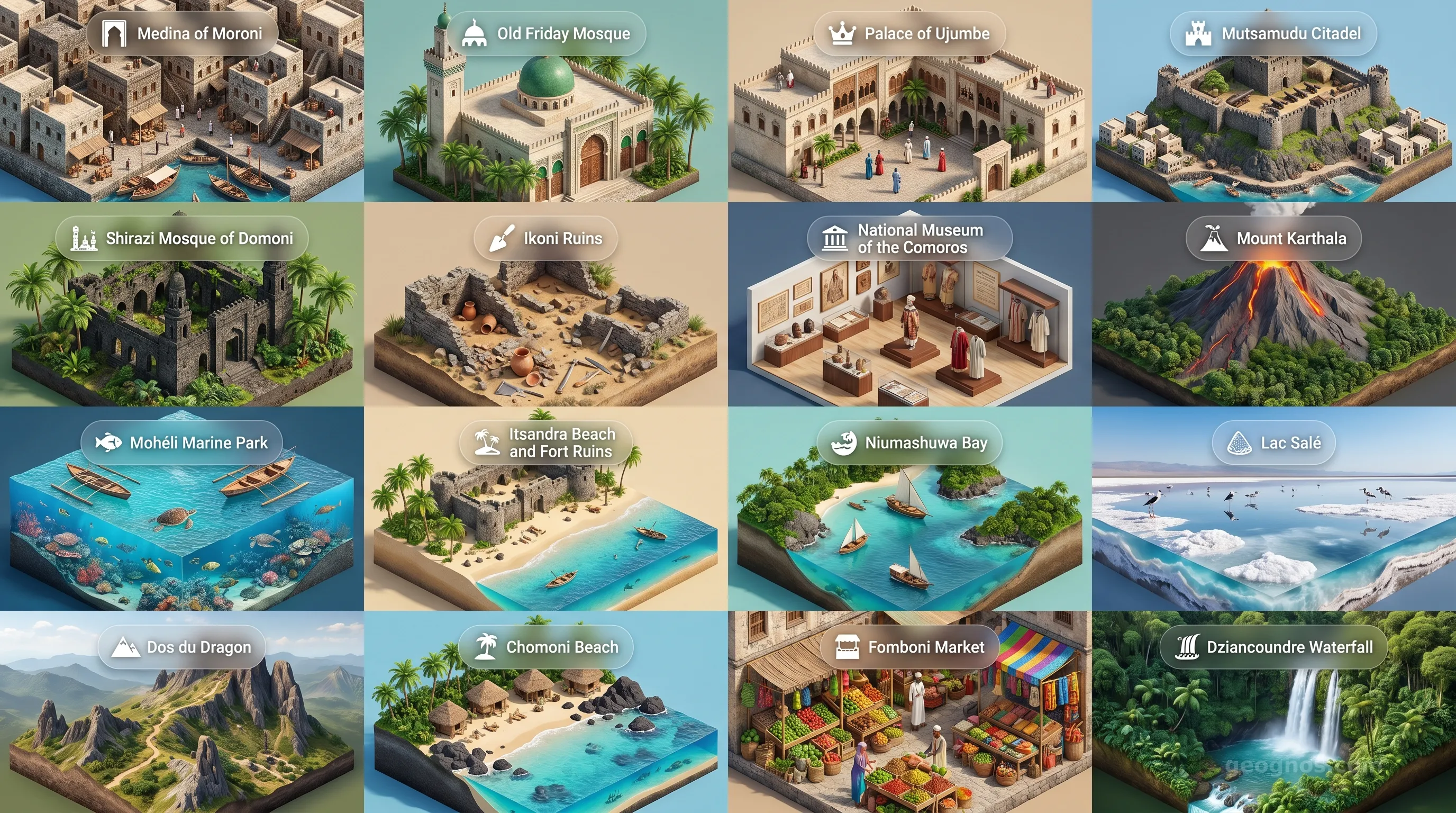
Comoros - Panoramic Places of Interest Atlas including Medina of Moroni, Old Friday Mosque, Palace of Ujumbe, Mutsamudu Citadel, Shirazi Mosque of Domoni, Ikoni Ruins, National Museum of the Comoros, Mount Karthala, Mohéli Marine Park, Itsandra Beach and Fort Ruins, Niumashuwa Bay, Lac Salé, Dos du Dragon, Chomoni Beach, Fomboni Market, Dziancoundre Waterfall

Top Sights & Landmarks

01

Medina of Moroni

Ancient Swahili-Arab Settlement

02

Old Friday Mosque

Iconic 15th-Century Waterfront Mosque

03

Palace of Ujumbe

Former Seat of the Anjouan Sultanate

04

Mutsamudu Citadel

Imposing 18th-Century Fortress

05

Shirazi Mosque of Domoni

11th-Century Islamic Heritage Site

06

Ikoni Ruins

Ancient Capital with a Tragic History

07

National Museum of the Comoros

Cultural and Natural History Center

08

Mount Karthala

Massive Active Volcanic Crater

09

Mohéli Marine Park

Biosphere Reserve and Turtle Haven

10

Itsandra Beach and Fort Ruins

Historic Beach and Ancient Capital

11

Niumashuwa Bay

Spectacular Islet-Dotted Bay

12

Lac Salé

Mysterious Volcanic Crater Lake

13

Dos du Dragon

The Dragon's Back Rock Formations

14

Chomoni Beach

White Sands and Black Volcanic Rocks

15

Fomboni Market

Bustling Heart of Mohéli

16

Dziancoundre Waterfall

Lush Tropical Cascade

Background

For centuries prior to colonization in the 19th century, the Comoros archipelago in the Indian Ocean served as a key node in maritime trade networks that connected the Middle East, India, and eastern African regions. Composed of the islands of Anjouan, Mayotte, Moheli, and Grande Comore, Comoros spent most of the 20th century as a colonial outpost until it declared independence from France on 6 July 1975. Residents of Mayotte, however, voted to remain in France, and the French Government has since classified it as a French Overseas Department. Since independence, Comoros has weathered approximately 20 successful and attempted coups, mostly between 1975 and 2000, resulting in prolonged political instability and stunted economic development. In 2002, President AZALI Assoumani became the first elected president following the completion of the Fomboni Accords, in which the islands of Grande Comore, Anjouan, and Moheli agreed to rotate the presidency among the islands every five years. This power-sharing agreement also included provisions allowing each island to maintain its local government. In 2007, Mohamed BACAR effected Anjouan's de-facto secession from the Union of the Comoros, refusing to step down when Comoros' other islands held legitimate elections. The African Union (AU) initially attempted to resolve the political crisis with sanctions and a naval blockade of Anjouan, but in 2008, the AU and Comoran soldiers seized the island. The island's inhabitants generally welcomed the move. In 2011, Ikililou DHOININE won the presidency in peaceful elections widely deemed to be free and fair. In closely contested elections in 2016, AZALI won a second term, when the rotating presidency returned to Grande Comore. In 2018, a referendum -- which the opposition parties boycotted -- approved a new constitution that extended presidential term limits and abolished the requirement for the presidency to rotate between the three main islands. AZALI formed a new government later that year, and he subsequently ran and was reelected in 2019. AZALI was reelected again in January 2024 in an election that the opposition disputed but the Supreme Court validated.

Location

Latitude
-12.1667° N
Longitude
44.25° E
N S W E
World Map Location
Geographic Location

Southern Africa, group of islands at the northern mouth of the Mozambique Channel, about two-thirds of the way between northern Madagascar and northern Mozambique

Map Reference
Africa

Area

Total Area
2,235 sq km
Land (100%)
Land: 2,235 sq km
Water: 0 sq km

Elevation

Highest Point
Karthala
Karthala 2,360 m
Lowest Point
Indian Ocean
Indian Ocean 0 m

Detailed Geography Information

Coastline

340 km

Geography - note

important location at northern end of Mozambique Channel; the only Arab League country that lies entirely in the Southern Hemisphere

Irrigated land

1.3 sq km (2012)

Land boundaries

total: 0 km

Maritime claims

territorial sea: 12 nm exclusive economic zone: 200 nm

Natural hazards

cyclones possible during rainy season (December to April); volcanic activity on Grand Comore volcanism: Karthala (2,361 m) on Grand Comore Island last erupted in 2007; a 2005 eruption forced thousands of people to be evacuated and produced a large ash cloud

Natural resources

fish

Terrain

volcanic islands, interiors vary from steep mountains to low hills

Population & Growth

+1.30% Growth
911,707
Total inhabitants (2025 est.)
Male: 48.4% (441,215) Female: 51.6% (470,492)

Age Distribution

0-14 years
32.6%
~297,216
15-64 years
62.8%
~572,552
65 years
4.6%
~41,939
Note: 2024 est.

Demographic Longevity

Median Age
23.1 years
Male
22.1 yrs
Female
23.3 yrs
Life Expectancy
67.8 years
Male
65.5 yrs
Female
70.2 yrs

Vital Dynamics

Birth Rate
21.12
births per 1,000 people
Death Rate
6.38
deaths per 1,000 people
Net Migration
-2.17
migrants per 1,000 people
Fertility Rate
2.52
children born per woman

Detailed People & Society Information

Alcohol consumption per capita

0.18 liters of pure alcohol (2019 est.)

Children under the age of 5 years underweight

9.1% (2022 est.)

Currently married women (ages 15-49)

63.1% (2022 est.)

Dependency ratios

total dependency ratio: 57.3 (2025 est.) youth dependency ratio: 49.9 (2025 est.) elderly dependency ratio: 7.4 (2025 est.) potential support ratio: 13.5 (2025 est.)

Education expenditure

2.3%

2.3% of GDP (2023 est.) 11.5% national budget (2025 est.)

Ethnic groups

Gross reproduction rate

1.24 (2025 est.)

Health expenditure

6.3%

6.3% of GDP (2021) 4.7% of national budget (2022 est.)

Infant mortality rate

total: 53.9 deaths/1,000 live births (2025 est.) male: 64.9 deaths/1,000 live births female: 44.7 deaths/1,000 live births

Languages

Literacy

total population: 75.8% (2021 est.) male: 79.9% (2021 est.) female: 72.2% (2021 est.)

Major urban areas - population

62,000 MORONI (capital) (2018)

Maternal mortality ratio

179 deaths/100,000 live births (2023 est.)

Mother's mean age at first birth

23 years (2012 est.) note: data represents median age at first birth among women 25-49

Nationality

noun: Comoran(s) adjective: Comoran

Obesity - adult prevalence rate

7.8% (2016)

Physician density

0.42 physicians/1,000 population (2022)

Population distribution

the capital city of Maroni, on the western side of the island of Grande Comore, is the country's largest city; however, Anjouan is the most densely populated of the three islands that comprise Comoros, as shown in this population distribution map

Refugees and internally displaced persons

Total Displaced & Vulnerable Persons
56 individuals
Refugees
32.1%
18
18 (2024 est.)
Internally Displaced Persons (IDPs)
67.9%
38
38 (2024 est.)

Religions

Muslim (overwhelmingly Sunni Muslim
98.1%
ethnic religionist
1.1%
Christian
0.6%
other
0.3%

Sex ratio

at birth: 1.03 male(s)/female 0-14 years: 1 male(s)/female 15-64 years: 0.92 male(s)/female 65 years and over: 0.77 male(s)/female total population: 0.94 male(s)/female (2024 est.)

Tobacco use

total: 14.7% (2025 est.) male: 24.8% (2025 est.) female: 4.7% (2025 est.)

Climate & Issues

Climate Profile

tropical marine; rainy season (November to May)

Key Environmental Issues
deforestation soil degradation and erosion from forest loss and crop cultivation on slopes without proper terracing silting of coral reefs

Land Cover

Coverage Distribution
Agri (72%)
Forest (18%)
Arable: 34.9%
Crops: 28.5%
Pasture: 8.1%
Forest: 17.8%

Air & Carbon Emissions

Annual CO2 Output 2023 est.
436,000
Coal (0%) Oil (100%) Gas (0%)
PM2.5 Exposure 14.5 µg/m³
0 5 (WHO Limit) 15 25 35+

Water Resources & Use

Renewable Water Resources 1.2 billion cubic meters (2022 est.)
Annual Water Withdrawal
municipal: 4.8 million cubic meters (2022 est.)
Municipal (48%) Ind (5%) Agri (47%)

Detailed Environmental Information

International environmental agreements

BiodiversityClimate ChangeClimate Change-Kyoto ProtocolClimate Change-Paris AgreementComprehensive Nuclear Test BanDesertificationEndangered SpeciesHazardous WastesLaw of the SeaOzone Layer ProtectionShip PollutionWetlands

Urbanization

urban population: 30.1% of total population (2023) rate of urbanization: 2.97% annual rate of change (2020-25 est.)

Waste and recycling

municipal solid waste generated annually: 91,000 tons (2024 est.) percent of municipal solid waste recycled: 10.1% (2022 est.)

Capital & State Profile

Capital City
Moroni
-11.7° N, 43.2333° E
Timezone UTC+3
Government Type
federal presidential republic
Independence 1975-07-06
National Holiday 07-06

Executive Branch

Chief of State
President AZALI Assoumani (since 26 May 2016)
Head of Government
President AZALI Assoumani (since 26 May 2016)
Last Election 14 January 2024
Next Election 2029
Cabinet Council of Ministers appointed by the president

Legislative Branch

unicameral
Legislature Name Assembly of the Union (Assemblée de l'Union)
Seats & Term
33 (all directly elected) seats / 5 years
Women in Chamber
18.2% Representation
Electoral System plurality/majority
Parties Composition
Convention for the Renewal of the Comoros (CRC) 31Other 2

National Identity & Symbols

National Flag Description

four equal horizontal bands of yellow (top), white, red, and blue, with a green isosceles triangle based on the left; a vertical white crescent moon is centered in the triangle, with four five-pointed white stars placed vertically in a line between the points of the crescent

Symbolic Meaning the horizontal bands and the stars represent the four main islands of the archipelago -- Mwali, N'gazidja, Ndzuwani, and Mahore (Mayotte is a department of France, but claimed by Comoros)
National Symbol four five-pointed stars and crescent moon
National Colors green, white
National Anthem Udzima wa ya Masiwa (The Union of the Great Islands)

Detailed Government Information

Administrative divisions

3 islands; Anjouan (Ndzuwani), Grande Comore (N'gazidja), Moheli (Mwali)

Citizenship

citizenship by birth: no citizenship by descent only: at least one parent must be a citizen of the Comoros dual citizenship recognized: no residency requirement for naturalization: 10 years

Constitution

history: previous 1996, 2001; newest adopted 30 July 2018 amendment process: proposed by the president of the union or supported by at least one third of the Assembly of the Union membership; adoption requires approval by at least three-quarters majority of the total Assembly membership or approval in a referendum

Country name

conventional long form: Union of the Comoros conventional short form: Comoros local long form: Udzima wa Komori (Comorian)/Union des Comores (French)/Al Ittihad al Qumuri (Arabic) local short form: Komori (Comorian)/Les Comores (French)/Juzur al Qamar (Arabic) former: Comorian State, Federal Islamic Republic of the Comoros etymology: name derives from the Arabic al qamar, meaning "the moon"

International law organization participation

has not submitted an ICJ jurisdiction declaration; accepts ICCt jurisdiction

International organization participation

Judicial branch

highest court(s): Supreme Court or Cour Supreme (consists of 7 judges) judge selection and term of office: Supreme Court judges - selection and term of office NA subordinate courts: Court of Appeals (in Moroni); Tribunal de première instance; island village (community) courts; religious courts

Legal system

mixed legal system of Islamic religious law, the French civil code of 1975, and customary law

Political parties

Convention for the Renewal of the Comoros or CRC Juwa Party (Parti Juwa) or PJ Orange Party (2020)

Suffrage

18 years of age; universal

Economic Overview

small trade-based island economy; declining remittances; new structural and fiscal reforms; adverse cyclone and COVID-19 impacts; manageable debts; fragile liquidity environment; large foreign direct investment; state-owned enterprises suffering

Size & Performance

Real GDP (PPP)
$3.092 billion
Latest available estimate (2024)
2023: $2.99 billion2022: $2.901 billion
Real GDP Growth
3.4% (2024 est.)
+3.4%
GDP Per Capita (PPP)
$3,600
2023: $3,5002022: $3,500

GDP Sector Breakdown

Agriculture: 36.6%Industry: 9.6%Services: 50.1%
Origin GDP %
Agriculture 36.6%
Industry 9.6%
Services 50.1%

Trade Balance

Trade Position
Trade Deficit
$355.58 million
Total Exports
$148.455 million (2023 est.)
Total Imports
$504.036 million (2023 est.)
Exports (23%) Imports (77%)

Budget Balance

Budget Position
Budget Deficit
-$17.79 million
Revenues
$212.551 million (2023 est.)
Expenditures
$230.338 million (2023 est.)
Revenues (48%) Expenditures (52%)

Export Profile

Top Export Partners

23.0%
16.0%
11.0%
3.0%
Note: 2023; top five export partners based on percentage share of exports

Major Export Commodities

clovesshipsessential oilsvanillascrap iron

Import Profile

Top Import Partners

24.0%
21.0%
6.0%
Note: 2023; top five import partners based on percentage share of imports

Major Import Commodities

refined petroleumpoultryriceflavored wateradditive manufacturing machines

Labor & Employment

Total Labor Force 276,400 (2024 est.)
General Unemployment Rate 3.9%
Youth Unemployment (Ages 15-24) 8.9%
Population Below Poverty Line 44.8% (2020 est.)

Income Inequality

Detailed Economic Data

Agricultural products

bananascoconutscassavayamsmaizetaromilktomatoessweet potatoespulses

Current account balance

-$24.621 million (2023 est.) -$5.248 million (2022 est.) -$4.076 million (2021 est.) note: balance of payments - net trade and primary/secondary income in current dollars

Debt - external

$267.652 million (2023 est.) note: present value of external debt in current US dollars

Exchange rates

Comoran francs (KMF) per US dollar - Exchange rates: 454.524 (2024 est.) 454.991 (2023 est.) 467.184 (2022 est.) 415.956 (2021 est.) 430.721 (2020 est.)

GDP - composition, by end use

Industrial production growth rate

3.8% (2024 est.) note: annual % change in industrial value added based on constant local currency

Industries

fishingtourismperfume distillation

Inflation rate (consumer prices)

1% (2017 est.) 1.8% (2016 est.) note: annual % change based on consumer prices

Remittances

21.4% of GDP (2023 est.) 22% of GDP (2022 est.) 22.2% of GDP (2021 est.) note: personal transfers and compensation between resident and non-resident individuals/households/entities

Reserves of foreign exchange and gold

$323.946 million (2024 est.) $324.561 million (2023 est.) $283.746 million (2022 est.) note: holdings of gold (year-end prices)/foreign exchange/special drawing rights in current dollars

Grid Infrastructure

Electricity Access 89.9%
Urban: 100% Rural: 82.9%
Capacity 32,000 kW (2023 est.)
Consumption 113.052 million kWh (2023 est.)
Grid Losses: 22.1 million kWh (2023 est.)

Generation Mix

Percentage Share of Production
fossil fuels 100%

Fossil Fuels Production

Petroleum
Consumption 3,000 bbl/day (2023 est.)
Coal
Imports 2,000 metric tons (2023 est.)

Intensity & Nuclear

Energy Consumption Per Capita 7.139 million Btu/person (2023 est.)
No nuclear energy infrastructure or reactor operations reported in this country dossier.

Digital Access

.km
Internet Usage 36%

Active internet users as a percentage of the total population.

Fixed Broadband

Penetration Rate 0 / 100
Total Subscriptions 3,000 (2023 est.)

Mobile Cellular

Penetration Rate 110 / 100
Total Subscriptions 934,000 (2023 est.)

Broadcast Media

national state-owned TV station and a TV station run by Anjouan regional government; national state-owned radio; regional governments on the islands of Grande Comore and Anjouan each operate a radio station; a few independent and small community radio stations operate on the islands of Grande Comore and Moheli, and these two islands have access to Mayotte Radio and French TV

Aviation

D6
Airports
3
As of 2025

Ports & Harbors

Ports Count 4
Hover for breakdown & key ports As of 2024

Merchant Marine

Commercial Fleet
273 ships
Hover for vessel types breakdown As of 2023

Active Duty Strengths

estimated 600 Defense Force; estimated 500 Federal Police (2023)

Refers to active military personnel.

Service & Defense Details

Military and security forces

National Army for Development (l'Armee Nationale de Developpement, AND): Comoran Defense Force (Force Comorienne de Defense or FCD; includes Comoran National Gendarmerie); Ministry of Interior: Coast Guard, Federal Police, National Directorate of Territorial Safety (customs and immigration) (2025) note 1: when the Gendarmerie serves as the judicial police, it reports to the Minister of Justice; the Gendarmerie also has an intervention platoon that may act under the authority of the Interior Minister note 2: the FCD is also known as the Comoran Security Force

Military equipment inventories and acquisitions

the AND is lightly armed and equipped with small arms, a few light aircraft, and utility vehicles (2024)

Military - note

the focus for the security forces is search and rescue operations and maintaining internal security; a defense treaty with France provides naval resources for the protection of territorial waters, training of Comoran military personnel, and air surveillance; France maintains a small maritime base and a Foreign Legion contingent on neighboring Mayotte (2024)

Military service age and obligation

18-25 years of age for voluntary military service for men and women; no conscription (2023)