Bhutan
Top Sights & Landmarks
The Palace of Great Happiness
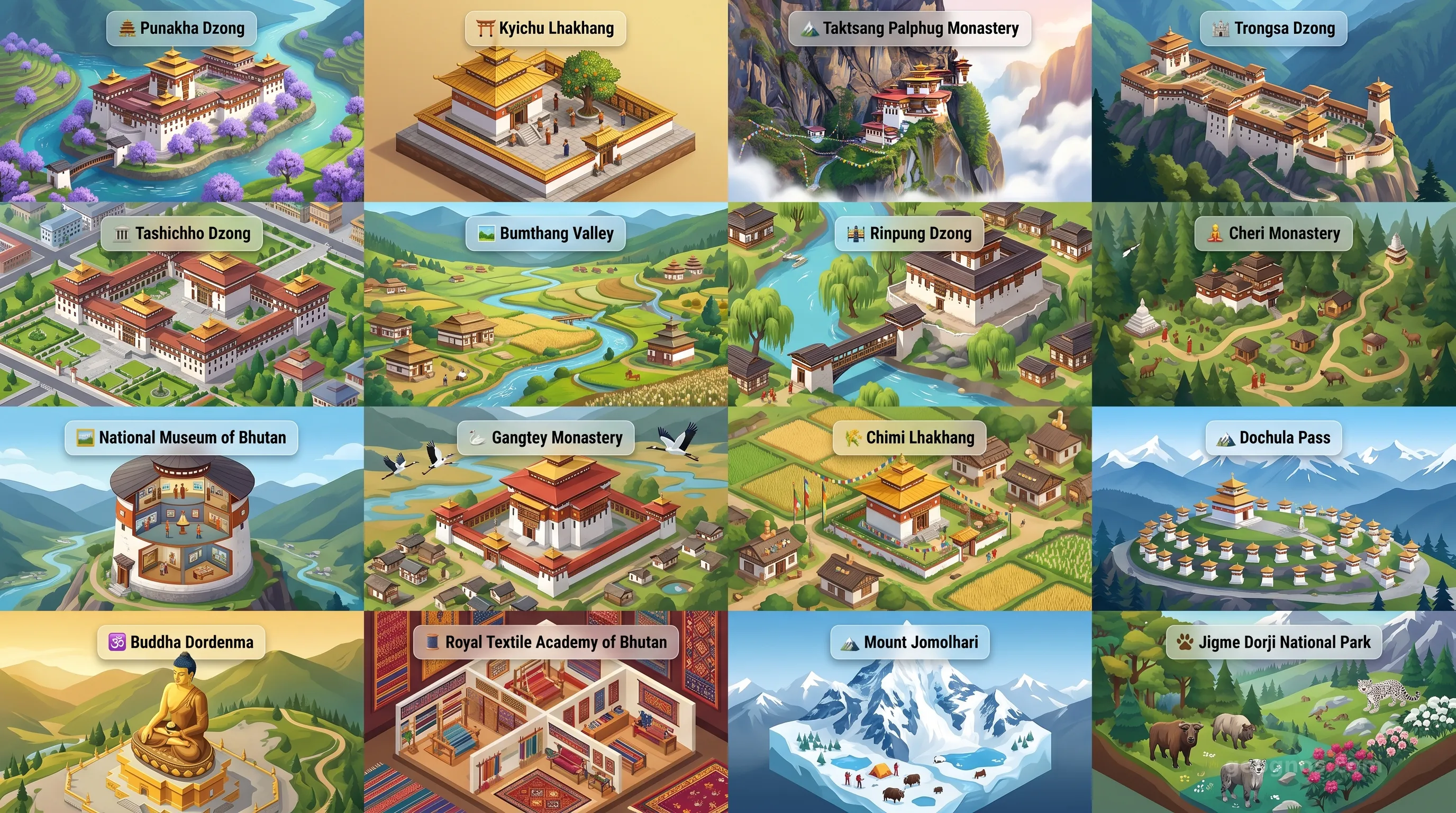
Punakha Dzong is widely considered the most beautiful fortress in Bhutan. Historically serving as the capital and seat of government until 1955, it is a masterpiece of Bhutanese architecture that students of structural history will find fascinating, as it was built without a single nail. It holds profound cultural significance, housing the sacred relics of the southern Drukpa Lineage. The best season to visit is spring (March to May) when the stunning purple jacaranda trees bloom against the white walls. Tourist tip: Ensure you wear respectful, collared attire covering arms and legs, and take time to walk across the nearby Mo Chhu suspension bridge.
Bhutan's Oldest Sacred Temple
Constructed in the 7th century by the Tibetan King Songtsen Gampo, Kyichu Lhakhang is one of Bhutan's oldest and most historically significant shrines. It provides an excellent study of early Himalayan Buddhism and the mythos of pinning down a giant demoness whose body covered the region. The spiritual ambiance here is unparalleled, drawing both pilgrims and historians. Autumn (September to November) offers clear skies and pleasant weather for visiting. Tourist tip: Walk around the temple to spin the ancient prayer wheels, and do not miss the magical orange tree in the courtyard that reportedly bears fruit year-round.
The Iconic Tiger's Nest
Perched precariously on a cliffside 900 meters above the Paro Valley, the Tiger's Nest is the quintessential symbol of Bhutan. It marks the spot where Guru Rinpoche, the founder of Tibetan Buddhism in Bhutan, is said to have meditated in the 8th century after flying there on a tigress. For students of religion and tourists alike, the sheer architectural marvel of its construction on a sheer rock face is astounding. The best time to hike is during spring or autumn for comfortable temperatures. Tourist tip: The hike takes 4-5 hours round trip; start early to avoid the midday sun and rent a walking stick at the base.
The Ancestral Fortress of Royals
As the largest dzong fortress in Bhutan, Trongsa Dzong represents the historical heart of the nation. It was the ancestral home of the ruling Wangchuck dynasty before they became kings. The strategic location overlooking the Mangde River gorge allowed it to control trade between eastern and western Bhutan, making it a brilliant case study in military and political history. The winter months (December to February) provide striking, clear views of the deep valleys. Tourist tip: Visit the Ta Dzong museum situated on the hill above the fortress to see artifacts from Bhutan's monarchy.
The Fortress of the Glorious Religion
Located in the capital city of Thimphu, this grand fortress serves as the current seat of the Bhutanese government and the central monastic body. Its origins trace back to the 13th century, though it was significantly expanded in the 1960s. The site offers incredible insights into Bhutan's unique dual system of government, where religion and state harmoniously coexist. It is best visited in autumn during the lively Thimphu Tshechu festival. Tourist tip: The Dzong is only open to tourists after 5:00 PM on weekdays, or all day on weekends, so plan your Thimphu itinerary accordingly.
The Spiritual Heartland of Bhutan
Bumthang is deeply revered as the religious heartland of the nation, home to some of the oldest Buddhist temples and monasteries, including Kurjey Lhakhang and Jambay Lhakhang. The valley is historically vital for studying the spread of Buddhism in the Himalayas and the ancient folklore of kings and saints. With its undulating, alpine terrain, it feels distinctly different from other parts of Bhutan. The best time to visit is in October for the spectacular Jambay Lhakhang Drup festival. Tourist tip: Try the local produce, including Bumthang honey, Swiss-style cheese, and unfiltered Red Panda beer.
Fortress on a Heap of Jewels
Rinpung Dzong defends the Paro valley and is a prime example of 17th-century Bhutanese defensive architecture. Historically, it was used to defend the valley against Tibetan invasions. Today, it stands as an excellent site for students of art and history, featuring intricate wooden carvings and beautiful murals detailing Buddhist cosmology. Spring is ideal, particularly during the Paro Tshechu, one of the country's most spectacular religious festivals. Tourist tip: Capture stunning photos of the dzong from the traditional wooden cantilever bridge, Nyamai Zam, located just below.
Bhutan's First Monastic Body
Established in 1620 by Zhabdrung Ngawang Namgyal, the unifier of Bhutan, Cheri Monastery holds extreme historical weight as the site of the country's first monastic body. Perched on a forested hill above the Thimphu valley, it remains an active retreat and meditation center for monks. The site is a rich case study of ascetic Buddhist life and 17th-century religious consolidation. The hike is pleasant year-round but especially lush during the post-monsoon autumn season. Tourist tip: The steep, one-hour hike up requires good footwear; keep an eye out for mountain goats (gorals) resting on the rocky slopes.
The Ta Dzong Watchtower
Housed in a 17th-century circular watchtower (Ta Dzong) above Paro Dzong, this museum is essential for anyone wanting to deeply understand Bhutanese heritage. The galleries hold over 3,000 works of Bhutanese art, covering more than 1,500 years of cultural heritage, from traditional thangkas to bronze statues and weaponry. It acts as an incredible educational primer on Bhutan's flora, fauna, and culture. Visit any time of year. Tourist tip: Cameras are not allowed inside the galleries, but the panoramic views of the Paro valley from the museum grounds are highly photogenic.
Crown Jewel of the Phobjikha Valley
Gangtey Monastery is an important seat of the Nyingmapa school of Buddhism, located on a strategic ridge overlooking the stunning Phobjikha Valley. Founded in 1613, it boasts incredibly detailed woodwork and a massive, striking layout that underwent a meticulous restoration completed in 2008, making it a triumph of conservation architecture. The best time to visit is November, allowing visitors to coincide with the arrival of the endangered black-necked cranes in the valley below. Tourist tip: Attend the Black-Necked Crane Festival held annually in the monastery's courtyard in November.
The Temple of the Divine Madman
Built in 1499, Chimi Lhakhang is famous as the fertility temple dedicated to Drukpa Kunley, an eccentric saint known as the 'Divine Madman' who used humor, songs, and shocking behavior to impart Buddhist teachings. The site provides a fascinating anthropological study into Bhutan's phallus worship and unique socio-religious narratives. Spring and autumn are excellent times for the short, scenic walk through a local village to the temple. Tourist tip: The hike passes through rice paddies and the village of Sopsokha; embrace the unusual phallic murals painted on the village houses as local cultural heritage.
The 108 Memorial Chortens
Dochula Pass, located at an elevation of 3,100 meters, features the 108 Druk Wangyal Chortens built to commemorate Bhutanese soldiers who died in a 2003 military operation. It is a modern yet profoundly impactful historical monument reflecting the country's spiritual and patriotic ethos. On clear days, it offers a breathtaking 360-degree panoramic view of the Himalayan mountain range. Winter (December to February) guarantees the crispest, clearest views of the snow-capped peaks. Tourist tip: Stop at the Druk Wangyal Cafe for a hot cup of tea to warm up while admiring the spectacular Himalayan backdrop.
The Giant Gilded Buddha
Dominating the Thimphu valley skyline, the Buddha Dordenma is a massive 51.5-meter tall bronze statue gilded in gold. Completed in 2015 to celebrate the 60th anniversary of the fourth king, it houses exactly 125,000 smaller Buddha statues inside. It is a marvel of modern sculptural engineering infused with deep prophetic and spiritual significance. The site is spectacular at dawn or sunset when the golden statue gleams in the light. Tourist tip: Rent a mountain bike or hike up the trails of the Kuensel Phodrang Nature Park surrounding the statue for excellent views of Thimphu.
The Art of Bhutanese Weaving
Weaving is a deeply ingrained part of Bhutanese culture, and the Royal Textile Academy is a state-of-the-art institution dedicated to preserving this living art. Students of textile design and cultural anthropology will be mesmerized by the intricate patterns and royal garments on display. It actively trains young weavers, ensuring the survival of regional techniques. Open year-round, it offers a perfect indoor activity. Tourist tip: Watch the weavers at work in the adjoining conservation center and consider buying an authentic piece at the museum shop to support the artisan community.
The Bride of Kangchenjunga
Reaching an imposing 7,326 meters, Mount Jomolhari is considered profoundly sacred in Bhutanese culture, believed to be the home of the protector goddess Jomo. Unclimbed out of respect for its sacred status, it offers unmatched opportunities for high-altitude geological and environmental studies. The Jomolhari trek is one of the most famous and breathtaking trekking routes in the Himalayas. Late spring (April-May) and autumn (October) are the only viable seasons for trekking due to weather constraints. Tourist tip: If not up for a multi-day trek, head to the ruins of Drukgyel Dzong in Paro on a clear day for a distant but spectacular view of the peak.
A Biodiversity Hotspot
As the second-largest national park in Bhutan, Jigme Dorji is a premier destination for studying high-altitude flora and fauna. It is globally unique as the only park where the habitats of the Bengal tiger and the snow leopard overlap. The park encompasses glaciers, alpine meadows, and broadleaf forests, reflecting Bhutan's strict environmental conservation policies. Spring is exceptional for spotting blooming rhododendrons and wild orchids. Tourist tip: The park covers multiple districts; accessing it via the Gasa district allows you to enjoy the famous Gasa hot springs after exploring the wilderness.