Bahrain
Top Sights & Landmarks
Ancient Capital of the Dilmun Civilization
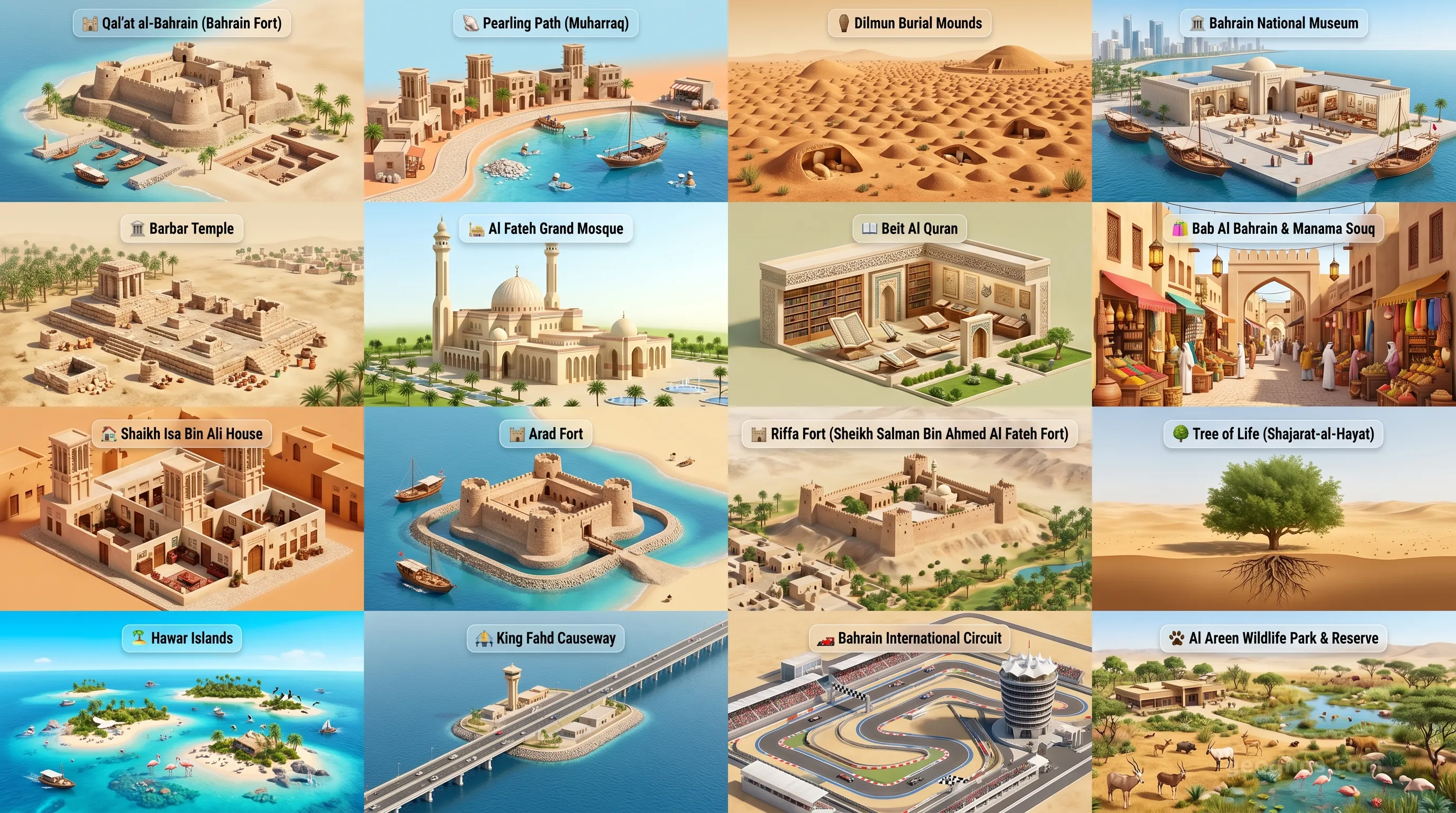
A must-visit for students of archaeology and history, this site represents the capital of the ancient Dilmun civilization, one of the most important ancient trade empires in the region. The fort and its surrounding tell (artificial mound) reveal over 4,000 years of continuous human occupation, spanning from 2300 BC to the 16th century AD. The best season to visit is between November and March when the weather is mild. Tourist Tip: Visit the adjacent on-site museum first to contextualize the complex layers of excavation, and stay until sunset for spectacular photographic opportunities as the ancient stone walls contrast with Manama's modern skyline.
Testimony of an Island Economy
This 3.5-kilometer trail offers an unparalleled educational journey into the cultural and economic history of the Arabian Gulf before the discovery of oil. The pathway connects oyster beds, a coastal fort, and 17 historic buildings in Muharraq, illustrating the complete narrative of the pearling industry. It is highly significant for understanding Bahrain's foundational wealth and social structure. Winter and early spring provide the most comfortable climate for walking the trail. Tourist Tip: Start your journey at the Bu Mahir Fort visitor center via a short boat ride from the National Museum, and wear comfortable walking shoes to navigate the narrow, traditional alleyways.
Vast Ancient Necropolis
Students of anthropology and ancient history will be fascinated by this sprawling necropolis, comprising over 11,000 burial mounds constructed between 2050 and 1750 BC. These mounds provide critical evidence of the early Dilmun civilization's burial practices and societal hierarchy, reflecting a period when Bahrain became a central trade hub. The cooler months of November to February are ideal for exploring the arid landscape. Tourist Tip: The A'ali village area features the 'Royal Mounds', which are the largest and most impressive; combine this visit with a stop at A'ali's traditional pottery workshops nearby.
Guardian of Bahraini Heritage
As the foremost repository of Bahrain's 6,000-year history, this museum is an essential study destination for anyone wanting to grasp the island's evolution from ancient Dilmun to the modern era. The museum houses exceptional artifacts, including actual Dilmun burial mounds transported and reassembled indoors, and a vivid traditional handicrafts section. It can be visited year-round due to its air-conditioned interior. Tourist Tip: Take time to explore the outdoor sculpture courtyard and enjoy a coffee at the museum cafe, which offers lovely views over the bay. Don't miss the boat ride available from the museum to the Pearling Path.
Ancient Dilmunite Religious Complex
This archaeological treasure is vital for understanding the spiritual life of the Dilmun civilization. Discovered in 1954, it consists of three superimposed temples dating back to the 3rd millennium BC, built to worship Enki, the Sumerian god of wisdom and sweet waters. It features a remarkable subterranean sacred well. The site is best visited during the cooler winter months. Tourist Tip: Since on-site signage is minimal, reading up on Dilmun mythology beforehand or hiring a local guide will immensely enrich your understanding of the ruins.
Magnificent Islamic Architectural Marvel
One of the largest mosques in the world, capable of accommodating over 7,000 worshippers, Al Fateh is a masterpiece of modern Islamic architecture. Students of architecture and religion will appreciate the spectacular fiberglass dome (the world's largest), Kufic calligraphy, Italian marble, and Austrian glass used in its construction. It is an excellent place to learn about Islamic culture and Bahraini religious practices. Accessible year-round. Tourist Tip: Free guided tours are provided by knowledgeable local volunteers in multiple languages. Modest dress is required, and women will be provided with an abaya and headscarf at the entrance.
House of the Quran
This unique institution is dedicated to Islamic arts and houses one of the world's most renowned collections of Islamic calligraphy and Quranic manuscripts, some dating back to the 7th century. It offers profound educational value for historians, linguists, and art students studying the evolution of Arabic script. The building's distinctive architecture incorporates engraved Quranic verses on its facade. It is an excellent indoor activity for the hot summer months. Tourist Tip: Pay special attention to the miniature Qurans and the manuscripts written on parchment and rice; photography without flash is usually permitted.
Gateway to Traditional Trade
Constructed by the British in 1949, Bab Al Bahrain (Gateway of Bahrain) marks the entrance to the bustling Manama Souq. It is a vibrant living study of the island's commercial history and cultural melting pot. Visitors can explore a labyrinth of narrow streets selling spices, perfumes, gold, and textiles. The best time to visit is during the cooler evenings when the market is most alive. Tourist Tip: Haggle respectfully when buying souvenirs or gold, and be sure to stop at Haji's Cafe inside the souq for an authentic, traditional Bahraini breakfast or lunch.
19th-Century Royal Residence
Located in Muharraq, this is one of the finest examples of traditional Gulf Islamic architecture. Built in 1800, it served as the royal residence and the seat of government for Shaikh Isa Bin Ali Al Khalifa. Students of architecture will marvel at the wind towers (badqeer) designed for natural climate control, the intricate wooden carvings, and the distinct courtyards separating family, guests, and servants. Winter is the ideal time to visit. Tourist Tip: Notice the thick mud-brick walls and traditional coral stone construction, which kept the interior cool long before the invention of air conditioning.
15th-Century Coastal Stronghold
This typical Islamic 15th-century fort was built in a strategic location overlooking the sea passages of Muharraq. It played a crucial role in defending Bahrain against Portuguese and Omani invasions. The fort has been extensively restored using traditional materials like palm trunks and coral stone, offering students a tangible look at historical military architecture. Winter is the best time to explore the ramparts. Tourist Tip: Visit during the late afternoon; the fort is brilliantly illuminated at night, making it a spectacular backdrop for photos. It is also adjacent to a nice waterfront walkway.
Seat of the Al Khalifa Dynasty
Perched on a cliff overlooking the Hunanaiya valley, Riffa Fort was built in 1812 and served as the seat of power for the Al Khalifa dynasty until 1869. It provides excellent insights into the royal history and military strategy of 19th-century Bahrain. The fort features an interactive museum detailing the royal family's genealogy. The cooler months are recommended for exploring its open courtyards. Tourist Tip: Enjoy a traditional cup of Arabic coffee or tea at the Saffron Cafe located within the fort, which offers breathtaking panoramic views of the valley.
Mystical Desert Survivor
This 400-year-old mesquite tree stands alone in the heart of the barren Arabian desert with no visible source of water, making it a botanical and geological marvel. It serves as a study in resilience and desert ecology, wrapped in local folklore claiming it marks the location of the Garden of Eden. The best time to visit is during winter to avoid the extreme summer desert heat. Tourist Tip: Sunset is the most magical time to visit. Respect the barriers around the tree, designed to protect its ancient root system from tourist damage.
Pristine Wildlife Archipelago
Located near the coast of Qatar but belonging to Bahrain, this archipelago is a protected wildlife reserve. It is an extraordinary destination for students of biology and ornithology, hosting the world's largest breeding colony of Socotra cormorants, alongside dugongs and Arabian oryx. Spring and autumn are the best times for bird watching. Tourist Tip: Access requires a 45-minute boat ride from the main island. It's best to book a stay at the island's resort or arrange an organized eco-tour to fully experience the remote natural beauty.
Engineering Marvel Connecting Nations
A remarkable feat of modern engineering, this 25-kilometer series of bridges and causeways connects Bahrain to Saudi Arabia. For engineering students, it represents a massive infrastructural triumph over the sea. Culturally, it has deeply shaped Bahrain's modern economy and tourism since its opening in 1986. Accessible year-round. Tourist Tip: You don't need a Saudi visa to drive to the middle passport island. You can park there, visit the observation tower for panoramic views of both countries, and enjoy a meal at the border restaurants.
Home of Motorsport in the Middle East
As the first track in the Middle East to host the Formula 1 Grand Prix, the BIC is a symbol of Bahrain's modern development and sporting culture. It is an excellent case study in sports tourism and modern venue architecture. The best time to visit is during the F1 race in March/April, or during winter for track days. Tourist Tip: Even if there isn't a race, you can book a VIP tour of the control tower and track, or experience the thrill of the adjacent international-standard karting track.
Arabian Flora and Fauna Sanctuary
This conservation park is critical for the preservation of indigenous Arabian species, including the Arabian leopard, the sand gazelle, and the elusive Arabian oryx. It provides excellent educational value for students of conservation biology and zoology. The park is split into a visitor-accessible zoo and a restricted reserve. The cooler winter season is highly recommended for visiting, as animals are more active. Tourist Tip: Take the guided bus tour which grants access to the restricted reserve area where animals roam freely in their natural habitat.