Antigua and Barbuda
Top Sights & Landmarks
Historic Georgian Naval Base
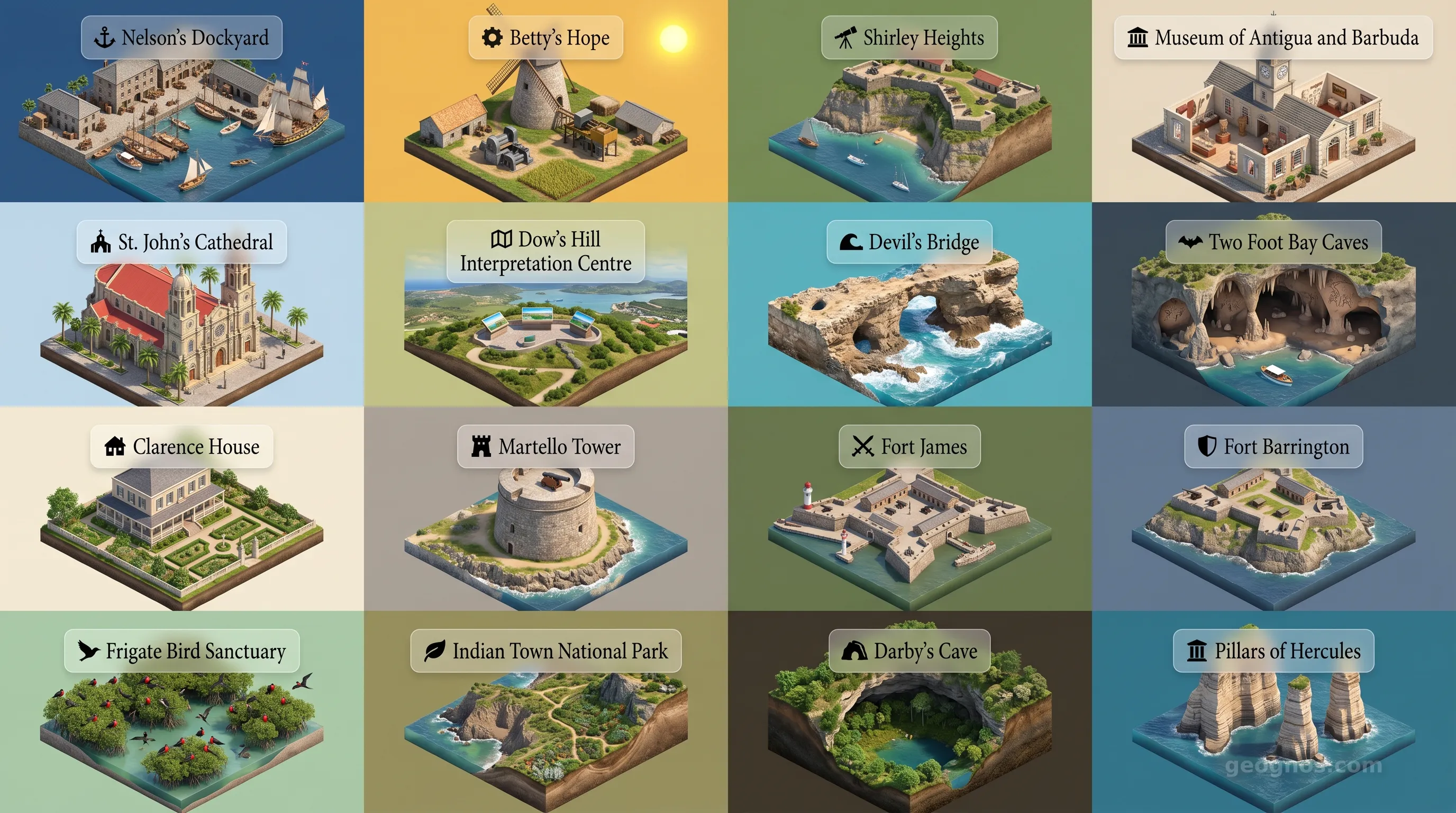
Nelson's Dockyard is the only continuously working Georgian naval dockyard in the world. Originally developed in the 18th century by the British Royal Navy to maintain ships, it gained worldwide fame through its association with Admiral Horatio Nelson. Historically, it was crucial in protecting Britain's highly lucrative Caribbean sugar trade. Today, it offers a deep dive into colonial maritime history for students and history buffs, complete with beautifully restored stone warehouses that now house museums, boutiques, and restaurants. The best season to visit is between December and April when the weather is ideal and sailing events like Antigua Sailing Week bring the harbor to life. Tourist tip: Purchase a National Parks pass for access to both the Dockyard and nearby Shirley Heights.
Restored 17th-Century Sugar Plantation
Established in 1650, Betty's Hope was the first large-scale sugar plantation in Antigua, significantly altering the island's economic and demographic landscape. Its historical importance is deeply tied to the transatlantic slave trade, making it an essential site for studying Caribbean colonial history, the brutal realities of enslaved laborers, and the evolution of the sugar industry. Two restored stone windmill towers stand as stark reminders of the past, alongside ruins of the boiling house and estate structures. A small on-site museum provides vital context. Visit during the dry season (January to May) for easy access. Tourist tip: Hire a local guide or historian to truly grasp the profound historical weight of the site beyond its picturesque ruins.
Panoramic Military Lookout
Named after Sir Thomas Shirley, the Governor of the Leeward Islands, this restored military lookout and gun battery once fiercely guarded the naval base at English Harbour below. It is historically significant for its strategic role in British naval supremacy during the 18th and 19th centuries. Today, it provides arguably the most iconic and photographed panoramic view of English and Falmouth Harbours. It is a brilliant destination for both architectural study of military fortifications and tourist leisure. The best time to visit is late afternoon, especially on a Sunday. Tourist tip: Do not miss the famous Sunday evening barbecue party, featuring live steel drum bands, breathtaking sunsets, and vibrant local culture.
National History Repository
Located in the heart of St. John's within the colonial-era Old Court House (built in 1747), this museum is the paramount institution for understanding the dual-island nation's heritage. It exhibits artifacts charting the islands' history from their geological formation and indigenous Arawak/Carib settlements through the colonial slavery era, right up to modern independence. It's a fantastic educational starting point for students studying Caribbean history and anthropology. Open year-round, making it a great rainy-day activity regardless of the season. Tourist tip: Take your time reading the exhibits on the indigenous people, as they feature rare Arawak pottery and tools not found elsewhere on the island.
Imposing Twin-Towered Cathedral
St. John's Cathedral, with its towering twin spires, dominates the skyline of the capital city. The current baroque-style structure is the third on the site, built in 1845 after earthquakes destroyed its predecessors. Historically, it symbolizes the dominance of the Anglican Church in colonial Antigua. Its unique architecture features a 'church within a church'—an inner shell of pitch pine designed to withstand earthquakes and hurricanes, surrounded by stone. It's a marvel for architectural students. Accessible year-round. Tourist tip: Check the opening hours locally, as ongoing restoration work occasionally limits interior access, but the exterior and the historic graveyard are always accessible.
Multimedia History Experience
Located within the Nelson's Dockyard National Park, the Dow's Hill Interpretation Centre offers a structured, multimedia journey through 15,000 years of Antiguan history. The presentation covers six eras: Amerindian hunters, British military history, the slavery era, and post-emancipation life. It’s highly recommended for students and families looking to contextualize the historical ruins scattered across the island. The observation decks here also offer magnificent views of the surrounding historical park. Visit any time of year. Tourist tip: Combine this visit with your trip to Shirley Heights, as it sits on the same route and uses the same National Parks entry ticket.
Dramatic Limestone Arch
Devil's Bridge is a striking natural limestone arch carved over millennia by the crashing waves of the Atlantic Ocean. Geologically fascinating, it demonstrates intense marine erosion. Historically and culturally, the site carries a dark and tragic legend: it is said to be the location where enslaved Africans, driven to despair, threw themselves into the turbulent waters to escape their captivity. This duality makes it a poignant site for both geological study and historical reflection. The best time to visit is during high tide when the blowholes are most active. Tourist tip: The limestone is incredibly slippery and sharp; stay well back from the edge and wear sturdy footwear.
Ancient Amerindian Cave Dwellings
Situated on the rugged northeast coast of Barbuda, the Two Foot Bay Caves are a complex of limestone caverns. They hold immense archaeological importance due to the presence of Arawak petroglyphs (rock carvings) that provide a rare glimpse into the spiritual and daily lives of the island's pre-Columbian indigenous inhabitants. Exploring the caves also reveals unique geological formations and native bat populations. The best time to visit is the dry season (December-April) when the unpaved roads in Barbuda are most navigable. Tourist tip: Barbuda is less developed than Antigua; hire a knowledgeable local guide to help navigate to the caves and explain the meaning behind the petroglyphs.
Royal Colonial Residence
Built in 1804 for Prince William Henry (later King William IV), Clarence House is a masterpiece of colonial-era masonry and carpentry. Overlooking Nelson's Dockyard, it served as the residence for the naval commissioner and later the island's governors. It is a pristine example of Georgian architecture adapted for the Caribbean climate, featuring hurricane shutters and deep verandas. Recently restored, it is an excellent study site for historical architecture and colonial lifestyle. The winter tourist season offers the best weather for touring. Tourist tip: Access is typically via guided tour only; call ahead to the National Parks Authority to confirm tour times.
19th-Century Coastal Fortification
Located on the southern coast of Barbuda, this 56-foot high Martello Tower is a defensive fort built by the British in the early 1800s. It is believed to be the highest of its kind in the Caribbean. Its thick stone walls and elevated gun platform were designed to protect the island's anchorage from French privateers and naval attacks. It is an exceptional artifact of 19th-century military engineering. Visiting during the cooler months (January to March) makes exploring the exposed site much more comfortable. Tourist tip: It is a bit of a hike or requires a 4x4 vehicle from the main road; bring plenty of water and sun protection.
Harbor Defense Fortress
Guarding the entrance to St. John's harbor, Fort James was constructed by the British in 1706 to protect the city from French invasion. The fort still retains much of its original masonry, the foundation walls, powder magazine, and several impressive 18th-century cannons weighing over two tons each. It is a fantastic site for students of military history to observe coastal defense strategies of the colonial era. The site provides excellent views of the cruise ships entering the harbor. Open year-round. Tourist tip: Pair a visit to the fort with a relaxing afternoon at the adjacent Fort James Beach, popular with locals.
Hilltop Military Stronghold
Perched on a steep hill overlooking Deep Bay, Fort Barrington is one of Antigua’s oldest defensive structures, built in 1779. It is notable for being the only fort on the island to have seen major military action when the French captured it in 1666. The hike up to the ruins provides a rewarding physical activity and culminates in an excellent opportunity to study 18th-century military architecture, including its semi-circular battery and dungeon. The dry season is the safest time to tackle the hike. Tourist tip: Wear sneakers, not flip-flops, for the steep 15-minute trek to the top, and bring a camera for the stunning views of Deep Bay.
Western Hemisphere's Largest Frigate Colony
Located in Barbuda's Codrington Lagoon, this sanctuary is accessible only by small boat and is home to an estimated 100,000 Magnificent Frigatebirds. It is of immense ecological and scientific importance, offering biologists and nature enthusiasts a front-row seat to avian mating, nesting, and rearing behaviors in a pristine mangrove habitat. It is the largest frigate bird colony in the Western Hemisphere. The absolute best time to visit is mating season (September to April), when the males inflate their giant red throat pouches to attract females. Tourist tip: Use a licensed local boat guide from Codrington; their deep knowledge of the lagoon’s ecosystem is invaluable.
Pre-Columbian Settlement Ground
Encompassing the Devil's Bridge area, Indian Town National Park is not just a geological wonder but a verified archaeological zone. Extensive excavations have unearthed tools and artifacts confirming it was a major campsite for the Arawak people prior to European arrival. For students of anthropology and archaeology, it provides geographical context to how indigenous populations utilized coastal ecosystems. The park's harsh, arid landscape contrasts sharply with the island's typical lushness. Best visited during the cooler winter months. Tourist tip: There is very little shade in the park, so visit early in the morning to beat the heat and the crowds.
Massive Sinkhole Rainforest
A geological marvel located on Barbuda, Darby's Cave is not a traditional cave but a massive sinkhole measuring over 300 feet across and 70 feet deep. The microclimate created within the sinkhole supports a lush, dense mini-rainforest of palmetto palms, ferns, and lianas, contrasting vividly with the arid scrubland above. It is a fantastic site for geologists and botanists studying karst landscapes and micro-ecosystems. The hike requires cooler, dry weather (January-March) to be safe and comfortable. Tourist tip: The trail is unmarked and can be difficult to find; hiring a local Barbudan guide is essential to safely locate and descend into the sinkhole.
Dramatic Limestone Sea Pillars
Located at the end of Charlotte Point guarding the entrance to English Harbour, the Pillars of Hercules are majestic limestone rock formations that have been sculpted by relentless wind and wave erosion into massive, pillar-like columns. They are a textbook example of coastal geomorphology, making them an excellent study site for earth sciences. The area is also highly regarded for snorkeling and diving due to vibrant marine life below the water line. The sea is calmest from December to April. Tourist tip: You can hike to the pillars from Galleon Beach, but the easiest and most impressive way to view them is by booking a boat tour.